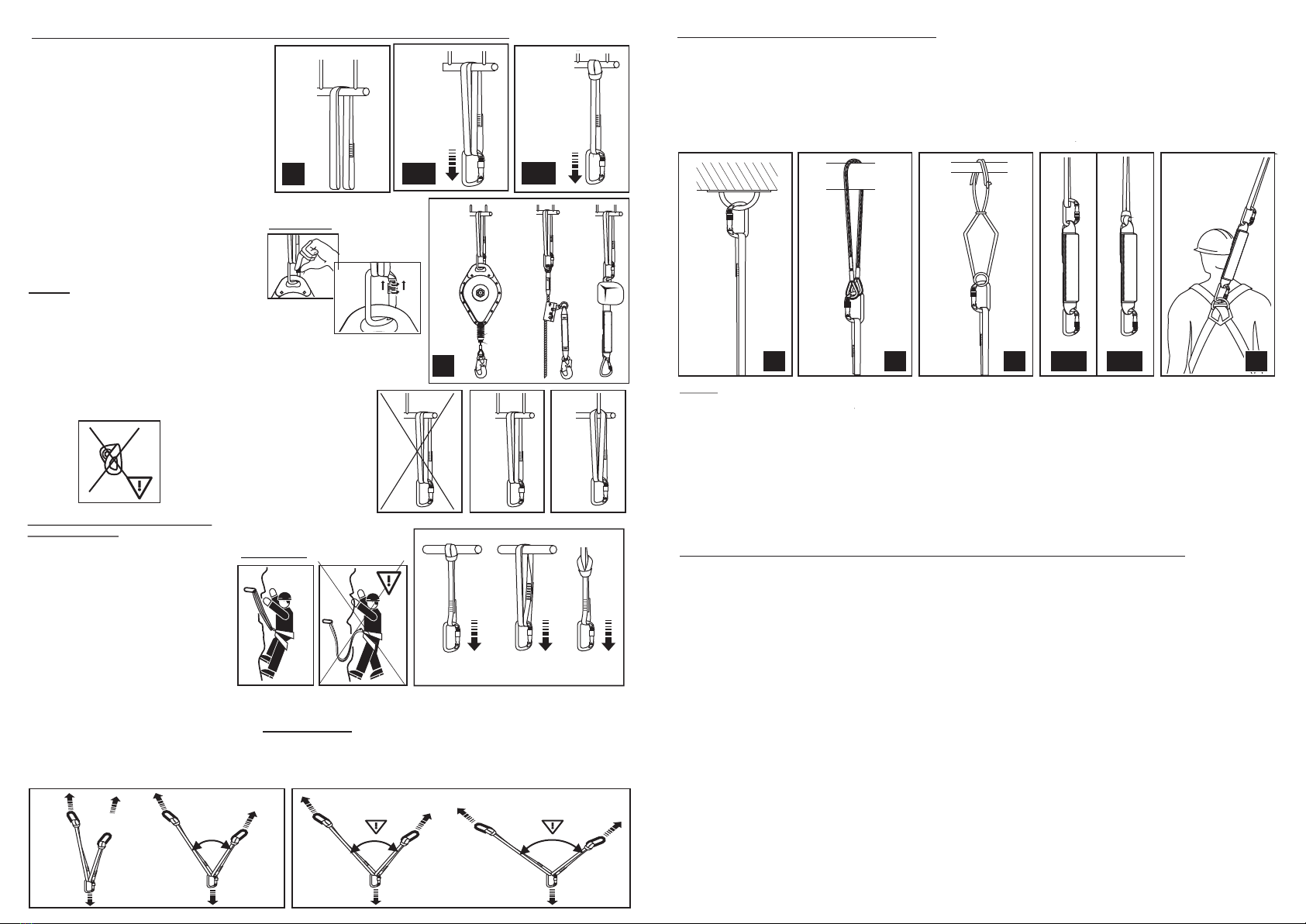
USING THE AZ900 AS A SAFETY LANYARD (EN 354)
1. One snap hook of the AZ900 attach to the structural anchor point of static strength min. 12 kN
- straight - drawing 1
- with an additional connector like wire rope connector - drawing 2 or scissor connector - drawing 3
2. Second one ending of the AZ900 attach to the energy absorber with snap additional snap hook - drawing 4A
or by putting one AZ900 ending through the second one - drawing 4B
3. Formed fall arrest subassembly (energy absorber+webbing sling connector) attach to the front or back attaching buckle of a
safety harness - drawing 5
USING THE WEBBING SLING CONNECTOR AS THE ANCHORAGE DEVICE (EN 795)
1. Put the AZ900 around a construction element
(structural anchor point) e.g. a steel beam -
drawing A
2. Connect the AZ900 endings with oval type snap
hook - drawing B1or
3. Put one ending of the AZ900 through the second
one - drawing B2
4. Attach a fall arrest device (e.g. energy absorber
with lanyard, guided type fall arrester or
retractable type fall arrester) to the Webbing Sling
Connector with oval type snap hook - drawing C.
NOTICE:
When the is used as a part
of connecting-absorbing subsytem, the user has to
be equipped with an energy absorber which limits
maximum dynamic forces exerted on the user during
the arrest of fall to a maximum of 6 kN.
Webbing Sling Connector
Attention:
Use only a certyfied (EN 362)
snap hooks.
1
C
2 3 4B4A 5
Structural
Anchor
Point
min. 12 kN
Structural
Anchor
Point
min. 12 kN
Structural
Anchor
Point
min. 12 kN
NOTICE: - In determining the space under the workplace required to arrest the fall, consider the sling as an additional element that extends the distance
for arresting a fall.
- The total length of the sling connected to an energy absorber compliant with EN 355 and snap hooks and fasteners shall not exceed 2 m.
- The user should minimise the amount of slack in the sling near a fall hazard.
- The user must rule out any risk of the situation (e.g. wrapping the sling around neck) that during use ar arresting a fall the sling may be used
choke hitched.
- The user should avoid interleaving the sling between construction elements or the situation when there is a risk of falling over the sharp edge
(e.g. roof edge).
0 0
- The sling can be used in temperatures from -30 C to 50 C.
- Do not use only the sling (with no shock absorber) on its own as a device to arrest a fall from height.
- Two separate slings each with an energy absorber should not be used side by side (i.e. parallel).
- The free tail of a twin tail (double) sling combined with energy absorber should not be clipped back on the harness.
- It is permissible to use the AZ900 without a shock absorber only as a rope that restricts (prevents) the worker from the area at risk of a fall.
-
- The legability of the product markings should be checked.
Twisting and kinking the legs (branches) shall be avoided.
WARNING !
DO NOT FALL
ONTO A SLING
OK
16 kN 22 kN 10 kN
USING THE AZ900 AS A MOUNTAINEERING
EQUIPMENT (EN 566)
Using the AZ900 as a mountaineering
equipment must be compatible with user
instructions of the mountaineering equipment
and obligatory standards:
- EN 12275 - for connectors
- EN 12277 - for harnesses
- EN 567 - for rope clamps
- EN 958 - for energy absorbing systemsfor use
in klettersteig climbing.
Before using this equipement you have to:
1. Read and understand this instruction for use.
2. Get proper training for actual use.
3. Follow declared capabilities and limitations.
4.Understand and accept risks involved.
5. Before each use check the AZ900 for
damages webbing or seams.
6. Stay below the attachment point.
120°
100%
100%
DANGEROUS
90°
70% 70%
60°
60%
OK
60%
50%
OK
FORCE TRIANGLE
When increasing angle in force triangle cause increasing load applied to anchor
points.
To avoid such effect use the AZ900 of proper length.
LINA ROBOCZA
USP BLOCMAX-RORIP
CORRECT
INCORRECT
CORRECT
The structural anchor
point should be situated
above the working place
and the shape of the
structural anchor point
should not let self-acting
disconection of the
.Webbing Sling Connector
USE ANCHOR POINT ONLY IN VERTICAL DIRECTION
DO NOT USE THIN OR SHARP EDGE ANCHOR POINT.
WARNING !
NECESSARILY PROTECT
THE SNAP HOOK GATE
WITH THE LOCKING GEAR
50%
AB1 B2
18 kN
22 kN
!personal protective equipment shall only be used by a person trained and competent in its safe use.
!personal protective equipment must not be used by a person with medical condition that could affect the safety of the equipment user in normal and emergency use.
!a rescue plan shall be in place to deal with any emergencies that could arise during the work.
!it is forbidden to make any alterations or additions to the equipment without the manufacturer's prior written consent.
!any repair shall only be carried out by equipment manufacturer or his certified representative.
!personal protective equipment shall not be used outside its limitations, or for any purpose other than that for which it is intended.
!personal protective equipment should be a personal issue item.
!before use ensure about the compatibility of items of equipment assembled into a fall arrest system. Periodically check connecting and adjusting of the equipment components to avoid accidental loosening or
disconnecting of the components.
!it is forbidden to use combinations of items of equipment in which the safe function of any one item is affected by or interferes with the safe function of another.
!before each use of personal protective equipment it is obligatory to carry out a pre-use check of the equipment, to ensure that it is in a serviceable condition and operates correctly before it is used.
!during pre-use check it is necessary to inspect all elements of the equipment in respect of any damages, excessive wear, corrosion, abrasion, cutting or incorrect acting, especially take into consideration:
- in full body harnesses and belts - buckles, adjusting elements, attaching points, webbings, seams, loops;
- in energy absorbers - attaching loops, webbing, seams, casing, connectors;
- in textile lanyards or lifelines or guidelines - rope, loops, thimbles, connectors, adjusting element, splices;
- in steel lanyards or lifelines or guidelines - cable, wires, clips, ferrules, loops, thimbles, connectors, adjusting elements;
- in retractable fall arresters - cable or webbing, retractor and brake proper acting, casing, energy absorber, connector;
- in guided type fall arresters - body of the fall arrester, sliding function, locking gear acting, rivets and screws, connector, energy absorber;
- in connectors - main body, rivets, gate, locking gear acting.
!after every12 months of utilization, personal protective equipment must be withdrawn from use to carry out periodical detailed inspection. The periodic inspection must be carried out by
a competent person for periodic inspection. The periodic inspection can be carried out also by the manufacturer or his authorized representative.
In case of some types of the complex equipment e.g. some types of retractable fall arresters the annual inspection can be carried out only by the manufacturer or his authorized representative.
!regular periodic inspections are the essential for equipment maintenance and the safety of the users which depends upon the continued efficiency and durability of the equipment.
!during periodic inspection it is necessary to check the legibility of the equipment marking.
!it is essential for the safety of the user that if the product is re-sold outside the original country of destination the reseller shall provide instructions for use, for maintenance, for periodic examination and for repair in
language of the country in which the product is to be used.
!personal protective equipment must be withdrawn from use immediately when any doubt arise about its condition for safe use and not used again until confirmed in writing by equipment manufacturer or his
representative after carried out the detailed inspection.
!personal protective equipment must be withdrawn from use immediately and destroyed (or another procedures shall be introduced according detailed instruction from equipment manual) when it have been used to
arrest a fall
THE ESSENTIAL PRINCIPLES FOR USERS OF PERSONAL PROTECTIVE EQUIPMENT