IGNITION NOISE INTERFERENCE
Use of a mobile receiver at low signal levels is normally limited by the
presence of electrical noise. The primary source of noise in automobile
installation is from the generator and ignition system in the vehicle. Under
most operating conditions, when signal level is adequate, the background
noise does not present a serious problem. Also, when extremely low level
signals are being received, the transceiver may be operated with vehicles
engine turned off. The unit requires very little current and therefore will not
significantly discharge the vehicle battery.
Even though the transceiver has ANL and NB controls, in some installation
ignition interference may be high enough to make good communications
impossible. The electrical noise may come from several sources. Many
possibilities exist, as variations between vehicles require different solutions
to reduce the noise.
ANTENNA
A vertically polarized, quarter-wavelength whip antenna provides the most
reliable operation and greatest range. Shorter, loaded-type whip antennas are
more attractive, compact and adequate for applications where the maximum
possible distance is not required. Also, loaded whips do not present the
problems of high wind resistant imposed by a full quarter-wavelength whip.
Mobile whip antennas utilize the metal body of the vehicle as a ground
plane. When mounted at a corner of the vehicle they are slightly directional,
in the direction of the body of the vehicle. For all practical purpose, however,
the radiation pattern is nondirectional. The slight directional characteristic
will be observed only at extreme distances. A standard antenna connector
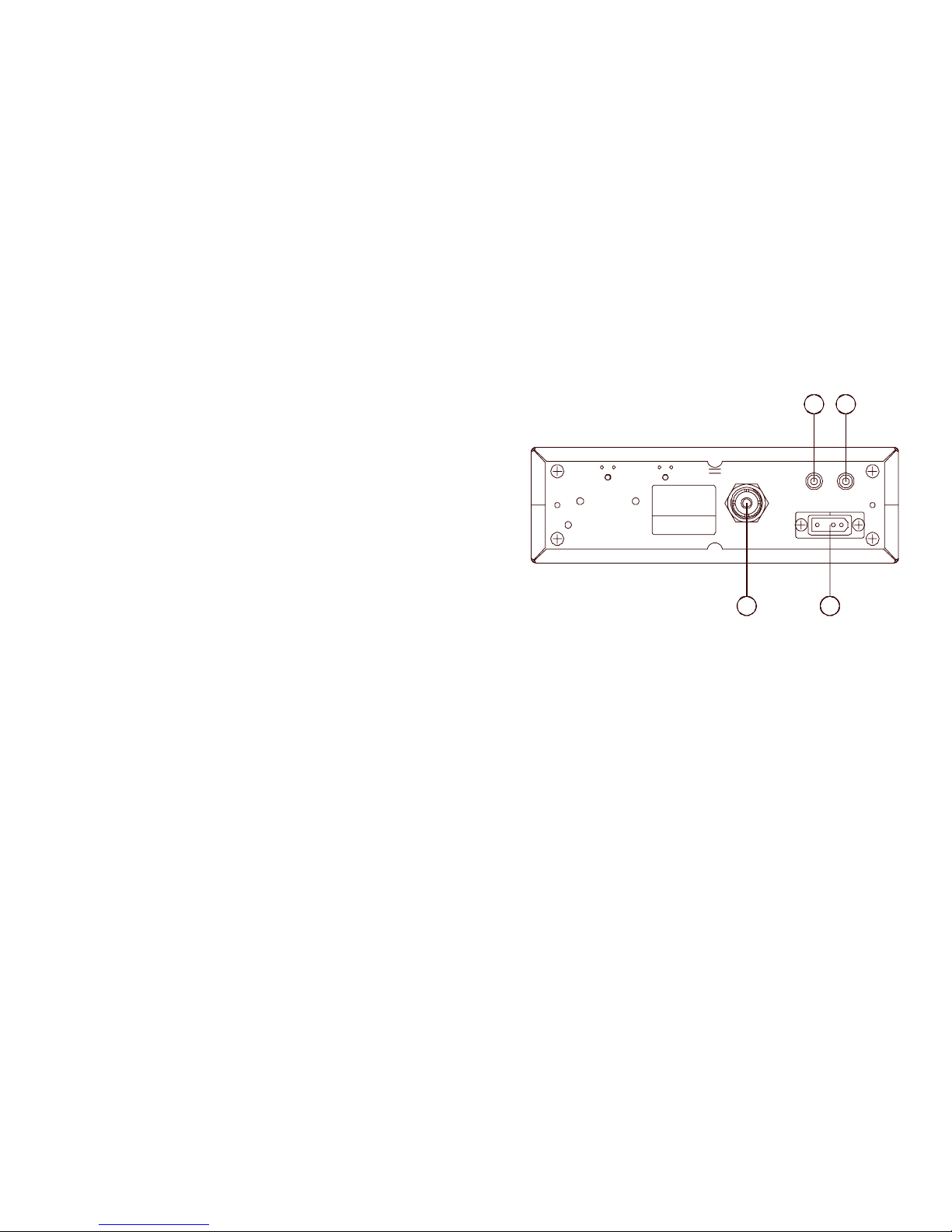
(type SO-239) is provided on the transceiver for easy connection to a
standard PL-259 cable termination.
If the transceiver is not mounted on a metal surface, it is necessary to run a
separate ground wire from the unit to good metal electrical ground in the
vehicle. When installed in a boat, the transceiver will not operate at
maximum efficiency without a ground plate, unless the vessel has a steel
hull.
Before installing the transceiver in a boat, consult your dealer for
information regarding an adequate grounding system and prevention of
electrolysis between fittings in the hull and water.
TUNING THE ANTENNA FOR OPTIMUM S.W.R
Since there is such a wide variety of base and mobile antennas, this section
will strictly concernitself to the various types of mobile adjustable antennas.
Because the antenna length is directly related to the channel frequency, it
must be tuned to resonate optimally on all channels of the transceiver.
Channel 1 requires a longer antenna than Channel 40 because it is lower in
its frequency of operation.
Due to the various methods of adjusting antennas for proper S.W.R. we
have chosen what we think is the optimum method:
A. Antenna with adjustment screws (set screws).
1. Starts with the antenna extended and tighten the set screw lightly enough
so that the antenna can be lightly tapped with your finger for easy
adjustment.
2. Set your transceiver to Channel 20. Press the PTT (push-to-talk) switch,
and tap the antenna (making it shorter). The S.W.R meter will show a
lower reading each time the antenna is tapped. By continuing to shorten
the antenna, you will notice the S.W.R reading will reach a low point
and then start rising again. This means that you have passed the
optimumpoint for Channel 20.
Extend the antenna a short distance and again follow the procedure above.
When the lowest point has been reached, switch to Channel 1 and then to
Channel 40 and compare S.W.R readings. They should be almost equal.
NOTE
The proper setting is achieved when the SWR is 1.5 or
below, and when it has the same reading for channels 1
and 40.
B. Antennas which must be cut to proper length
1. Follow the same procedure as above but adjust the length by cutting in
1/8” increments until a good match is obtained.
2. Be very careful not to cut too much at one time, as once it is cut, it can
no longer be lengthed.
3. The whip is easily cut by filing a notch all the way around and breaking
the piece off withpliers.
- 4 - - 5 -