RAULAND-BORG CORPORATION
l
3450 West Oakton Street, Skokie, Illinois 60076-2951
l
(708) 679-0900
PRELIMINARY
DESCRIPTION MOUNTING PARTS
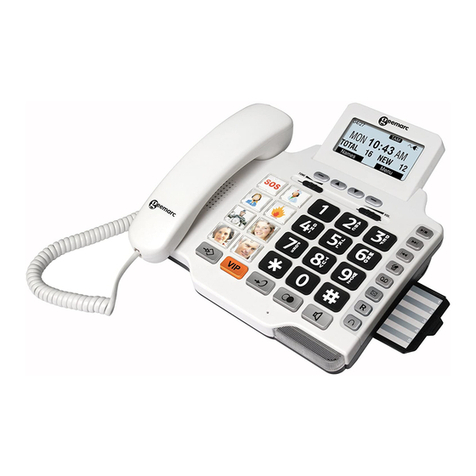
The CRT3 is a dial-less telephone designed for use with
the Rauland Telecenter@ systems. On the Telecenter IV
and Telecenter TCS, it can serve asa single-link or a multi-
link staff phone. On the Telecenter 5500, it can serve as a
common-line staff phone in conjunctionwith an ADS55 10
Console and an RS503 Staff-Telephone Adapter.
In addition to the standard“tip”and“ring”wiring, the
CRT3 has a second pair of contacts that provide a dry con-
tact when the phone is lifted off-hook. This connection
enables the phone to call in when the handset is lifted.
Important: Never connect the CRT3 to the modular
jack of an Administrative Display Telephone: the CRT3’s
extra set of contacts would place ashort across the display
lines.
The telephone comes with the following mounting
parts:
Qty.
Description
1
Modular jack.
1 Short four-wire connector with amodular plug ateach
end.
1 Long four-wire connector with a modular plug at each
end.
2 #632 x ~3%” machine screws.
1 Locking clip (to secure the phone to the mounting
plate).
The CRT3 has been approved by the Federal Commu-
nications Commission (F2SGBN-7273S-TE-E) .
This Telephone is Not Hearing-Aid Compatible.
The following will need to be supplied by the user:
4 Wiring ftom the Telecenter to the telephone.
4 Single-gang electrical box.
4 On the TC5500: ADS55 10 Console, RS503 Module,
and speaker.
INSTALLATION
These instructions tell how to mount the telephone.
Wiring diagrams are included in the main Telecenter IV
manual (K&1435), the Telecenter TCS drawings manual
(KI-1550), and in the installation manual for the ADS5510
console (RI-1557). The installer is responsible for comply-
ing with all local codes and the National Electrical Code
or the Canadian Electrical Code.
shields to ground (see KI-1551). For the Telecenter IV,
Step 1. For the TC5500, use shielded conductors;
conduit is also strongly recommended. Connect all
Step 4. Fasten the system wires to the appropriate
screw terminals. Push the front plate onto the module.
then rotate it 180” (see the following illustration).
Step 5. If the telephone is to be wall-mounted, skip to
Step 6. If the telephone is to be desk-mounted, use the
longer modular cord to connect the phone to the jack,
then set the phone in place. Skip to Step 9.
Step 6. If the telephone is to be wall-mounted, locate
the u&clip reversible hook near the hook switch on the
base. Pull up on this uni-clip until it is clear of the hole,
use a twisted pair, shielded or unshielded (see RI-1435) 1
Install the electrical box in the wall vertically, and pull
through the wires.
/;
m ’
I! u 1
-
1
Step 2. Set aside the hont plate from the modular jack.
Orient the module in keeping with its 7OP marking. Find
the unused hole near each screw terminal. Pull each field
wire through the appropriate hole. On the modular jack,
the TI (green wire) and RI (red wire) terminals provide
the conventional “tip” and “ring” telephone contacts; the
AUX (black wire) and GZV(“ground” -yellow wire) provide
a dry contact for calling in.
Step 3. Secure the module to the back box with the
0
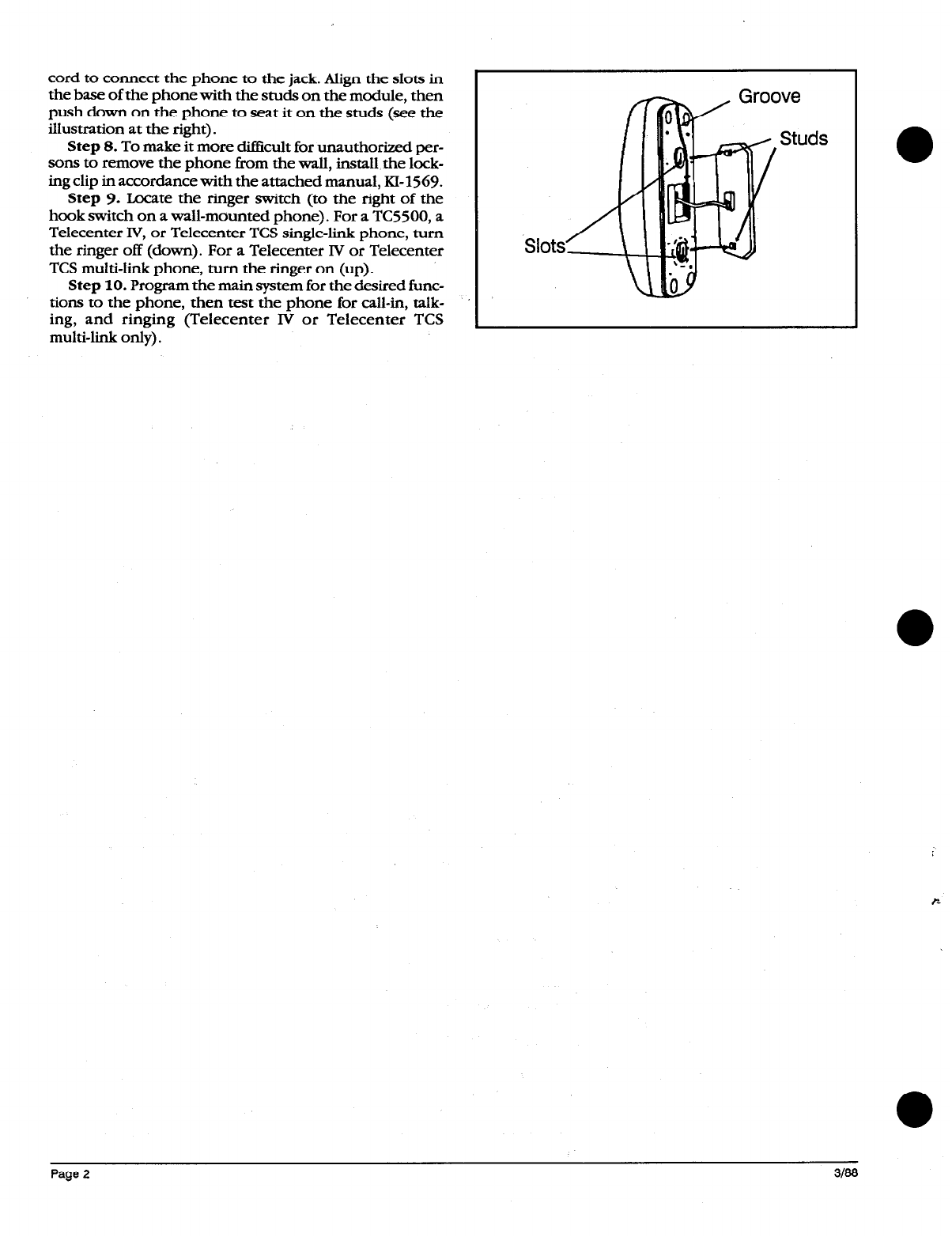
two #6 screws provided. Use the two holes immediately Step 7. To complete the wall-mounting, orient the
inside the module’s studs. phone with the hook switch on top and use the shorter
01988 RAULAND-BORG CORPORATION
l
Printed in U.S.A.
Orig.
5187 Rev.3188 _ .
Page 1 of 2