manuals.online logo
Brands
  1. Home
  2. •
  3. Brands
  4. •
  5. RDL
  6. •
  7. Media Converter
  8. •
  9. RDL RLC-10R User manual

RDL RLC-10R User manual

Other RDL Media Converter manuals

RDL HALF-RACK Series User manual

RDL

RDL HALF-RACK Series User manual

RDL HALF-RACK Series User manual

RDL

RDL HALF-RACK Series User manual

RDL Half-Rack Series User manual

RDL

RDL Half-Rack Series User manual

RDL HR-DDA4 User manual

RDL

RDL HR-DDA4 User manual

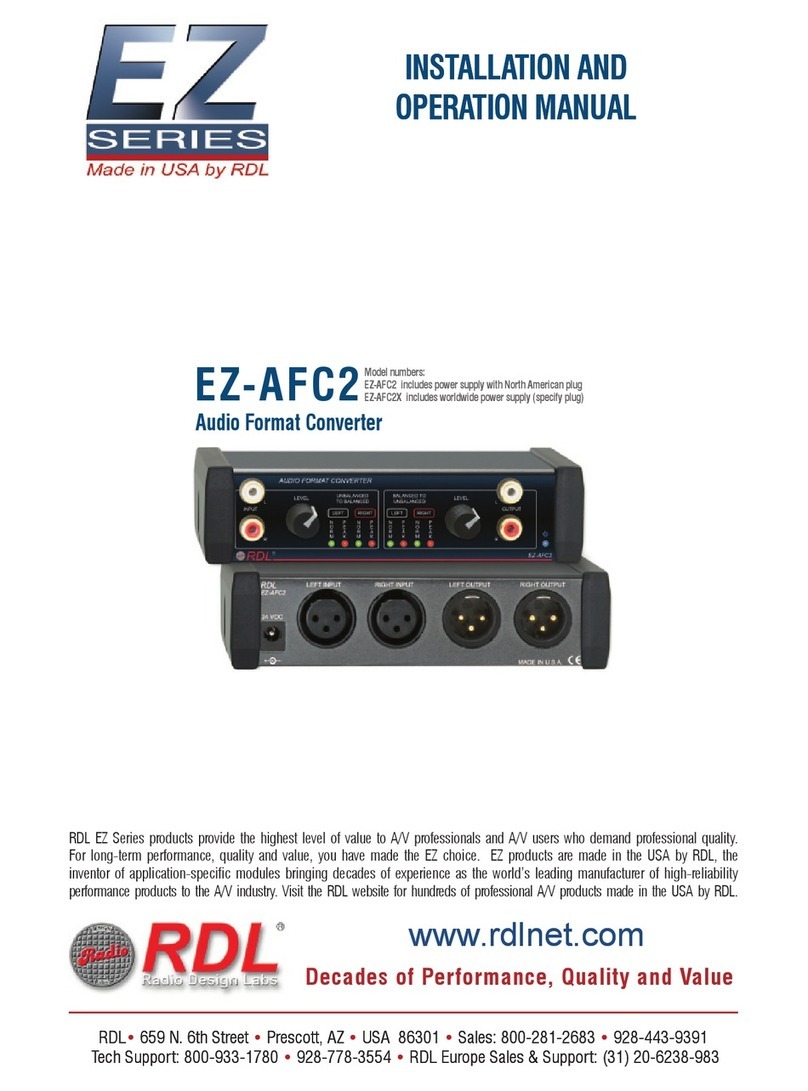
RDL EZ-AFC2 User manual

RDL

RDL EZ-AFC2 User manual

RDL Half-Rack Series Guide

RDL

RDL Half-Rack Series Guide

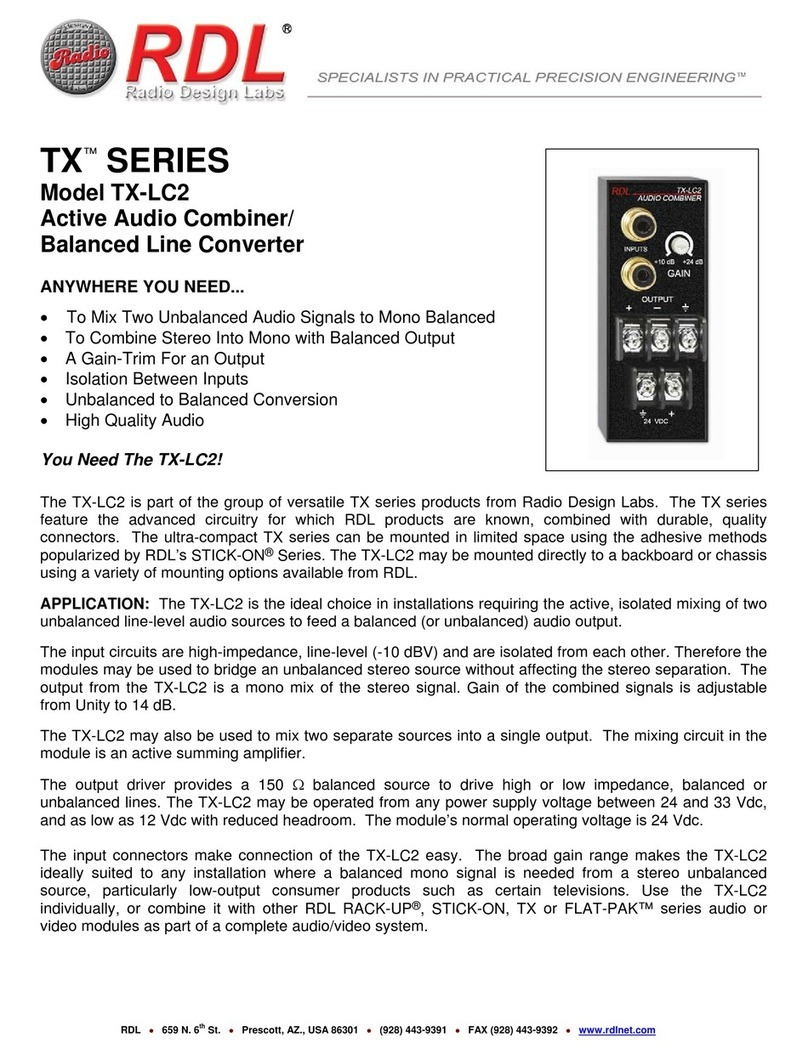
RDL TX-LC2 Owner's manual

RDL

RDL TX-LC2 Owner's manual

RDL HALF-RACK Series Guide

RDL

RDL HALF-RACK Series Guide

Popular Media Converter manuals by other brands

SoundTraxx Blunami BLU-2200 user guide

SoundTraxx

SoundTraxx Blunami BLU-2200 user guide

SPROLINK VA1 user manual

SPROLINK

SPROLINK VA1 user manual

Acclaim Lighting DDC-1-AC user guide

Acclaim Lighting

Acclaim Lighting DDC-1-AC user guide

Nikon AF-S TC-20E III user manual

Nikon

Nikon AF-S TC-20E III user manual

Axis AXIS Q7406 user manual

Axis

Axis AXIS Q7406 user manual

Omega TAC80B-J instruction sheet

Omega

Omega TAC80B-J instruction sheet

Zoom Thunderbolt TAC-2R Operation manual

Zoom

Zoom Thunderbolt TAC-2R Operation manual

OST iConverter 10/100M quick start guide

OST

OST iConverter 10/100M quick start guide

Vertiv Netsure user manual

Vertiv

Vertiv Netsure user manual

birddog MINI user guide

birddog

birddog MINI user guide

Roland GI-10 owner's manual

Roland

Roland GI-10 owner's manual

Wallenstein WX310 Operator's manual

Wallenstein

Wallenstein WX310 Operator's manual

Pace MSS 200-1 Service manual

Pace

Pace MSS 200-1 Service manual

Solar Converters EQ 12/24-50 manual

Solar Converters

Solar Converters EQ 12/24-50 manual

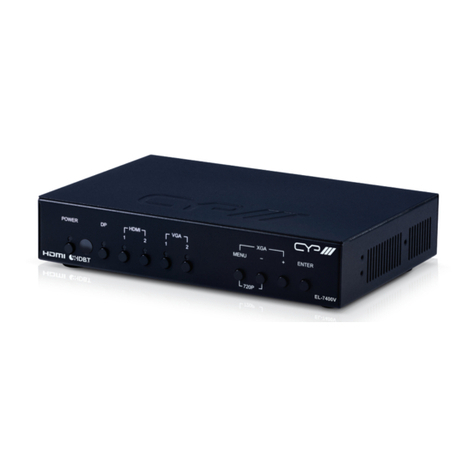
CYP EL-7400V Operation manual

CYP

CYP EL-7400V Operation manual

TIE MIDI 1i1o user manual

TIE

TIE MIDI 1i1o user manual

DCS Vivaldi Upsampler user manual

DCS

DCS Vivaldi Upsampler user manual

Westermo MCW-211 SERIES user guide

Westermo

Westermo MCW-211 SERIES user guide

manuals.online logo
manuals.online logoBrands
  • About & Mission
  • Contact us
  • Privacy Policy
  • Terms and Conditions

Copyright 2025 Manuals.Online. All Rights Reserved.

ACCESSORIES
Model RLC-10R
Remote Level Control Rotary Encoder
Rotary Encoder Remote Level Adjustment
Direct 0 to 10 Vdc Output from a Remote Control
Up/Down Pulse Output from a Remote Control
0 to 10 Vdc LED Display of Internal/External Voltage
Optical Encoding for Long Life
Noise-Free Performance
Professional High Quality Appearance
RDL ULTRASTYLE™Design
The RLC-10R is part of the group of remote control accessories from Radio Design Labs. The rugged high quality
construction and professional styling make the RLC-10R the optimum choice for level control in critical high quality
installations.
APPLICATION: The RLC-10R is the ideal choice for 0 to 10 Vdc or pulsed control from a remote location. Control is
based on optical encoder technology to produce long-term trouble-free operation.
Two output modes are simultaneously available. The 0 to 10 Vdc output operates continuously. Up and down pulses
from the optical encoder are also provided on the rear barrier block. The 0 to 10 V output is used to control RDL VCA
products, and may be connected to a wide range of other industry 0 to 10 Vdc controlled equipment. This mode is used
for single point control. If multiple control points are desired, the pulse outputs may be connected to RDL RU-VCA
products and various other industry products. A rear-panel jumper sets the PULSE outputs to either produce +15 Vdc
pulses or momentary open collector pulses.
Control is incremented up or down when the large front-panel knob is rotated. Acceleration is provided so the rate of
change is faster when the knob is rotated more rapidly, yielding a responsive feel.
The LED ring display encircling the control knob operates as a virtual pointer. The input to this display is a 0 to 10 Vdc
signal. A strap on the module rear barrier block determines if the display operates from the internally generated control
voltage or from an external control voltage. Typically, if the 0 to 10 Vdc control voltage from the RLC-10R is being used to
control a VCA, the internal voltage is also used for the display. If the RLC-10R pulse outputs are used with RDL RU-VCA
modules, the 0 to 10 Vdc EQRAMP from the VCA module is fed back to the RLC-10R. Therefore, multiple RLC-10R
modules may be connected together with all modules providing the same level indication.
In the event of power loss, internal non-volatile memory stores the last level value. When power returns, the 0 to 10 V
output will return to the operating level present when power was lost.
Wherever the highest quality, durability, performance and appearance are required in remote level control, the
RLC-10R is the ideal choice. Use the RLC-10R individually, or combine it with other RDL products as part of a complete
audio/video system.
Additional ULTRASTYLE design options shown at www.rdlnet.com
RDL 659 N. 6th St. Prescott, AZ., USA 86301 (928) 443-9391 FAX (928) 443-9392 www.rdlnet.com
ACCESSORIES
Model RLC-10R
Remote Level Control Rotary Encoder
LINEAR
AUDIO LEVEL
GND
+24 VDC
PULSE DOWN
MODE SELECT
RAMP OUT
RAMP IN
PULSE UP
RLC-10R
OBSERVE LEVEL ON LEDs
ADJUST LEVEL ON KNOB
CONNECTIONS TO ST-VCA3
(SAME WIRING MAY BE USED FOR
OEM OR RU-VCA 0 TO 10V CONTROL)
(SHOWN IN +15V PULSE CONNECTION MODE)
CONNECTIONS TO RU-VCA2A or RU-VCA6A
PARALLEL CONNECTIONS
REMOTE CONTROLS
TO ADDITIONAL RLC-10R
GND
+24 VDC
PULSE DOWN
MODE SELECT
RAMP IN
PULSE UP
RAMP OUT
RLC-10R
CONNECTION MODE)
(SHOWN IN OPEN-COLLECTOR
CONNECTIONS TO OEM EQUIP
GND
UP PULSE
DOWN PULSE
0 TO 10V OUT
OEM EQUIP
24VDC SUPPLY
PRESET
EQ
P
M
A
R
10
VN
D
U
P10 V
0 TO
P
UD
N
R
A
M
P
24V
IN
OUT
EXTERNAL
CONTROL
DATA
SETTINGS
E
D
O
M
MOM
0 TO 10 VDC
C
T
R
L
L
E
V
E
L
MASTER
SLAVELAST
POWER UP
IN 1 IN 2 OUT 2OUT 1
CONTROL AUDIO
PWR
VDC
24
RDL
MADE IN U.S.A.
RU-VCA2A
+24 VDC
GND
PULSE DOWN
RAMP OUT
PULSE UP
RAMP IN
MODE SELECT
RLC-10R
E
E
V
U
OPWR IN
TL
10V L
C
R
T
LINE IN OUTPUT
LINE
L
G
IMIC IN
A
N
NOTE: Wiring between VCA and RLC-10R must be electrically shielded, either by installation in
a metal conduit or using shielded cable. When shielded cable is used without conduit (or in
nonmetallic conduit), the shield should be connected to the RLC-10R mounting enclosure.
TYPICAL PERFORMANCE
Ramp output: 0 to 10 Vdc
Pulse outputs (2): PULSE UP, PULSE DOWN
(programmable open collector, or +15 V pulse)
Pulse output current: 20 mA (open collector)
Display RAMP IN input resistance: 200 k
Display input voltage: 0 to 10 Vdc
Rotations, approximate min-to-max: 5 (slow rotation, no acceleration)
3 (medium rotation, with acceleration)
1 (fast rotation counterclockwise, anti-feedback mode)
Power Requirement: 24 Vdc @ 50 mA, Ground-referenced
Overall Dimensions: Height: 4.9 in. 12.44 cm
Width: 3.4 in. 8.63 cm
Depth: 1.6 in. 4.06 cm
Installation/Operation
EN55103-1 E1-E5; EN55103-2 E1-E4
Typical Performance reflects product at publication time
exclusive of EMC data, if any, supplied with product.
Specifications are subject to change without notice.
891-9115E
Radio Design Labs Technical Support Centers
U.S.A. (800) 933-1780, (928) 778-3554; Fax: (928) 778-3506
Europe [NH Amsterdam] (++31) 20-6238 983; Fax: (++31) 20-6225-287
NOTE: This equipment has been tested and found to
comply with the limits for a Class B digital device, pursuant
to part 15 of the FCC Rule. These limits are designed to
provide reasonable protection against harmful interference
in a residential installation. The equipment generates,
uses and can radiate radio frequency energy and, if not
installed and used in accordance with the instructions,
may cause harmful interference to radio communications.
However, there is no guarantee that interference will not
occur in a particular installation. If this equipment does
cause harmful interference to radio or television reception,
which can be determined by turning the equipment off an
on, the user is encouraged to try to correct the
interference by one or more of the following measures:
Reorient or relocate the receiving antenna
Increase the separation between the equipment
and receiver
Connect the equipment into an outlet on a circuit
different from that which the receiver is
connected.
Consult the dealer or an experienced radio/TV
technician for help.