The German testing authority BG, recommends the
following minimum for the bolt lengths:
1.0 x M in steel (minimum quality S235JR [1.0037])
≈AS3678 GR250.
1.25 x M (thread diameter) in cast iron (e.g. GG 25)
2 x M (thread diameter) in aluminium
2.5 x M (thread diameter) in light alloys of low strength
(M = thread size/diameter, e.g. M20)
• When lifting light metals, nonferrous metals and gray cast
iron the thread has to be chosen in such a way that the
WLL of the thread corresponds to the requirements of the
base material.
• The min. quality of the hexagon bolt of the VWBG-V must
be class 10.9 according to EN 24014 (DIN 931) with correct
nominal diameter.
• RUD supplies the Vario length complete with a washer and
crack-detected nut corresponding to DIN EN ISO 7042
(DIN 980) or will be supplied with a crack inspected collar
nut acc. to DIN 6331 or 2 x crack inspected hex nuts Class
8 AS1112.1 with washer.
• The position of the lifting points must be carried out in such
be avoided.
• For single leg lifts, the lifting point should be vertically
above the centre of gravity of the load.
• For two leg lifts, the lifting points must be equidistant to/
or above the centre of gravity of the load.
• For three and four leg lifts, the lifting points should be
arranged symmetrical around the centre of the gravity, in
the same plane if possible.
Load Symmetry: The working load limit of individual RUD
lifting points are calculated using the following formula and
are based on symmetrical loading:
NOTE: For WLL Calculations
• ß angle is taken from the vertical plane.
• Included angle is the angle between the sling legs.
Number of load bearing legs is as follows:
Symetrical Unsymetrical
2/3/4 leg 2 1
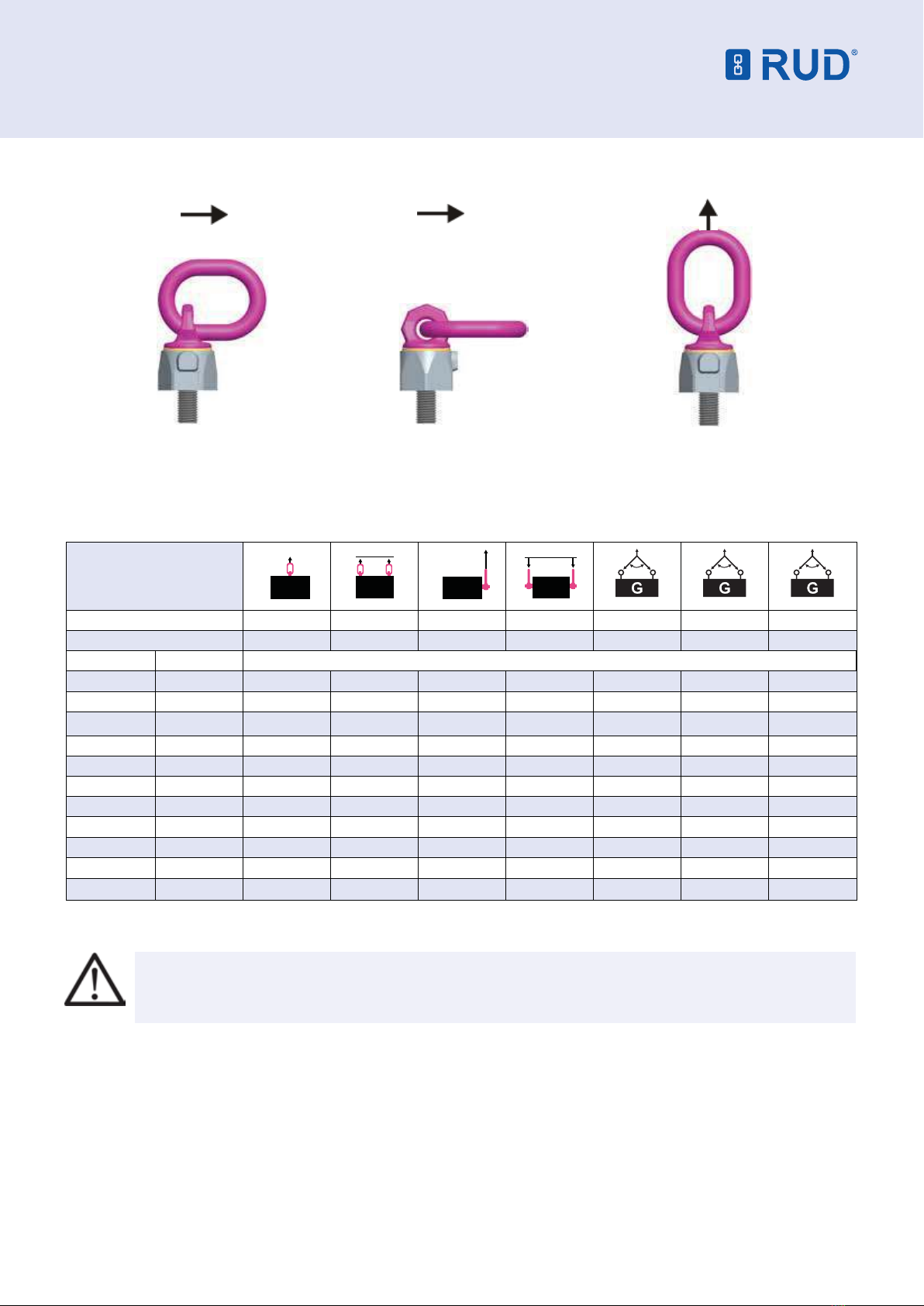
Load bearing legs (compare also with table 1)
• When lifting points are used in a multileg assembly, care
should be taken to calculate the WLL (Working Load Limit)
due to the deration caused by forces acting in multiple
directions. The reduction in WLL (Working Load Limit)
for multileg assemblies should be checked with relevant
Standards e.g. AS 3775.2:2014 Chain slings for lifting
purposes - Grade T(80) and V(100) - Care and use.
• The lifting points should be mounted in such a way that
they may easily be accessed for inspection and assembly/
disassembly of the sling.
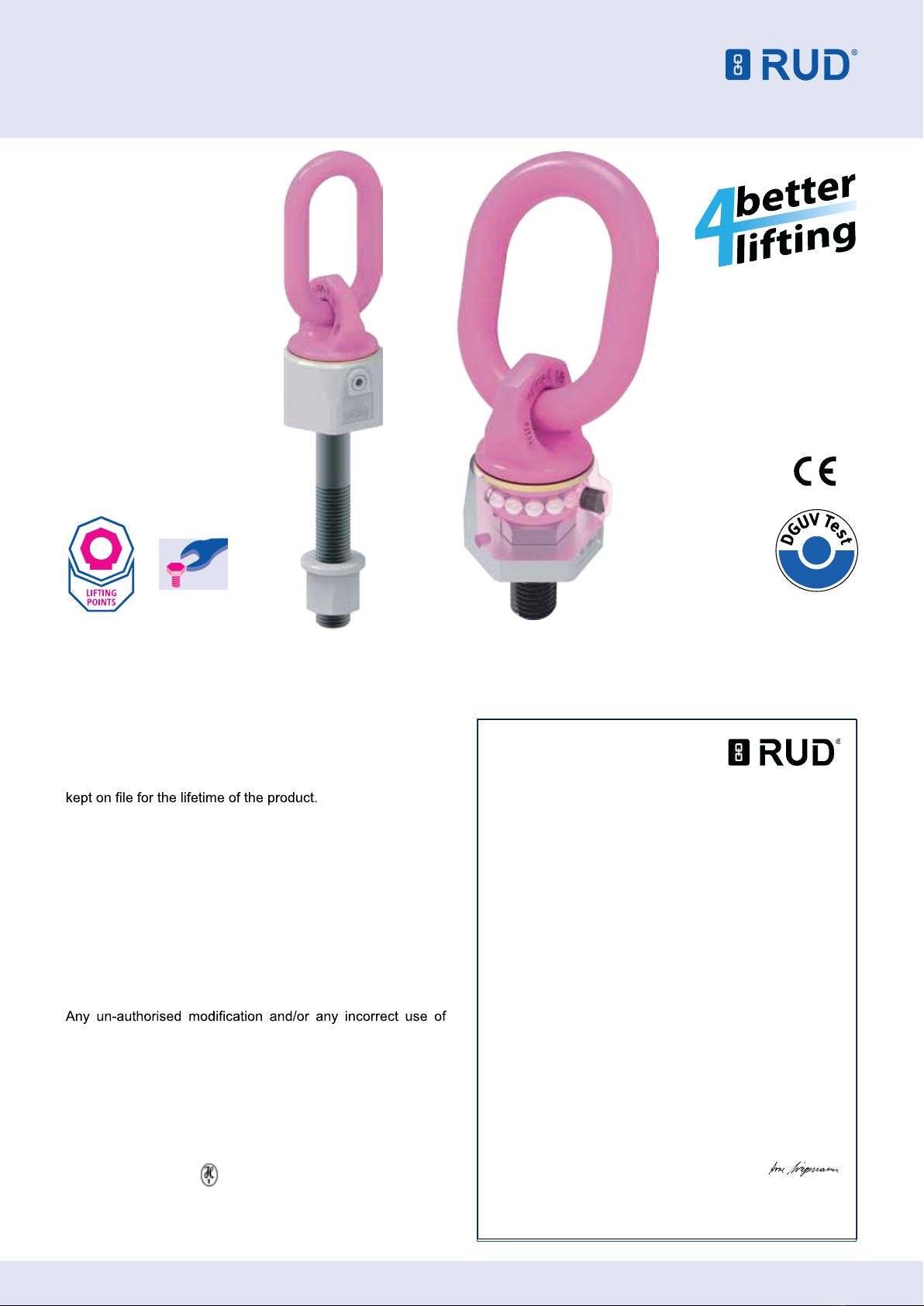
VWBG-V LOAD RING
User Instructions - Part 2
1. Safety Instructions
ATTENTION: Please inspect all lifting points
prior to use. Damage, incorrect assembly or
improper use may result in serious injuries
and/or material damage.
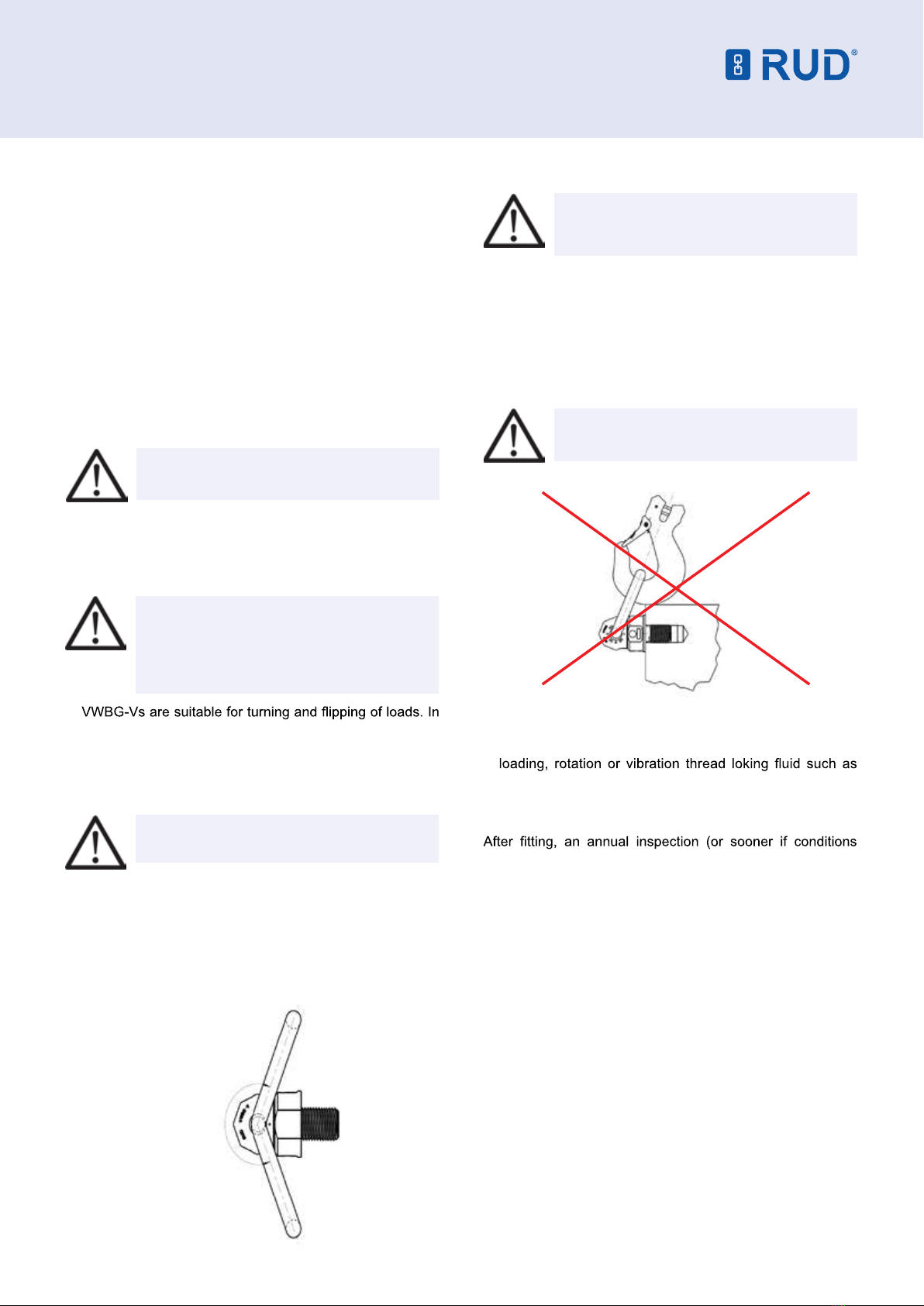
• Not suitable for permanent turning operations under load.
Lifting point cannot be turned to 90° from the bolt-on
direction under full load.
• The ball bearing must not be disassembled.
• The load ring must not be free to articulate.
• RUD VWBG-V lifting points must only be used by instructed
and competent persons considering BGR 500 / DGUV 100-
statutory regulations.
2. Intended use of VWBG-V
RUD VWBG-V lifting points must only be used for the assembly
at the load or at lifting means.
They are intended to be bolted into the payload and can be
turned under load, but not under full load, especially not in the
90° direction. Not suitable for permanent turning operations
under load.
RUD VWBG-V lifting points can also be used as lashing points
to attach lashing means.
If the lifting points are used exclusively for lashing the value
of the WLL (working load limit) can be doubled. LC (lashing
capacity) = 2 x WLL.
RUD VWGB-V lifting points must only be used in the hereby
described operation purpose.
Before installing and every use, visually inspect RUD lifting
points, with particular attention to any evidence of corrosion,
wear and weld cracks and deformations. Please ensure
compatibility of bolt thread and tapped hole.
3. Assembly and Instruction Manual
3.1 General Information
• Temperature range:
Usage at higher temperatures is not recommended due to
necessary, the working load limit (WLL) of the VWBG-V
must be reduced as follows:
-40°C up to 100°C no reduction
100°C up to 200°C minus 15 %
200°C up to 250°C minus 20 %
250°C up to 350°C minus 25 %
Temperatures exceeding 350°C are prohibited!
Please pay attention when using DIN EN 7042 (DIN 980)
nuts the max. operation temperature of 150°C (acc. to DIN
EN ISO 2320).
• RUD VWBG-V lifting points must not be used with
aggressive chemicals such as acids, alkaline solutions and
their vapours.
3.2 Hints for the assembly
• The material construction to which the lifting point will be
attached should be of adequate strength to withstand forces
during lifting without deformation.
WLL = required of lifting point/individual leg (kg)
G = load weight (kg)
n = number of load bearing legs
ß = angle of inclination of the individual leg
WLL = G
n x cos ß