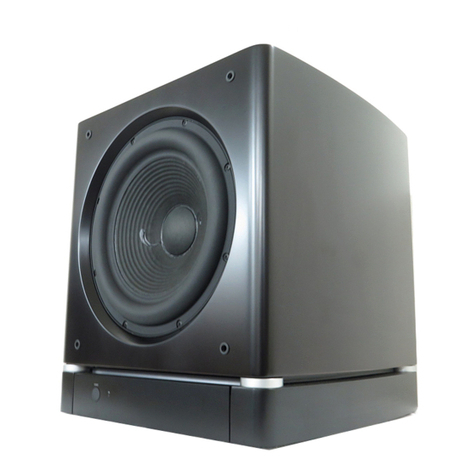
Rythmik Audio FM8 Sealed Subwoofer Quick Guide
*More information can be found at www.rythmikaudio.com/phase1.html
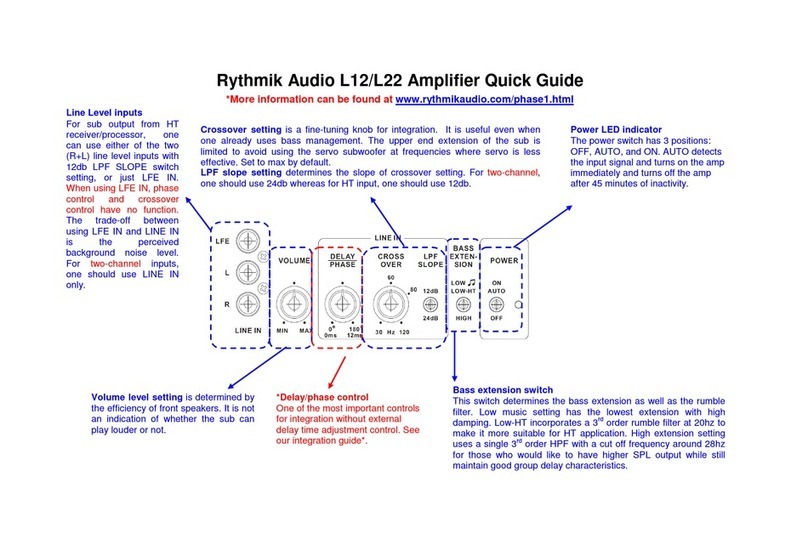
output
For sub output from HT
receiver/processor, one can
use either of the two (R+L)
line level inputs. This model
provides a single high pass
filter (HPF) output @150hz
from the L line-in input only.
To enable a stereo pair of
HPF outputs, two units of
this model are required.
determined by the efficiency of
front speakers. It is not an
indication of whether the sub can
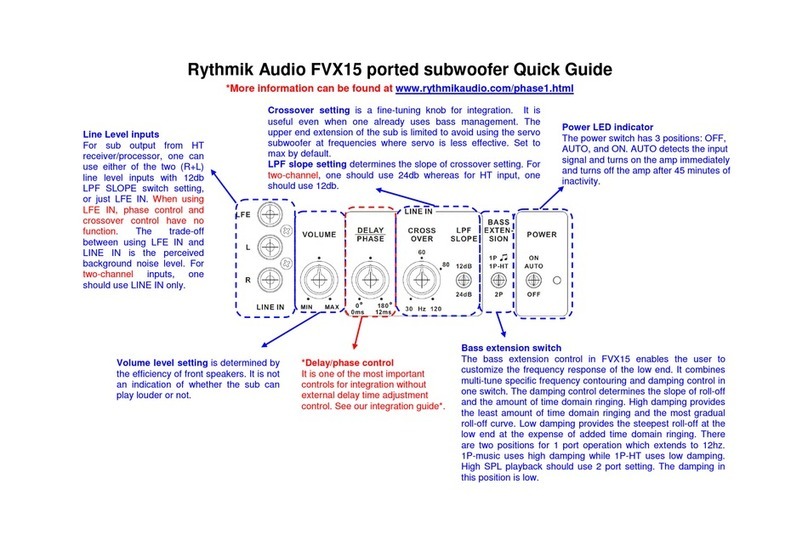
Crossover setting is a fine-tuning knob for integration. It is useful
even when one already uses bass management. The upper end
extension of the sub is limited to avoid using the servo subwoofer at
frequencies where servo is less effective. Set to max by default.
LPF slope setting determines the slope of crossover setting. For
two-channel, one should use 24db whereas for HT input, one should
use 12db.
It is one of the most important
controls for integration with line-in
and no external delay time
adjustment control. See our
Parametric equalization (PEQ)
Defeatable EQ for tackling room modes.
Please see separate application note for
proper usage. For initial setup, set PEQ
switch to “off”. Markings on FREQ knob
are from 40hz to 160hz in 20hz
increments.
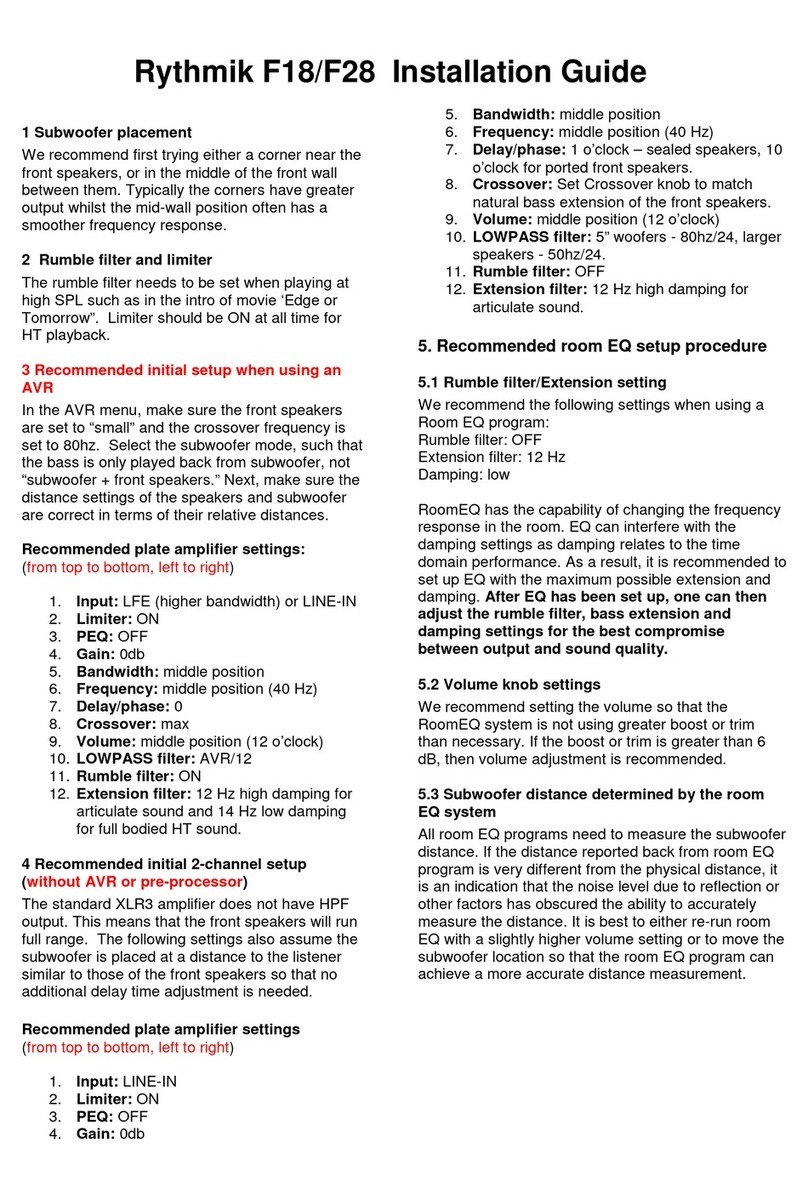
This switch determines the bass extension as well
as the rumble filter. Low music setting has the
lowest extension with high damping. Low-HT
incorporates a 3rd order rumble filter at 20hz to
make it more suitable for HT application. To use
this model as a mid bass module, extension filter
needs to be set to 50hz/24 position. It provides a
24db/oct HPF @50hz.
Power LED indicator (Also
Clipping/Fault indicator)
The power switch has 3 positions: OFF,
AUTO, and ON. AUTO detects the
input signal and turns on the amp
immediately and turns off the amp after
45 minutes of inactivity.
This LED also serves as a clipping
indicator which will flash momentarily to
indicate that amp is into clipping. On
the other hand, when the amp detects
a fault, it will blink with a repetitive
pattern. Toggle the switch to OFF will
clear the fault. If the fault comes back
again, please contact us with the
number of blinks in the pattern.
ON
OFF
+3dB
0
-12dB MIN MAX 40
6ms
50
100
50Hz/24
200
Hz 160
BANDWIDTH FREQ
60 100
PEQ
PEQ GAIN
HPF OUT
@150Hz
Fuse box is located below power socket. Use only correctly rated fuses.
There is a notch to pry open the fuse box. Do not try to pull it off the
amplifier. There are two fuses: the inner one is the in circuit fuse, and the
outer one is a spare. Continuingly blowing fuses is an indication of a
more serious problem. Contact us if this occurs.
150