manuals.online logo
Brands
  1. Home
  2. •
  3. Brands
  4. •
  5. Saker
  6. •
  7. Measuring Instrument
  8. •
  9. Saker XFVP-L User manual

Saker XFVP-L User manual

This manual suits for next models

1

Other Saker Measuring Instrument manuals

Saker XFVP10-2 User manual

Saker

Saker XFVP10-2 User manual

Saker ISOVP-L User manual

Saker

Saker ISOVP-L User manual

Saker XFVP User manual

Saker

Saker XFVP User manual

Popular Measuring Instrument manuals by other brands

Powerfix Profi 278296 Operation and safety notes

Powerfix Profi

Powerfix Profi 278296 Operation and safety notes

Test Equipment Depot GVT-427B user manual

Test Equipment Depot

Test Equipment Depot GVT-427B user manual

Fieldpiece ACH Operator's manual

Fieldpiece

Fieldpiece ACH Operator's manual

FLYSURFER VIRON3 user manual

FLYSURFER

FLYSURFER VIRON3 user manual

GMW TG uni 1 operating manual

GMW

GMW TG uni 1 operating manual

Downeaster Wind & Weather Medallion Series instruction manual

Downeaster

Downeaster Wind & Weather Medallion Series instruction manual

Hanna Instruments HI96725C instruction manual

Hanna Instruments

Hanna Instruments HI96725C instruction manual

Nokeval KMR260 quick guide

Nokeval

Nokeval KMR260 quick guide

HOKUYO AUTOMATIC UBG-05LN instruction manual

HOKUYO AUTOMATIC

HOKUYO AUTOMATIC UBG-05LN instruction manual

Fluke 96000 Series Operator's manual

Fluke

Fluke 96000 Series Operator's manual

Test Products International SP565 user manual

Test Products International

Test Products International SP565 user manual

General Sleep Zmachine Insight+ DT-200 Service manual

General Sleep

General Sleep Zmachine Insight+ DT-200 Service manual

Sensa Core Lacto Spark user manual

Sensa Core

Sensa Core Lacto Spark user manual

VOLTCRAFT UTS-1980 operating instructions

VOLTCRAFT

VOLTCRAFT UTS-1980 operating instructions

EBCHQ 94915 Operation manual

EBCHQ

EBCHQ 94915 Operation manual

Balluff BIP LD2-T017-01-EP-S4 Series user guide

Balluff

Balluff BIP LD2-T017-01-EP-S4 Series user guide

Pulsar IMP Lite Series instruction manual

Pulsar

Pulsar IMP Lite Series instruction manual

ETCR 6800 user manual

ETCR

ETCR 6800 user manual

manuals.online logo
manuals.online logoBrands
  • About & Mission
  • Contact us
  • Privacy Policy
  • Terms and Conditions

Copyright 2025 Manuals.Online. All Rights Reserved.

User Manual
XFVP-L
Medium Voltage Fiber Isolated Voltage Probe
Revision 2!
BR-XFVPL-Rev 2. 12/22
www.saker-mv.com
CONTENTS
INTRODUCTION
SAFETY NOTES
SPECIFICATIONS
ACCESSORIES SPECIFICATIONS
COMPATIBILITY
XFVP PROBE CONTENTS
INSTALLATION AND USE
OPERATION
CARE AND MAINTENANCE
EQUIPMENT CODES
PERFORMANCE VERIFICATION
CERTIFICATIONS
DIMENSIONS
INTRODUCTION
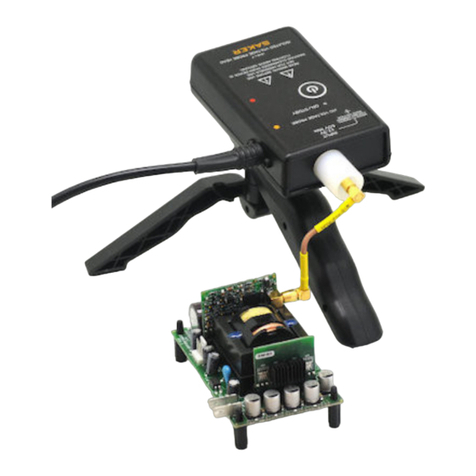
The XFVP-L is a novel voltage probe that provides high voltage isolation via fiber optic cables.
Not only is this approach advantageous from the voltage isolation point of view, but is also
immune to typical radiated interferences and capacitances created when using long coaxial
measuring cables. The XFVP-L probe was designed to minimize input capacitance as this is
what hurts most high frequency measurements.
Most high-end oscilloscopes feature proprietary input connectors that force the user to choose
among the supplied accessories of the scope. XFVP probe can be used in any 50Ωterminated
oscilloscope. This gives developers freedom to use their favourite digital scope and reduce
overall investment costs at the same time. Lastly the back of the probe head features a
standard camera tripod mount thread. This makes it more convenient to place the probe inside
tightly spaced cabinets or power modules and maintain proper clearance distances.
BR-XFVPL-Rev 2. 12/22
www.saker-mv.com
SAFETY NOTES
Do not connect or disconnect sensor cables or attenuators in the probe head while they are
connected to a voltage source to avoid the risk of shock.
Remember that all metallic parts in the probe head are at the same potential
This product is not intended for detection of hazardous voltages.
The probe head is not meant to be used as a handheld unit
Do not use the probe for measurements on mains circuits as it is not CAT rated.
Do not use in wet or explosive atmospheres.
Do not connect the probe or attenuators to any circuit that exceeds the probe ratings
The probe can be floated at very high voltages, please consider all clearances before making
any measurements
Do not open the probe head or receiver, they do not contain user-serviceable parts inside
Fiber cables can break if bent at sharp angles, take care not to trip over the fiber cable that
joins both receiver and probe head
The unit contains electrooptical components, do not shock or drop the probe onto the floor
It is always recommended that the probe head be installed over a tripod mount and secured
When manually positioning the probe head keep in mind the unit is physically joined to the
receiver unit, moving the probe head may send the receiver into the floor
BR-XFVPL-Rev 2. 12/22
www.saker-mv.com
This product is intended to be used only by trained personnel
WARNING
CAUTION
BR-XFVPL-Rev 2. 12/22
www.saker-mv.com
Receiver output
Coax cable BNC, 50Ω
CMRR (4)
<-110dB from DC to
10MHz
-90dB at 100MHz
-65dB at 200MHz
Output ratio
1/10
V/V
Max common mode voltage
50
kV
Receiver input power
5V, USB micro B
Probe head batteries
2x1.5V AA type
Batteries duration (6)
>10h
Battery low indication
Yes
Autozero (5)
Yes, with no signal at
input
Common mode capacitance
1.5
pF
Pollution degree (EN 61010-1)
2, Indoor use only
Operating temperature, probe
0..65
ºC
Operating temperature, receiver
0..50
ºC
ESD, EMI standards
IEC61000-4-2,
61000-4-3
CE certification
GPSD 2001/95/EC,
EMC Directive
2014/30/EU,
RoHS2 2011/65/EU
1) Specs for XFVP20 model
2) -3dB, small signal, 25Ωsource
3) See user manual for more details
4) Normalized to 1V input range
5) Disconnect input signal first
6) With alkaline or 2600mAh NiMh
±
XFVP-L Specification
Units
Bandwidth, minimum. (1)(2)
>220
250 typ.
MHz
Input impedance
Risetime, typical (1)
2
ns
Input voltage range
V
Max voltage at input
500Vdc
Noise, output referred
<3
mVrms
Delay, 2m cable. 5ns for each extra
meter of cable
20
ns
Offset error, output referred, after cal
<3
mV
Overall accuracy, LF, after cal
2.5
±
3% Offset error
±
±
1MΩ0.5% || 8 pF
±
SPECIFICATIONS
ACCESSORIES
Several accessories for the XFVP-L are available which include patch cables, attenuators and
external power supplies. Consult the accessories list.
COMPATIBILITY
The XFVP-L probe requires an external oscilloscope with internal 50 termination. The
termination is needed to provide appropriate high-frequency transmission of the signal. If the
oscilloscope does not have internal 50 termination, an optional BNC terminator (code
XFVPTERM) can be supplied.
A bandwidth of at least 300MHz is recommended. Also modern digital scopes do have a useful
Hi-Res mode that can lower the measurement noise substantially. (Read the document “XFVP
Probe Measurements Guide”). The same can be said about the scope ADC resolution.
XFVP PROBE CONTENTS
Each package contents must include:
- Carrying case
- XFVP-L probe head and receiver with 1m coaxial output cable
- SMB unterminated coax cable
- Quick users guide
- Tripod
- Adjusting tool
- Safety list sheet
Ω
Ω
BR-XFVPL-Rev 2. 12/22
www.saker-mv.com
INSTALLATION AND USE
PLACING THE PROBE HEAD
The probe head uses a SMB connector as its input. For mechanical stability and electrical
clearance it is always recommended to install a tripod in the probe head, making sure the the
tripod is made of plastic and not metal.
It is recommended to leave at least 15 mm of air space around the probe for each kV that the
probe is floated. Increase this distance if faster than 15kV/us slew rates in the common mode
voltage are expected. The higher the spacing, the lower the common mode capacitance, which
lowers the current to earth provided by the measured circuit.
Do not use the probe for measurements on mains circuits. This probe and its attenuators are
not CAT rated for use on these types of circuits according to definitions of IEC/EN 61010-031.
The accessories provided by Saker for connecting the probe head to the DUT are compatible
with the touch protected SMB connector in the probe. Please refer to the accessories list.
RECEIVER-OSCILLOSCOPE CONNECTION
Connect the receiver to a measuring oscilloscope with the BNC cable.
BR-XFVPL-Rev 2. 12/22
www.saker-mv.com
MAKE SURE NO DANGEROUS VOLTAGE POTENTIALS ARE
PRESENT WHILE INSTALLING THE PROBE HEAD IN THE DUT
Touch protected SMB connector developed by SAKER. For safety use only SMB
connectors that provide touch protection when connecting/disconnecting
Set the oscilloscope vertical scale at an appropriate scale given the conversion ratio of the
XFVP-L and attenuator (see specifications section) in question. A 50 termination is necessary
for calibration and signal integrity.
The preferred method of operation is as follows:
1. Place and secure the probe head
2. Connect the probe head to the DUT using the appropriate attenuator.
3. Connect the receiver to the oscilloscope
4. Turn on the probe head and receiver.
5. Press the “Offset Cal” key in the receiver. Power on the DUT.
6. Take measurements as needed.
OPERATION
TURNING ON
Ω
BR-XFVPL-Rev 2. 12/22
www.saker-mv.com
Do not touch the sensor head or attenuator cable and connectors while taking
measurements. The probe head is not a hand-held device
Connect the receiver to the USB cable to power the unit, as long as it is powered the ON led
will light. To turn on the probe head press the TURN ON button. If the probe head fails to turn
on check if the batteries are dead, and replace them.
TURNING OFF
Turn off the probe head by pressing the TURN ON button shortly, the ON led will turn off.
To turn off the receiver disconnect the USB cable.
FIBER OPTIC CONNECTIONS
The probe head unit and the receiver are connected with a fiber optic cable. This is not the
same standard fiber cables as those found in a house installation. Although this cable has a 4
layer protection, be mindful that they are not as resilient as copper cables so do not bend them
sharply, avoid putting tension on cables and do not pull them, especially when kinks or knots
are present.
Also do not remove or bend the protective fiber optic cable boots since these protect the
connectors from dust and maintain the necessary alignment for proper accuracy.
CALIBRATION
Calibration is needed to adjust the analog parameters of the fiber optic link and correct for
offsets and temperature drifts in each unit. Every time the “Offset adj” button is pressed in the
receiver, the output is adjusted to zero, given that the input at the probe head has been
disconnected.
To adjust the gain of the signal, adjust the potentiometer found at the back of the receiver. To
do so, connect the probe head to a well known voltage source (for example the GEVP-OSC
oscillator) in the range permitted by the attenuator and adjust the amplitude of the signal seen
in the oscilloscope with the trimmer.

BR-XFVPL-Rev 2. 12/22
www.saker-mv.com
DO NOT TWIST OR BEND THE FIBER OPTIC CABLE AT SHARP ANGLES. MINIMUM
BENDING RADIUS IS 6 CM
WARNING REGARDING ISOLATION
Due to their non-conductive nature, fiber optic cables provide excellent isolation between
probe head and receiver. However the probe head is floating at the same potential of the
measured conductor. Thus the whole body of the XFVP-L probe head can be at hazardous
potentials.
It is advisable to install a voltage detector/indicator on the measured line that provides visual
and clear indication about the presence of potentially dangerous voltages. SAKER offers the
MVD and MVDZ series of medium voltage presence detectors.
LOW BATTERY CONDITION
The probe head will measure the voltage of the batteries to warn the user in case of a low
battery condition, in which case the ON led blinks. The threshold is set to work with alkaline
batteries, with other chemistry types this indicator may not work.
BATTERY REPLACEMENT
The probe head unit uses standard 1.5V AA batteries. Either alkaline or NiMh (2500mAh) type
can be used. To replace the batteries open the back cover of the unit. Follow the polarity sign
to replace the batteries and close the cover afterwards.
CARE AND MAINTENANCE
Clean only the exterior surfaces of the device using a soft cloth moistened with an alcoholic/
water solution. Do not use harsh chemicals, solvents, or abrasive cleansers. To prevent damage
to the measurement system, do not expose it directly to sprays, liquids, or solvents. Avoid
getting moisture inside when cleaning the exterior. Dry the probe before making any voltage
measurements. The probe is not waterproof.
BR-XFVPL-Rev 2. 12/22
www.saker-mv.com
THE XFVP-L PROBE HEAD IS NOT A HANDHELD INSTRUMENT AND SHOULD BE
CONSIDERED TO BE FLOATING AT THE SAME POTENTIAL OF THE DUT
REMOVE THE BATTERIES FROM INSIDE THE EQUIPMENT IF IT IS TO BE STORED
DURING MORE THAN 5 MONTHS
The fiber cable should never be disconnected. The boots in the cables protect the connectors
from movement, shock and dust.
There are no serviceable parts inside the probe. Return the probe in case probe fails to meet
its specs or does not operate. Opening the probe voids the warranty.
EQUIPMENT CODES
PERFORMANCE VERIFICATION
XFVP-L probes are shipped from Saker and both probe head and receiver are tested as a
system and adjusted to meet the DC gain, offset and bandwidth specification.
Equipments needed to perform verification:
-Bench Multimeter of at least 4.5 digits
-Adjustable power supply or precision voltage source
-Banana to BNC cable (Pomona 4531 or similar)
-BNC-SMB adapter (Amphenol 242185 or similar)
-BNC-BNC cable (Caltest CT2942 or similar)
-50 Ohm terminator (Pomona 3285 and Amphenol 202104)
-BNC to banana Jack adapter (Caltest CT2939 or similar)
CODE
Description
XFVP-L10-x
XFVP-L probe 110MHz with 0.5m BNC output cable, SMB
unterminated coax cable, 2xAA batteries, tripod, adjusting tool, quick
guide, carrying case, 1m USB cable. Specify -x for length, standard
2m
XFVP-L20-x
XFVP-L probe 220MHz with 0.5m BNC output cable, SMB
unterminated coax cable, 2xAA batteries, tripod, adjusting tool, quick
guide, carrying case, 1m USB cable. Specify -x for length, standard
2m
XFVP MODEL
XFVP SERIAL NUMBER #
DATE
BR-XFVPL-Rev 2. 12/22
www.saker-mv.com