Digital I/O Interface
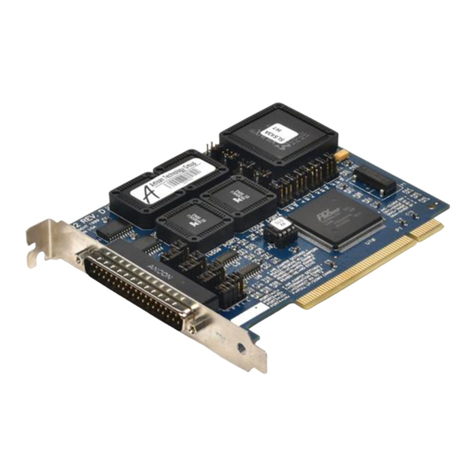
The PIO-24.LPCI’s 24 digital I/O channels are accessed via two (2) 26-pin header connectors. The included
CA315 connects to the two 26-pin header connectors on the PIO-24.LPCI and brings them out to a single
50-pin IDC connector, which is compatible with industry-standard relay racks. The headers provide 24 bits
of digital I/O divided into three eight-bit ports. Each port may be individually configured via software
command as input or output.
26-pin Header Connectors
You will need to install the bracket assembly and cable to the PIO-24.LPCI prior to installing it in
the PC. The PIO-24.LPCI’s bracket features a unique cable clamp that provides a solid strain relief
to prevent inadvertent cable removal.
Refer to page 12 for the 26-pin connectors pin out.
Sealevel’s SeaI/O software is provided on Sealevel’s website in order to assist in the development
of reliable applications for the Sealevel Systems family of digital I/O adapters.
Programming for Windows
The SeaI/O API (Application Programmer Interface) provides a variety of useful high-level function
calls implemented in a Windows dynamic link library (DLL). The API is defined in the help file
(Start/Programs/SeaIO/SeaIO Help) under “Application Programmers Interface”. This help file
also includes detailed information dealing with installation / removal of the software and
information about latency, logic states, and device configuration.
For C language programmers we recommend using the API to access the PIO-24.LPCI. If you are
programming in Visual Basic, using the ActiveX control included with SeaI/O is advised.
Samples and Utilities
A variety of sample programs and utilities (both executable and source code) are included with
SeaI/O. Further documentation on these samples can be found by selecting
“Start/Programs/SeaIO/Sample Application Description”. Information about where the files are
physically stored on your disk is also included in this same file.
Programming for Linux
SeaI/O for Linux consists of two major parts: a kernel module and a library. The kernel module is a
simple IO pass-through device, allowing the library to handle the more sophisticated functions
provided to SeaI/O users. It is provided in a ‘tarball’ format and can easily be compiled and included
in the kernel build.