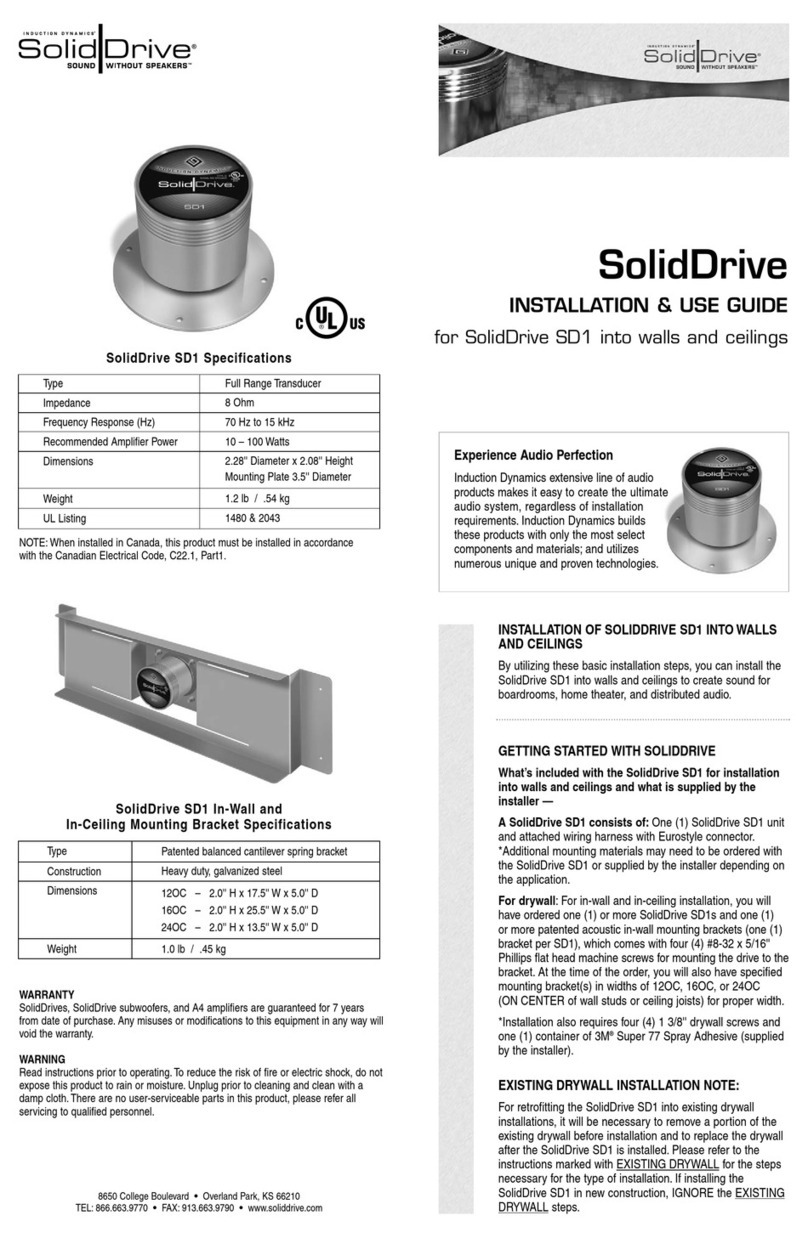
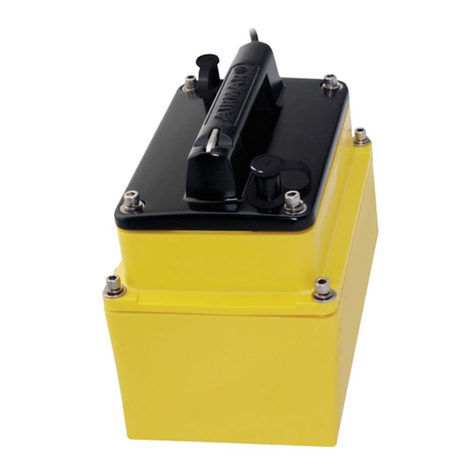
Feed the SolidDrive SD1 cable through the round
opening in the face of the mounting bracket. Insert
the SolidDrive SD1 through the same opening with
the oversized mounting base facing outward toward
the side that the drywall will be installed and flush
against the bracket face. Align the pre-drilled holes in
the mounting base to the threaded holes in the bracket
face (Figure 3). Attach the SolidDrive SD1 securely to
the mounting bracket using the 4 Phillips flat head
machine screws.
NOTE: The SolidDrive SD1 can also be installed without
the mounting bracket in ceilings that areaccessible
from above. Use the 3M®Super 77 contact spray
adhesive and liberally spray both the surface of the
oversized mounting base and the drywall. Press the
SolidDrive SD1 directly against the drywall. Make
sure the surface is dry and free of dust.
Make the electrical connection between the SolidDrive
SD1 and the speaker cable using the Eurostyle connector
attached to the end of the SolidDrive SD1 audio cable.
The polarity of the wiring is clearly indicated (Figure4).
Use the 3M®Super 77 contact spray adhesive and
liberally spray both the surface of the oversized
mounting base (masking around the base is highly
recommended to prevent overspray) and the drywall
just prior to mounting the drywall panel back into the
wall. The adhesive provides the proper acoustic
coupling between the base and the drywall.
IMPORTANT: Failure to apply the adhesive to both the
drywall surface and oversized mounting base will
prevent the system from functioning properly.
For re-installing the rectangle drywall panel that was
cut out to install the SolidDrive SD1, it is important
to create a uniform seal between the cut drywall and
the existing drywall. This will allow proper distribution
of sound and the SolidDrive SD1 will function with
optimum performance. Apply fast setting joint
compound, not vinyl based, between the cutout
section and the existing drywall panel, making sure to
fill the crack completely with mud then proceed with
the normal mud and tape routine.
The surface material plays a key role in the system’s
sound performance. Toensure an optimal listening
experience the installer MUST equalize the SolidDrive
SD1 system. Equalization is accomplished by using the
SolidDrive Drywall Passive Equalization Module or
using the auto equalization feature available on some
receivers. *Additional information about the
SolidDrive Drywall Passive Equalization Module can
be found on the back cover of this guide.
HIGH OUTPUT INSTALLATIONS
For installations requiring high output, such as a
home theater or other high output type applications,
two SolidDrive SD1’sshould be used for each of the
high output channels. For example the left, right, and
center channel of a home theater or the left and right
channels of a high output stereo system. The two
SD1’sshould be wired in series for each of the high
output channels (Figure5). For maximum output each
SolidDrive channel should have available at least 20
square feet of surface area.
Figure 3. SolidDrive SD1 being installed into mounting bracket
STEP 4. Make the electrical connections.
STEP 3. Install the SolidDrive SD1 into the bracket. STEP 5. Apply adhesive to the drywall surface
and base of the SolidDrive SD1.
STEP 6. Re-install the cutout.
STEP 7. Equalize the SolidDrive SD1 sound system
Figure 5. SolidDrives wired in seriesFigure 4. Eurostyle connector