Page 5/6
Congratulations on the purchase of your new smoke alarm device. We recommend that you spend some time
reading this instruction manual in order to fully understand all the operational features. You will also find
some hints and advice to help you resolve any issues. Read all the safety instructions carefully before use and
keep for future reference.
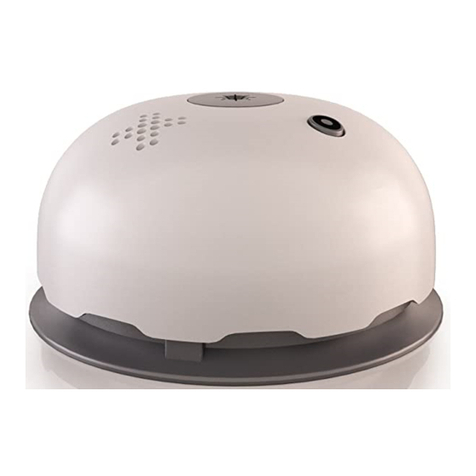
The Housegard smoke alarm device is designed to detect smoke particles and to reduce the number of false
alarms. The Housegard smoke alarm device is designed to give an early warning if a fire occurs, but it´s
operation depends on correct positioning and maintenance.
FEATURES
• Early warning
• High sensitivity and stability
• Test and pause function
• LED diode indicates normal operation
• Low battery warning
• Low power consumption
TECHNICAL SPECIFICATIONS
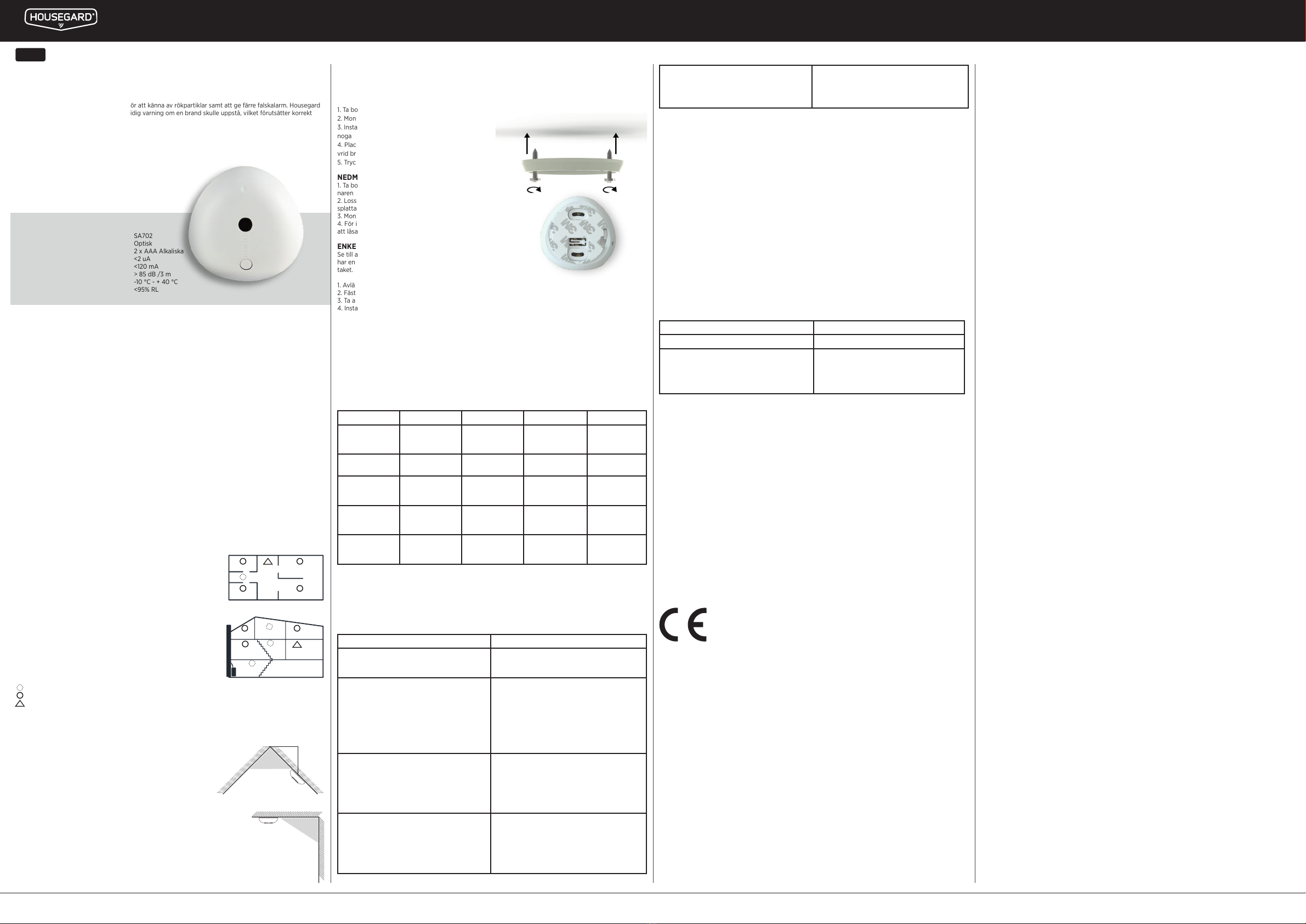
Model No: SA702
Detection type: Photo electric
Power source: 2 x AAA Alkaline
Standby current: <2 uA
Alarm current: <120 mA
Alarm sound level: 85 dB /3 m
Operating temperature: -10 °C to + 40 °C
Ambient humidity: <95% RH
IMPORTANT SAFETY INFORMATION
• The smoke alarm device is battery-powered. The smoke alarm device will not work without batteries, or
if the batteries are dead, removed or not correctly connected. Only use the specified type of battery. DO
NOT connect the smoke alarm device to any type of detector or equipment other than what is stated in
this manual.
• The test button provides a full test of all the smoke alarm device´s functions. No other test methods are
required. Test smoke alarm devices every week to check that they are working properly.
• Do not remove or disconnect the batteries to stop false alarms, as this will cause the smoke alarm device
to lose important functionality. Open a window or ventilate the air around the smoke alarm device to stop
the alarm and/or press the pause button.
• The smoke alarm device must be installed in line with all local and national rules and regulations on instal-
lation.
• The smoke alarm device is intended for use in houses. In apartment blocks, each apartment should be
fitted with its own smoke alarm device. This smoke alarm device is not suitable for use in non-residential
buildings. The smoke alarm device is not a replacement for a complete alarm system as required under law
or by the fire safety authorities.
• There may be reasons why a person in a household might not hear the alarm (e.g. noise, deep sleep, impai-
red hearing). If you suspect that a person in the household will not hear the smoke alarm device, specialist
alarms should be installed. If a person in the household has impaired hearing, special alarms should be
installed to alert the person via sound, light and vibrations.
• The smoke alarm device detects combustion particles in the air (smoke). It does not react to flames or gas.
The smoke alarm device is designed to give off an audible alarm if a fire is developing.
• No smoke alarm devices are entirely reliable and they cannot give a 100% guarantee to protect life and
property against fire. The smoke alarm device is no replacement for insurance. Homeowners and tenants
should take out life and home insurance.
• The smoke alarm device should be tested regularly every week and replaced every ten years.
POSITIONING THE SMOKE ALARM DEVICE
For the smoke alarm device to give an early warning, it needs to be installed where the fire occurs. House-
gard therefore recommends that you install a smoke alarm device in every room and on all floors.
• Install a smoke alarm device in all separate bedrooms and in rooms commonly occupied.
• In homes with several storeys, a smoke alarm device should be installed
at the top of every staircase between each storey.
• In the basement, a smoke alarm device should be installed on the ceiling
at the foot of the stairs.
• In bedrooms where people sleep with closed doors, there should always
be a smoke alarm device fitted in the bedroom.
• Install a smoke alarm device in every room where there is a potential
risk of fire.
• If you install the smoke alarm device in a passageway whose width is less
than 3m, install it in the middle and install one unit every 12m.
• Install the smoke alarm device in the middle of the ceiling. If this is not
possible, install the smoke alarm device at least 1m from the wall (Wall-
mounting is not recommended).
KEY:
Minimal protection
Recommended/more substantial protection
Smoke alarm devices with a pause function are recommended
SMOKE ALARM DEVICES SHOULD NOT BE PLACED IN THE FOLLOWING LOCATIONS
• In the kitchen (at least 6m away from kitchen or stove), where smoke from cooking could cause false
alarms.
• In areas of high air humidity, such as bathrooms (at least 3m from the bathroom) or near dishwashers or
washing machines, where steam and moisture could cause false alarms.
• Near fans and ventilation ducts, where air flows may prevent smoke from
reaching the smoke alarm device.
• Near light sources (at least 100cm from lamps) and electrical equipment
that emit an electromagnetic field.
• Near a fireplace or stove with an open fire.
• At the top of a v-shaped ceiling (minimum 100 cm from the top), where air pockets
could stop the smoke from reaching the smoke alarm.
• In a garage, where exhaust fumes could cause false alarms.
• In dusty and dirty areas, where the dust and dirt could damage the smoke alarm
device.
• In an area where insects often appears.
• In rooms where the temperature may fall below -10°C or rise above +40°C, or in rooms
with large temperature variations
GPBM Nordic AB | Argongatan 2B | 431 53 MÖLNDAL
Tel: 031-799 16 00
info@housegard.com | www.housegard.com
Multi-story residence
Single-story residence, apartment
100 cm
50 cm
USER MANUAL OPTICAL SMOKE ALARM DEVICE PEBBLE MINI
GB
WARNING: Incorrect positioning may lead to reduced reliability and false alarms.
PROTECT YOUR HEARING
Smoke alarm devices emit a loud audible signal. We recommend that you always use earplugs or other
hearing protection when testing your smoke alarm devices.
HOW TO INSTALL YOUR SMOKE ALARM ALARM
1. Remove the mounting plate on the back of the smoke
alarm by twisting it anticlockwise.
2. Install the batteries.
3. Install the mounting plate in the chosen position on
the ceiling. Take care to position your smoke alarm
device properly.
4. Place the smoke alarm device against the mounting
plate and twist the smoke alarm device clockwise until
it clicks into place.
5. Press the test button to test the smoke alarm device.
MOUNTING TAMPER
1. Remove the mounting plate from the smoke alarm by twisting it
anticlockwise.
2. Loosen the plastic plug attached to the base plate of the smoke
alarm.
3. Attach the mounting plate in line with the smoke alarm by twist-
ing it clockwise.
4. Insert the plastic plug through the hole in the mounting plate to
lock the smoke alarm against the mounting plate.
EASY INSTALLATION WITH TWO-SIDED TAPE
Make sure that the installation surface is flat and clean to attach the
tape. If the surface is rough, we recommend you to install the smoke alarm with the help of the screws.
1. Remove one side of the 3M tape protection
2. Attach the tape on the base plate on back of the smoke alarm. Press for 5 seconds.
3. Remove the base plate from the smoke detector turning it anti-clockwise.
4. Install the batteries correctly inside the smoke alarm.
5. Mount the base plate on the back side of the smoke alarm by turning it clockwise.
6. Remove the second side of the 3M tape protection.
7. Place the smoke alarm according to the manual. Press the smoke alarm for five seconds against the ceiling
to make sure that the smoke alarm is well attached.
OPERATION
During normal operation, the smoke alarm device’s LED flashes every 344 seconds. This means that the
battery and the unit are working correctly. If the alarm detects smoke, it will emit three loud, pulsing warning
signals and at the same time the red LED will flash twice until the air is clear.
MEANING OF THE DIFFERENT LED AND ALARM SIGNALS
STATUS RED LED GREEN LED ALARM SIGNAL DESCRIPTION
Normal mode Flashes once every
344 seconds
None The smoke alarm
device is working
normally. The
device detects
the environment
every 10 seconds.
Low battery Loud audible signal
every 43 second
Replace the
battery with a
similar battery
Alarm memory 3 flashes every 43
sec. for 24h
After
24h:Indicates by
one distinct
beep during
the
Alarm mode / test
mode
Flashes conti-
nously every
second.
Continuous alarm
is given with 0,5
sec. intevall
Smoke alarm
is warning you
there might be
a fire
Pause mode Flashes
Every 10 second
The alarm
is silent for appr.
9 minutes.
CAUSES AND REMEDIES FOR FALSE ALARMS
A smoke alarm device detects and reacts to smoke particles in the air. The smoke particles set off the smoke
alarm device. This function means that the smoke alarm device will also react to dust particles, moisture or
other particles in the form of pollen, insects and so on. These factors are usually the cause of a false alarm.
Cause of error Action
Steam and moisture. A false alarm may occur if
the smoke alarm device is placed too close to a
bathroom, laundry room, or other location with
high air humidity.
Place the smoke alarm device at least 3 metres
from any bathroom, laundry room, or other loca-
tion where high air humidity may occur.
Dust and dirt. Since air passes freely through the
detection chamber, the smoke alarm device will
always attract some dust and pollen particles. This
can lead to a false alarm. The smoke alarm device
may also become more sensitive for this reason,
which could cause false alarms. In addition, dirt
will collect over time, as the smoke alarm device
ages, which may result in false alarms.
Regularly vacuum the smoke alarm device, using
a plastic nozzle to avoid damaging the electronics.
Avoid fitting smoke alarm devices in places with
a lot of dust and dirt. You can put a ‘hat’ over the
smoke alarm device or remove it entirely while
you are carrying out renovation work at home that
involves sawing, sanding, etc.
Draughts, dust and air flows. False alarms may be
caused by the smoke alarm device being placed
too close to doors, windows, ventilation systems,
fans, air ducts, heat pumps or suchlike. This can
lead to dust particles being carried up into the
detection chamber.
Do not install smoke alarm devices in a draughty
location, close to windows or doors, ventilation,
fans, air ducts, heat pumps or suchlike. Find a
better location for the smoke alarm device, further
away from draughts and air flows.
Temperature variations. Temperature variations
may lead to condensation in the detection cham-
ber. This may happen, for example, if the smoke
alarm device is placed in a room where windows
are opened for ventilation in the winter, or close
to exits, balcony doors or other places that switch
between hot and cold
Avoid fitting smoke alarm devices in rooms with
rapid temperature changes or close to windows
and doors that are frequently opened and closed.
Move the smoke alarm device to a place with a
more even and stable temperature.
Generally unfavourable positions. Incorrect
positioning in an unstable indoor environment, a
draughty area, close to electronic apparatus (EMC)
and lighting may cause a false alarm.
Place smoke alarm devices at least 5 metres from
open fires, stoves or other heating devices; 2
metres from ventilation ducts, heat pumps and
air conditioning; 1 metre from light bulbs and
fluorescent tubes.
TESTING THE SMOKE ALARM DEVICE
1. Always test all alarms after installation to ensure that they are functioning properly.
2. The test button performs a full test of all functions. Never use a naked flame to test the smoke alarm
device, since this can destroy the alarm.
3. Test your smoke alarm device routinely once a week.
4. Always test your smoke alarm devices after a long period of absence from the home and always when you
return from a holiday.
5. Always stand at arm’s length when testing your smoke alarm device to avoid damage to your hearing.
FOR YOUR SAFETY! NEVER IGNORE A SMOKE ALARM DEVICE THAT HAS GONE OFF. WHEN
YOU HEAR THE ALARM SIGNAL, YOU MUST GIVE IT YOUR FULL ATTENTION AND ACT
ACCORDINGLY.
CLEANING AND MAINTENANCE
The smoke alarm device should be cleaned regularly, every week. Clean your smoke alarm device by
vacuuming externally along the opening to the detection chamber to remove dust and dirt.
IMPORTANT: Do not try to open the cover to clean inside the smoke alarm device. This will negate the war-
ranty.
TYPE OF BATTERY
Voltage: DC 3V
Type: 2 x LR03/AAA
Battery life: Approx. 60 months
Recommended batteries: Gold Peak GN24A, Pairdeer AAA/LR03
TROUBLESHOOTING
Problem Action
The smoke alarm device gives off no signal when
tested.
1.Check that the batteries still have some charge.
The smoke alarm device goes off when there is no
smoke, or when cooking, etc.
1.Clean the smoke alarm device. See also section
“CAUSES AND REMEDIES FOR FALSE ALARMS”..
2.Change the location of the smoke alarm device.
See section “CAUSES AND REMEDIES FOR FALSE
ALARMS”.
WARRANTY
This smoke alarm device comes with a
5-year limited warranty against manufacturing defects. (valid from date of purchase.) The batteries are not
covered by the warranty. Liability under the warranty is limited to the value of an equivalent device. Defective
devices should be returned to the retailer, along with a description of the problem. If the claim is approved,
the faulty goods will be replaced with a new device of the same or an equivalent type. Any claim must be
accompanied by a receipt confirming the date of purchase.
EC DECLARATION OF CONFORMITY
Sunmatic The Safety Company AB
Argongatan 2B
SE-43153 Mölndal
Hereby declare under our sole responsibility that the product:
Housegard model smoke alarm SA702
To which this declaration relates is in conformity with the following standards and/or other normative docu-
ments:
EN 14604:2005/AC:2008
Technical file held by: Sunmatic The Safety Company AB
Mölndal 2021-006-08
2831-CPR-F4573
Sunmatic The Safety Company AB
DOP: 601144-CPR-0121
EN 14604:2005+AC:2008
21
User manual SA702 Ver: 210917