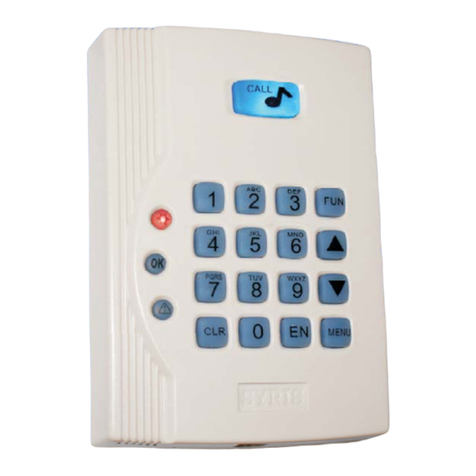
SY110SA SINGLE DOOR CONTROLLER
- 4 -
ⅤAdvanced Function Setup Table
Function Name Enter Steps Remark:
The use of Door Output “FUN” + 3 + “ ” + N + “ ” +
TTT + “EN”
TTT is the setup time, range: 06~255 (5*) sec.
N= 0~2, N = 0 means disable relay action
N = 1 means action by controller inner relay*
N = 2 means action by external module relay
Door Bell “FUN” + 4 + “ ” + N + “ ” +
TTT + “EN”
TTT is the setup time, range: 0~255 (3*) sec.
N= 0~2, N = 0 means disable door bell function
N = 1 means enable the inner relay as door bell function
N = 2 means enable external relay as door bell function*
Alarm Output Point Setup “FUN” + 5 + “ ” + N + “ ” +
TTT + “EN”
TTT is the setup time, range: 0~255 (30*) sec.
N= 0~2, N = 0 means stop the alarm signal output*
N = 1 means take inner relay for alarm function
N = 2 means take external relay for alarm function
Push Button Input Point
Setup
“FUN” + 6 + “ ” + N + “EN” N7is the DI ID, N= 0~6 (1*)
N = 0 means the use of open door push button
N = 1~6 means enable the DI as door open push button function
Door Sensor Input Point
Setup
“FUN” + 7 + “ ” + N + “EN” N is the DI ID, N= 0~6 (2*)
N = 0 means to stop the use of door sensor*
N = 1~6 means enable the DI as door sensor function
Door Bell Input Point Setup “FUN” + 8 + “ ” + N + “EN” N us the DI ID, N= 0~6 (3*)
N = 0 means to stop the use of door sensor
N = 1~6 means enable the DI as open door push button function
Push Button #2 Input Point
Setup
“FUN” + 9 + “ ” + N + “EN” N is the DI ID, N= 0~6 (4*)
N = 0 means the use of open door push button
N = 1~6 means enable the DI as door open push button function
Door Bell #2 Input Point
Setup
“FUN” + 10 + “ ” + N + “EN” N us the DI ID, N= 0~6 (6*)
N = 0 means to stop the use of door sensor
N = 1~6 means enable the DI as open door push button function
Setup Date “FUN” + 20 + “ ” +yy +mm+dd +
hh+mm+ss+ “EN”
Setup Time/Date
yy=year, mn = month, dd=day, ; hh =hour, mm=minute, ss=
second,
Door alway open “FUN” + 21 + “ ” + N + “EN” N=1or 0, N = 0 means disable door always open function*
N = 1 means enable door always open function
Door forced open “FUN” + 30 + “ ” + N + “EN” N= 1or 0, N = 0 means disable door forced open function*
N = 1 means enable door forced open, alarm output function
Door Open Timeout “FUN” + 31 + “ ” + N + “ ” +
TTT + “EN”
N= 1or 0, N = 1means enable door open timeout function
N = 0 means disable door open timeout function*
(Door open time + TTT = timeout time)
TTT is the time allow you to close the door, range: 0~ 255 sec. (10
*)
Tamper Switch “FUN” + 32 + “ ” + N + “EN”
*Controller inner contact point
N= 1or 0, N = 0 means disable tamper switch function*
N = 1 means disable tamper switch function
Card Type “FUN” + 40 + “ ” + N +“EN” N = 1~3, N = 1 means regular EM Card*, when N = 2 means
using SYRIS card, N = 3 means using Two Page Card.
Card Data Bytes format “FUN” + 41 + “ ” + N +“EN” N = 1~3, N = 1 means using 2 Bytes, when N = 2 means using 3
Bytes*, when N = 3 means using 4 Bytes format.
Setup Main Password “FUN” + 50 + “ ” + N + “ ”+
main password + “EN”
Only if the initial password havn’t been changed, you can modify
the main password. There are three sets of the main password you
can use. Use N to select which main password you want to use
(N=1~3). The default main password is “1234“*. Also, if other
set of the main password had been changed before, this function
will be disabled.
Restore Factory Default “FUN” + 86 + “ ” + 87 + “EN” All the setup data including card data and master card data will be
clean by executing this step, the controller will restore to factory
default.
Restore Main Password “FUN” + 98 + “ ” + 99 + “EN” Restore three set of the main password back to factory default, and
disable the use of the Master card. If the Initial password is not
equal to “0000000000“ This function will be disabled.
*This marks means the setting is factory defualt.
6IF you set the “TTT” to “0”, then it means that the door will be opened / closed when you swap the card. (Swap to change the status).
7The Input point you can use is from DI1~DI6, for detail information, please refer to the next page of the contrast table.