6
EN
1 Characteristics
• For single-cable systems according to EN 50494 and EN 50607
• With DC voltage feed-through via satellite connection to the trunk
line (max. 24 V/400 mA, 22 kHz- and DiSEqCTM signal)
• Monitoring of DiSEqCTM signalling by microcontroller
• Overload protection by means of an electronic fuse and decoupling
diodes
• Return-path compatible for systems with cable connection (CATV
modem)
• Configurable functions with the PROGRAMMING UNIT RVP 700:
— disabling individual user bands
— operation in Legacy mode (no switch-o at 18 V constant
signal for standard multi-switch system)
— operation in disconnect mode (no DC feed-through to the
trunk)
— LED display for status and fault indication (can be switched
o)
— Functions can be expanded.
• Basic functions at delivery:
— The connected receiver is switched o if it does not use
the single-cable DiSEqCTM command set in accordance
with EN 50494 or EN 50607 (switching o the power
from the satellite connection to the input at +18 VDC
aer approx. 400 ms).
— configured for single-cable systems according to EN 50494 and EN 50607
— All user bands (UB1 … UB32) are enabled.
— LED display switched o
• Connections:
— TV: IEC connector (m) (IEC 61169-2)
— Radio: IEC connector (f) (IEC 61169-2)
— SAT: F-socket (IEC 61169-24)
• With screw and claw fastening for flush-mounted installation boxes Ø 55 – 65 mm
2 Functional Specification
In single-cable satellite reception systems, interferences are possible if individual subscribers or receivers block the
trunk line by means of an 18 V constant signal. Due to these interferences, other subscribers are no longer able to
communicate with the multi-switch or LNB.
In practice, it is also possible that incorrectly configured receivers use the user IDs of other subscribers. In this
case, we are talking about interferences in the form of the so-called ping-pong eect, because two subscribers
“fight“ for the same transponder.
The single-cable outlets of the RV 700-E series have a microcontroller that monitors signalling inside single-cable
systems. In addition to signal voltages (14 V/18 V), audio signals (22 kHz) or DiSEqCTM signals are also analysed.
The antenna outlets turn o a permanent voltage of 18 V and, by means of a user ID check, ensure that only the
enabled user band IDs are transmied from the receiver to the multi-switch via the outlet.
The PROGRAMMING UNIT RVP 700 transmits the user band IDs which need to be enabled to the single-cable an-
tenna outlet, thus ensuring that the subscribers in a single-cable antenna system do not interfere with each other.
Using the PROGRAMMING UNIT RVP 700, a specialist retailer or installer configures one or several defined user IDs
in the single-cable antenna outlet during the installation of the antenna system. To do so, the specialist retailer or
installer connects the programming device to the F-socket of the antenna outlet. By means of the TechniSat RV-
control app, a connection to the PROGRAMMING UNIT is established, and the data for the configuration
of the antenna outlet is transmied to the programming device.
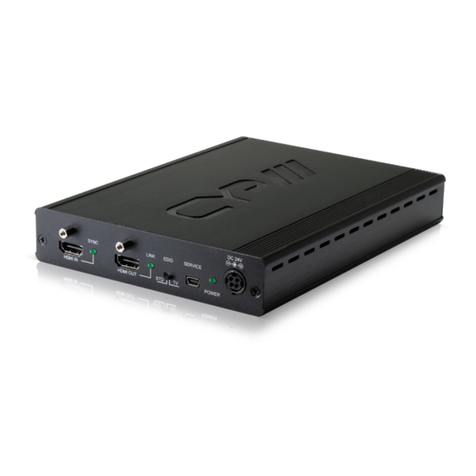
RV 700-8E End outlet, terminated
RV 700-10E Loop through outlet 10 dB
RV 700-14E Loop through outlet 14 dB
RV 700-17E Loop through outlet 17 dB
Input Output
TV Radio
Service LED
SAT
Programming
interface
Fig. 1: RV 700-14E