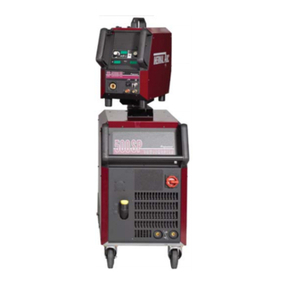
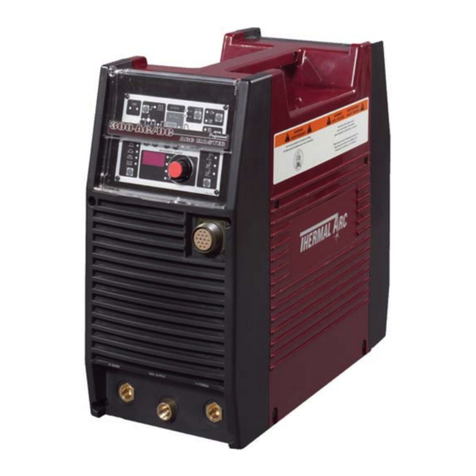
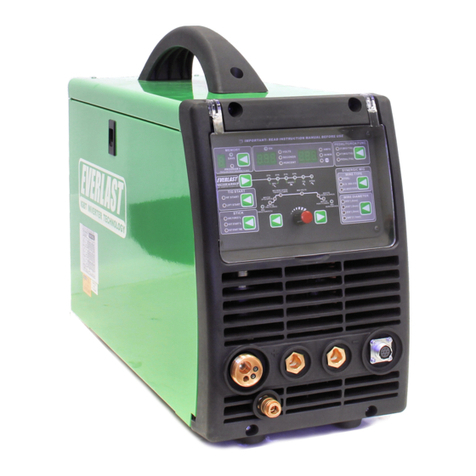
PRO-WAVE 300GTSW
1-3
June 21, 2012
7. Do not weld on coated metals, such as galvanized,
lead, or cadmium plated steel, unless the coating is
removed from the weld area, the area is well ventilated,
and if necessary, while wearing an air-supplied
respirator. The coatings and any metals containing
these elements can give off toxic fumes if welded.
WARNING
WELDING can cause fire or explosion.
Sparks and spatter fly off from the welding arc.
The flying sparks and hot metal, weld spatter,
hot workpiece, and hot equipment can cause
fires and burns. Accidental contact of electrode
or welding wire to metal objects can cause
sparks, overheating, or fire.
1. Protect yourself and others from flying sparks and hot
metal.
2. Do not weld where flying sparks can strike flammable
material.
3. Remove all flammables within 35 ft (10.7 m) of the
welding arc. If this is not possible, tightly cover them
with approved covers.
4. Be alert that welding sparks and hot materials from
welding can easily go through small cracks and
openings to adjacent areas.
5. Watch for fire, and keep a fire extinguisher nearby.
6. Be aware that welding on a ceiling, floor, bulkhead, or
partition can cause fire on the hidden side.
7. Do not weld on closed containers such as tanks or
drums.
8. Connect work cable to the work as close to the welding
area as practical to prevent welding current from
traveling long, possibly unknown paths and causing
electric shock and fire hazards.
9. Do not use welder to thaw frozen pipes.
10.Remove stick electrode from holder or cut off welding
wire at contact tip when not in use.
WARNING
FLYING SPARKS AND HOT METAL can cause
injury.
Chipping and grinding cause flying metal. As
welds cool, they can throw off slag.
1. Wear approved face shield or safety goggles. Side
shields recommended.
2. Wear proper body protection to protect skin.
WARNING
CYLINDERS can explode if damaged.
Shielding gas cylinders contain gas under
high pressure. If damaged, a cylinder can
explode. Since gas cylinders are normally
part of the welding process, be sure to treat
them carefully.
1. Protect compressed gas cylinders from excessive heat,
mechanical shocks, and arcs.
2. Install and secure cylinders in an upright position by
chaining them to a stationary support or equipment
cylinder rack to prevent falling or tipping.
3. Keep cylinders away from any welding or other
electrical circuits.
4. Never allow a welding electrode to touch any cylinder.
5. Use only correct shielding gas cylinders, regulators,
hoses, and fittings designed for the specific application;
maintain them and associated parts in good condition.
6. Turn face away from valve outlet when opening cylinder
valve.
7. Keep protective cap in place over valve except when
cylinder is in use or connected for use.
8. Read and follow instructions on compressed gas
cylinders, associated equipment, and CGA publication
P-1 listed in Safety Standards.
Welding or cutting Electrode Size Filter Welding or cutting Electrode Size Filter
Torch soldering 2Ga s metal-arc
11llAlatemesabsuorref-noN4ro3gnizarbhcroT
Oxygen CuttingFerrous base metalAll 12
LightUnder 1 in., 25 mm 3 or 4Gas tungsten arc weldingAll 12
Medium1to 6 in., 25-150 mm 4 or 5 (TIG)All 12
HeavyOve r 6 in., 150 mm 5 or 6Atomic hydrogen weldingAll 12
Ga s weldingCarbon arc weldingAll 12
LightUnder 1/8 in., 3 mm 4 or 5Plasma arc welding
Medium 1/8 to 1/2 in., 3-12 mm 5 or 6 Carbon arc air gouging
21thgiL8ro6mm21,.ni2/1revOyvaeH
Shielded metal-arc 41yvaeH01mm4,.ni23/5rednU
5/32 to 1/4 in., 12 Plasma arc cutting
9pmA003rednUthgiL41mm4.6,.ni4/
1revO
Medium 300 to 400 Am p12
HeavyOver 400 Am p14
Eye protection filter shade selector for welding or cutting
(goggles or helmet), from AW S A6.2-73.