THIESEN ACL3 User guide

Dear customer,
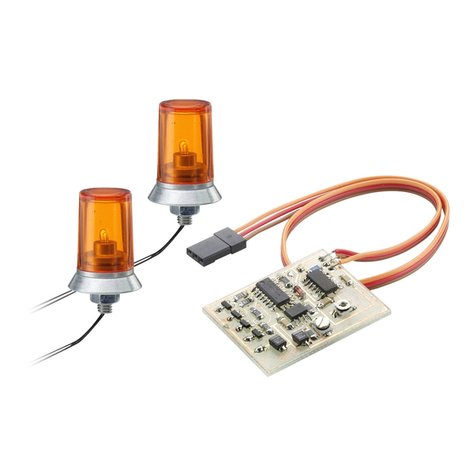
the electronic anti collision light “ACL” is a highly innovative product which contributes to saver airspace.
Now the new LED technology allows an incredibly excellent, red light with only approx. 10% of the input power compared with
conventional lights.
The casting in a high-optical plastic makes the ACL absolutely insensitive against water, vibrations and other environmental
influence.
The efficiency of the output is much higher, than with conventional electric light bulbs. The self-warming of the ACL is low and
can be determined as safe. To avoid overheating, the heat balance is controlled electronically.
This anti collision light for aircraft (NON-TSO’d) is designed to be mounted at a suitable position at the tail unit or at the top of
the stabilizer. Please adhere to the following instructions for a professional mounting of the ACL.
The illumination angle complies to the regulations for general aviation.
Required materials and tools
2-core twisted cord, according to the length of fuselage (5 - 8 meters),
clear silicone,
2 screws, approx. 4 mm x 30 - 35-mm length,
soldering iron, tin solder,
shrink hose (is enclosed).
Recommendations
Cable
2
We recommend a double core, flexible and twisted cable with a cross section of at least 1.5 mm .
Adhesion
We recommend standard silicon in a tube. It is available in do-it-yourself markets. This adhesion is strong and in case of a
dismantling you only need a sharp knife. We strongly advise against using other kinds of adhesion, like polyester or epoxy
resin.
.
Mounting
Use 2 metal countersunk screws (4 mm x 30 - 35 mm) to fix theACL and a thin layer of silicon to paste it to the required position.
By the use of silicon twisting of theACL is prevented and sealing against dirt and water is guaranteed.
Use only screws that do not corrode!
Illustration 1
Electronic
anti collision light
(NON-TSO’d)
Mounting instruction for anti collision light (ACL³)
Fuselage mounting position
Examples of mounting position
Stabilizer mounting position
(wooden or
epoxy-glass resin)
modeled cone
Stabilizer
longitudinal axis
vertically to
the yaw axis
top edge
of stabilizer
C
L
A
³

Electric power supply / cable connection to the aircraft system (12 Volts)
The best connection is solder with additional shrinking of the soldering joint with a shrink hose (enclosed). Only use solder for
electronic soldering never use cored solder. It contains acids which cause corrosion!
The ACL is provided with overload protection. In case of over voltage the protector switches off the ACL. After reset or voltage
drop the ACL is again fully functional. The automatic overload protector shall be activated at a voltage above 18 Volts.
(If the voltage reduces to a value below 18 Volts, theACL will again be functioning)
Servicing / maintenance
Should the ACL be scratched, use a good polish to refurbish the damages. With slightly deeper scratches use wet sandpaper
with very fine granulation (800-1000) carefully polish again. Do not use aggressive chemicals like gasoline or solvent.
For day to day cleaning use soap water!
Some insect removers and detergents forces embrittlement of epoxy based plastics and laminates. Use only aircraft certified
products.
If the aircraft can not hangarized, please cover the lamps to prevent surface aging!
Important notes
Carefully mount the cables inside the rudder and/or the fuselage. Connect the cables professionally to the aircraft system
(RED = positive, ) and to a 5 Amps fuse protection. Luster terminals are not suitable to connect cables.
There is a good selection of suitable crimp connections in various shops.
BLACK = negative
Pasting
Apply only as much silicone as required to paste theACL plane. (see illustration 2).
After fixing the EPL to the required position, slightly tighten the screw. With your moistened finger using dish liquid clean off any
laterally dispensable silicon, a smooth transition can be modeled between the wing and the EPL.
Silicone needs time to cure (vaporization of acetic acid). The best results are achieved at a temperature of 20 deg. Celsius (68
deg. Fahrenheit). Just follow the handling instructions of the silicone. The final firmness (stability) will be reached after a few
days.
Technical data
Operating voltage: 10-17 volts (DC), typically 12.8 - 13.4 volts
Input : approx. 20 watts
Fuse : 5 ampere (fusible cut-out or automatic fuse)
Dimensions : 61 x 46 x 52 mms
Drill hole : 4.5 mm
Weight : approx. 110 grams with connecting cables
Warranty : 5,000 operating hours or max. 3 years
Illustration 2
Subject to changes without notice
apply silicone here
apply silicone here
lateral view lateral view
mounting at the bottom of the fuselage
mounting on top of the fuselage
5.000 hours or max. 3 years
assured luminous duration
Made in Germany
Im Tiegel 9
36367 Wartenberg
Deutschland
Tel.: +49 (0) 66 41 - 979 - 0
eMail: info@thiesen-electronics.com
www.thiesen-electronics.com
www.flugzeuglichter.de
Table of contents