manuals.online logo
Brands
  1. Home
  2. •
  3. Brands
  4. •
  5. Toshiba
  6. •
  7. LCD TV
  8. •
  9. Toshiba 20WL56G User manual

Toshiba 20WL56G User manual

Other Toshiba LCD TV manuals

Toshiba 32SL415U User manual

Toshiba

Toshiba 32SL415U User manual

Toshiba 26SL738G User manual

Toshiba

Toshiba 26SL738G User manual

Toshiba 32DL66Ps User manual

Toshiba

Toshiba 32DL66Ps User manual

Toshiba 26AV52R User manual

Toshiba

Toshiba 26AV52R User manual

Toshiba 42WL55A User manual

Toshiba

Toshiba 42WL55A User manual

Toshiba 39 L28 Series User manual

Toshiba

Toshiba 39 L28 Series User manual

Toshiba 19SL400U User manual

Toshiba

Toshiba 19SL400U User manual

Toshiba 22BL712G DIGITAL Series User manual

Toshiba

Toshiba 22BL712G DIGITAL Series User manual

Toshiba Regza 47LZ196 User manual

Toshiba

Toshiba Regza 47LZ196 User manual

Toshiba 32C110U User manual

Toshiba

Toshiba 32C110U User manual

Toshiba 26AV502R - 26" LCD TV User manual

Toshiba

Toshiba 26AV502R - 26" LCD TV User manual

Toshiba Regza 52XF550U User manual

Toshiba

Toshiba Regza 52XF550U User manual

Toshiba 32HL85 User manual

Toshiba

Toshiba 32HL85 User manual

Toshiba 14DL74 User manual

Toshiba

Toshiba 14DL74 User manual

Toshiba 50L4333D User manual

Toshiba

Toshiba 50L4333D User manual

Toshiba 32BV512B User manual

Toshiba

Toshiba 32BV512B User manual

Toshiba Regza 40XV645U User manual

Toshiba

Toshiba Regza 40XV645U User manual

Toshiba 20DL75 User manual

Toshiba

Toshiba 20DL75 User manual

Toshiba 40L3400U User manual

Toshiba

Toshiba 40L3400U User manual

Toshiba 15DL15 User manual

Toshiba

Toshiba 15DL15 User manual

Toshiba REGZA 32HL66 User manual

Toshiba

Toshiba REGZA 32HL66 User manual

Toshiba REGZA 26HL67 User manual

Toshiba

Toshiba REGZA 26HL67 User manual

Toshiba 32 LA2B Series User manual

Toshiba

Toshiba 32 LA2B Series User manual

Toshiba 40SL412U User manual

Toshiba

Toshiba 40SL412U User manual

Popular LCD TV manuals by other brands

Panasonic Vieta TX-26LX600P null

Panasonic

Panasonic Vieta TX-26LX600P null

LG 22LK33 Series null

LG

LG 22LK33 Series null

Philips BDL323I null

Philips

Philips BDL323I null

LG 32LC4R* Service manual

LG

LG 32LC4R* Service manual

Samsung LA32E420 E-manual

Samsung

Samsung LA32E420 E-manual

Dell W1900 19 Setting up

Dell

Dell W1900 19 Setting up

Samsung LN40C670M1F user manual

Samsung

Samsung LN40C670M1F user manual

Runco CX-52HD Owner's operating manual

Runco

Runco CX-52HD Owner's operating manual

Sharp LC-32AX3H Service manual

Sharp

Sharp LC-32AX3H Service manual

Philips 47PFL7704D Specifications

Philips

Philips 47PFL7704D Specifications

Vizio VO42LFHDTV10A user manual

Vizio

Vizio VO42LFHDTV10A user manual

Philips 42PF7520D/79 user manual

Philips

Philips 42PF7520D/79 user manual

Insignia NS-LCD32-09 Service manual

Insignia

Insignia NS-LCD32-09 Service manual

Sony WEGA KLV-27HR3 operating instructions

Sony

Sony WEGA KLV-27HR3 operating instructions

Nexus NX32031 owner's manual

Nexus

Nexus NX32031 owner's manual

Zenith Z32LC2D Specifications

Zenith

Zenith Z32LC2D Specifications

Sony KDL-32S3000R - 32" Class Bravia S-series Digital Lcd... Specifications

Sony

Sony KDL-32S3000R - 32" Class Bravia S-series Digital Lcd... Specifications

Medion MEDION LIFE X14330 quick start guide

Medion

Medion MEDION LIFE X14330 quick start guide

manuals.online logo
manuals.online logoBrands
  • About & Mission
  • Contact us
  • Privacy Policy
  • Terms and Conditions

Copyright 2025 Manuals.Online. All Rights Reserved.

ENGLISH - 2 -
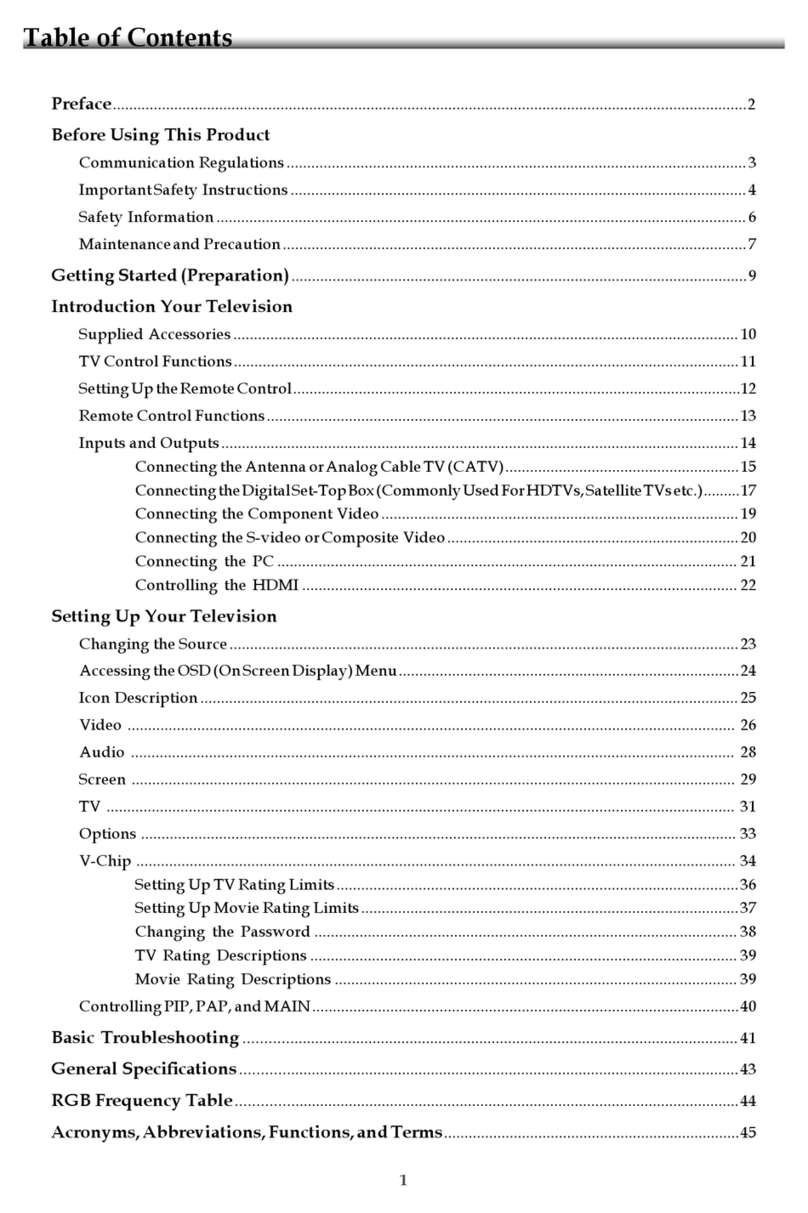
Contents
Sound controls continued  headphone,
AVL, effect ...................................................... 16
Effect ...................................................................... 16
Input selection, AV connections ................ 17
Input selection ......................................................... 17
OUTPUT signal selection for AV-2 (Scart 2 ........... 17
PC RGB Sound Mode .............................................. 17
PC Mode .......................................................... 18
Switching From TV to PC Mode ............................... 18
Sound ....................................................................... 18
Picture ..................................................................... 18
PIP Picture ............................................................... 18
Feature Menu ........................................................... 18
Geometry Menu ....................................................... 18
PC Mode continued ...................................... 1
Horizontal Position ................................................... 19
Vertical Position ....................................................... 19
Hsync Phase ........................................................... 19
Auto Position ........................................................... 19
Source ..................................................................... 19
PIP (Picture-in-Picture Source ................................ 19
PC and Picture ........................................................ 19
Text services  control buttons ............... 20
The Text button: .................................... 20
To display an initial page: ................................ 20
To access sub-pages: ...................................... 20
To reveal concealed text: ................................ 20
To hold a wanted page: .................................... 20
To enlarge the text display size: ..................... 20
To select a page whilst viewing a normal page: ...... 20
Questions and Answers ............................. 21
Notes .......................................................... 22-23
Specifications and accessories ................. 24
Safety Precautions ........................................... 3
Installation and important information ........ 4
Where to install .......................................................... 4
Please take note ........................................................ 4
The remote control .........................................5
Inserting batteries and effective range
of the remote ............................................................. 5
Connecting external equipment ...................6
Connecting external equipment
continued,..........................................................7
Connecting the PC via PC input ............................... 7
Connections and controls .............................. 8
Switching on ............................................................... 8
Using the remote control ........................................... 8
Using the controls and connections .......................... 8
Initial Tuning and programme sorting,
manual tuning ...................................................
Manual tuning ............................................................. 9
Manual tuning continued, fine tuning ....... 10
Fine tuning ............................................................... 10
APS, choosing a language ............................ 11
Autostore (Automatic Programming System ......... 11
Choosing a language ............................................... 11
General controls, time display, stereo/
bilingual transmissions, child lock, sleep
timer ................................................................ 12
Selecting programme positions ............................... 12
The Time Display..................................................... 12
Stereo and Bilingual transmissions.......................... 12
Child lock ................................................................. 12
Sleep timer............................................................... 12
Picture format ............................................... 13
Picture mode ........................................................... 14
Hue .......................................................................... 14
Picture controls  picture mode, hue,
noise reduction, VCR mode........................ 14
Noise Reduction ...................................................... 14
VCR Mode ............................................................... 14
Sound controls  volume, sound mute,
equalizer, balance, sound mode ................ 15
Sound Controls ........................................................ 15
Equalizer .................................................................. 15
Sound Balance ......................................................... 15
Sound Mode ............................................................. 15
Headphone ............................................................... 16
AVL - Auto Volume Limiter ....................................... 16
A01-20730W&ENG-17MB08P-1705UK-50076779.p65 21.03.2006, 15:012

ENGLISH - 3 -
Safety Precautions
This equipment has been designed and manufactured to meet international safety standards but, like any
electrical equipment, care must be taken to obtain the best results and for safety to be assured. Please
read the points below for your own safety. They are of a general nature, intended to help with all electronic
consumer products and some points may not apply to the goods you have just purchased.
Air Circulation
Leave at least 10cm clearance around the televi-
sion to allow adequate ventilation. This will pre-
vent overheating and possible damage to the
television. Dusty places should also be avoided.
Heat Damage
Damage may occur if the television is left in di-
rect sunlight or near a heater. Avoid places sub-
ject to extremely high temperatures or humidity,
or locations where the temperature is likely to fall
below 5°C (41°F .
Mains Supply
The mains supply required for this equipment is
230V AC 50Hz. Never connect to a DC supply
or any other power source. DO ensure that the
television is not standing on the mains lead. DO
NOT cut off the mains plug from this equipment,
this incorporates a special Radio Interference Fil-
ter, the removal of which will impair its perfor-
mance. In the UK, the fuse fitted in this plug is
approved by ASTA or BSI to BS1362. It should
only be replaced by a correctly rated and ap-
proved type and the fuse cover must be refit-
ted. This set requires an earthed supply. IF IN
DOUBT PLEASE CONSULT A COMPETENT
ELECTRICIAN.
Do
DO read the operating instructions before you at-
tempt to use the equipment.
DO ensure that all electrical connections (includ-
ing the mains plug, extension leads and inter-
connections between pieces of equipment are
properly made and in accordance with the manu-
facturers instructions. Switch off and withdraw
the mains plug before making or changing con-
nections.
DO consult your dealer if you are ever in doubt
about the installation, operation or safety of your
equipment.
DO be careful with glass panels or doors on
equipment.
Do not
DONT remove any fixed cover as this may
expose dangerous voltages.
DONT obstruct the ventilation openings of
the equipment with items such as newspa-
pers, tablecloths, curtains, etc. Overheating
will cause damage and shorten the life of the
equipment.
DONT allow electrical equipment to be ex-
posed to dripping or splashing or objects filled
with liquids, such as vases, to be placed on
the equipment.
DONT place hot objects or naked flame
sources, such as lighted candles or
nightlights on, or close to equipment. High
temperatures can melt plastic and lead to
fires.
DONT use makeshift stands and NEVER fix
legs with wood screws. To ensure complete
safety, always fit the manufacturers ap-
proved stand, bracket or legs with the fixings
provided according to the instructions.
DONT listen to headphones at high volume,
as such use can permanently damage your
hearing.
DONT leave equipment switched on when it
is unattended, unless it is specifically stated
that it is designed for unattended operation or
has a standby mode. Switch off by withdraw-
ing the plug, make sure your family know
how to do this. Special arrangements may
need to be made for people with disabilities.
DONT continue to operate the equipment if
you are in any doubt about it working nor-
mally, or it is damaged in any way - switch
off, withdraw the mains plug and consult your
dealer.
ABOVE ALL - NEVER let anyone, espe-
cially children, push or hit the screen,
push anythin into holes, slots or any
other openin s in the case.
NEVER uess or take chances with electri-
cal equipment of any kind - it is better to
be safe than sorry.
THE MAINS PLUG IS USED AS A DISCON-
NECTING DEVICE AND THEREFORE
SHOULD BE READILY OPERABLE.
A01-20730W&ENG-17MB08P-1705UK-50076779.p65 21.03.2006, 15:013
ENGLISH - 4 -
Installation and important information
Where to install
Locate the television away from direct sunlight and strong lights;
soft, indirect lighting is recommended for comfortable viewing.
Use curtains or blinds to prevent direct sunlight falling on the
screen.
Place on a sturdy platform, the mounting surface should be flat
and steady. It should then be secured to the wall with a sturdy
tie using the clip on the back of the television, this will prevent it
from falling over.
Make sure the television is located in a position where it cannot
be pushed or hit by objects and that small items cannot be in-
serted into slots or openings in the case.
Please take note
EXCLUSION CLAUSE
Toshiba shall under no circumstances be liable for loss and/or damage to the product caused by:
i fire;
ii earthquake;
iii accidental damage;
iv intentional misuse of the product;
v use of the product in improper conditions;
vi loss and/or damage caused to the product whilst in the possession of a third party;
vii any damage or loss caused as a result of the owners failure and/or neglect to follow the instructions
set out in the owners manual;
viii any loss or damage caused directly as a result of misuse or malfunction of the product when used
simultaneously with associated equipment;
Furthermore, under no circumstances shall Toshiba be liable for any consequential loss and/or damage
including but not limited to the following, loss of profit, interruption of business, the loss of recorded data
whether caused during normal operation or misuse of the product.
If stationary images generated by text services, channel identification logos, computer displays, video games,
on screen menus, etc. are left on the television screen for any length of time they could become conspicuous, it
is always advisable to reduce both the brightness and contrast settings.
A01-20730W&ENG-17MB08P-1705UK-50076779.p65 21.03.2006, 15:014
ENGLISH - 5 -
The remote control
Simple at-a-glance reference of your remote control.
Inserting batteries and effective range of the remote
Remove the back cover to reveal the battery compartment and make sure the
batteries are inserted the right way round. Suitable battery types for this remote are
AAA, IEC R03 1.5V.
Do not combine a used, old battery with a new one or mix battery types. Remove
dead batteries immediately to prevent acid from leaking into the battery compart-
ment. Dispose of them in a designated disposal area.
The performance of the remote control will deteriorate beyond a distance of five
metres or outside an angle of 30 degrees from the centre of the television. If the
operating range becomes reduced the batteries may need replacing.
:KHQXVLQJD7RVKLED9&5RU'9'
SUHVVWR3$86(67(3
SUHVVWR3/$<
SUHVVWR5(:,1'
SUHVVWR)$67)25:$5'
SUHVVWR(-(&7
SUHVVWR6723
SUHVVWR6.,35(:,1'
SUHVVWR6.,3)25:$5'
6WDQGE\PRGH
7RPXWHWKHVRXQG
7RUHWXUQWRWKHSUHYLRXVSURJUDPPHLQ
79PRGH
0DLQPHQX
7RVHOHFW79SURJUDPPHQXPEHU
7RVHOHFWLQSXWIURPH[WHUQDOVRXUFHV
7R YLHZ 3,3 SLFWXUHLQSLFWXUH DQG
3$3SLFWXUHDQGSLFWXUHLQ3&PRGH
7RH[LW0HQXV
6WHUHRELOLQJXDOWUDQVPLVVLRQV
7RFKDQJHSURJUDPPHSRVLWLRQVWH[WSDJHV
DQGYROXPH
:KHQXVLQJPHQXVWKHGLUHFWLRQEXWWRQV
PRYHWKHFXUVRURQWKHVFUHHQXS
GRZQOHIWRUULJKW WRFRQILUP\RXU
VHOHFWLRQ
2.
6HOHFW WR FRQWURO \RXU
7RVKLED79'9'RU9&5
6HOHFWDEOHSLFWXUHPRGH
3LFWXUHIRUPDW
7RGLVSOD\RQVFUHHQLQIRUPDWLRQ
7RFKDQJHWKHSODFHVRIPDLQ
DQGSLSSLFWXUHLQ3&PRGH
:KHQLQ79PRGH
7LPHGLVSOD\LQDQDORJXHPRGH
:KHQLQ7H[WPRGH
6HHSDJH IRUWKHIXQFWLRQV
RIWKHWH[WNH\V

A01-20730W&ENG-17MB08P-1705UK-50076779.p65 21.03.2006, 15:015
ENGLISH - 6 -
Connecting external equipment
Before connecting any external equipment, disconnect from the main power.
DGHFRGHU
FRXOGEH'LJLWDO
6DWHOOLWH)UHHWR
$LURUDQ\RWKHU
FRPSDWLEOH
GHFRGHU
79 0(',$5(&
,1287
6$7
GHFRGHU
PHGLDUHFRUGHU
A01-20730W&ENG-17MB08P-1705UK-50076779.p65 21.03.2006, 15:016
ENGLISH - 7 -
Connecting external equipment continued,
Aerial cables:
Connect the aerial to the socket on the rear of the
television. If you use a decoder and/or a media re-
corder it is essential that the aerial cable is con-
nected through the decoder and/or through the media
recorder to the television.
SCART leads:
Connect the media recorder IN/OUT socket to the
television. Connect the decoder TV socket to the
television. Connect the media recorder SAT socket
to the decoder MEDIA RECORDER socket.
Before running APS (AUTO PROGRAMMING SYS-
TEM) put your decoder and media recorder to
Standby.
A wide variety of external equipment can be con-
nected to the back of the television, therefore
the relevant owners manuals for all additional
equipment must be referred to.
We recommend SCART 1 for a decoder and SCART
2 for a media recorder.
If connecting S-VIDEO equipment, set the INPUT
for AV-3 S. See page 17.
If the television automatically switches over to
monitor external equipment, return to normal televi-
sion by pressing the desired programme position
button. To recall external equipment, press to
select between AV-1, AV-2, AV-2S, YPbPr, AV-3S or
PC RGB.
Connecting the PC via PC input
 Power off both computer and TV before making any
connections.
 Connect the PC cable to the PC input of your TV
and to the 15-pin connector on the rear of your com-
puter.
 Tighten the screws on the plugs until the connectors
are fastened securely.
 If you are using Windows operating system running
on a PC with a Microsoft Plug&Play compatible
video card, your system will select the appropriate
timing for your monitor.
A01-20730W&ENG-17MB08P-1705UK-50076779.p65 21.03.2006, 15:017
ENGLISH - 8 -
Connections and controls
A wide variety of external equipment can be connected via the sockets located on the rear side of the television.
Whilst all the necessary adjustments and controls for the television are made using the remote control, the buttons
on the to of the television may be used for some functions.
726+,%$
+($'3+21(
S itching on
Connect the power supply cord to the system.
Then the TV switches itself to the standby mode
and the power lamp becomes red on the front of
the TV. Then press a number, P or on the
remote control to see the screen. Then the LED will
turn GREEN.
To put the television into Standby press on the
remote control; another GREEN LED appears
briefly followed by RED LED when in standby.
To view the television press again or any of
the number buttons. The picture may take a few
seconds to appear.
Using the remote control
Press the MENU button on the remote control to
see the menus.
In TV mode the menu appears as a group of icons
each for a menu option. Press the Left or Right
button to select a topic.
To use the options press the U and Down buttons
on the remote control to move up and down
through them and OK, Left or Right buttons to se-
lect the required choice. Follow the on screen in-
structions. The functions of each menu are de-
scribed in detail throughout the manual.
Using the controls and connections
Using the control buttons on the top of the TV:
 To alter the volume press +  .
 To alter the programme position press
on the top of the TV.
 Press MENU and +  and to con-
trol the menu options.
 Press MENU to finish.
When connecting mono sound equipment to AV-3,
connect the audio output of the equipment to the L
or R socket on the rear side of the television, then
press to select Dual I for left mono or
Dual II for right mono.
To select the Input, press until the AV-3 is
highlighted in source select menu as described on
page 17. The television will automatically sense
the type of signal.
Please always refer to the owners manual of the
equi ment to be connected for full details.
Please note: Inserting the headphone jack will mute
the sound from all speakers.
A01-20730W&ENG-17MB08P-1705UK-50076779.p65 21.03.2006, 15:018
ENGLISH - 9 -
Initial Tuning and programme sorting,
manual tuning
Before switching on the television put your decoder and media recorder to Standby if they are
connected and ensure the aerial is connected. To set up the television use the buttons on the remote
control as detailed on page 5.
b
Connect the mains plug to the TV and press
any numbered button or standby button on
the remote control, the APS screen will ap-
pear. This screen will appear the first time
that the television is switched on and each
time the television is reset.
:DUQLQ
J
&RXQWU\8.
/DQJXDJH(QJOLVK
&RQWLQXH
(;,7&DQFHO
$OO3UHVWRUHG3URJUDPPHV
:LOO%H(UDVHG
c
Use U or Down to select the Country and
Lan ua e items. Press Left or Right to ad-
just the highlighted item.
d
Press Down to highlight the Continue and
use OK, Left or Right to start tuning.
The television will start to search for available
stations.
$36,V5XQQLQJ3OHDVH:DLW
You must allow the television to complete
the search.
When the search is complete the television
will automatically select programme position
1.This may not be a clear picture or the signal
may be weak, so the station order can be
changed using pro ram which will appear on
the screen.
'HOHWH
,QVHUW
$XWRVWRUH
3URJUDP3
e
With the list of stations now showing use U
or Down to select the station you want to
move and press GREEN button.
f
Use U or Down to move through the list to
the preferred position, as you do so the other
stations will move to make room, then press
GREEN button again. The selected station will
be moved to the new position.
Repeat as necessary, then press EXIT.
If the television cannot be connected to a me-
dia recorder/decoder with a SCART lead or if a
station on another system is required, a
programme position can be manually tuned in.
Manual tuning
To allocate a rogramme osition on the television
for a decoder and media recorder: turn the decoder
on, insert a re-recorded film into the media recorder
and ress PLAY, then manually tune.
b
Press MENU and using Down select Install
menu.
0HQX
A01-20730W&ENG-17MB08P-1705UK-50076779.p65 21.03.2006, 15:019
ENGLISH - 10 -
Manual tuning continued, fine tuning
The television can be tuned-in manually using Install menu. For example: if the television cannot be connected
to a media recorder/decoder with a SCART lead or to tune-in a station on another System.
c
When Install menu is entered, Pro ramme
item is selected. Key in the programme posi-
tion to be tuned using Left or Right buttons or
using the number buttons on the remote con-
trol, we suggest Programme 0 for a media re-
corder.
,QVWDOO
3&&%*
d
Use Down to select Search then press Left or
Right to search. The television will start
searching for channels.
e
Each signal will show on the television, if it is
not your media recorder press Left or Right
to restart the search.
f
When your media recorder signal is found,
save the selection by pressing Down until
Store is selected, then press Left/Right or
OK button to save. Stored message appears
on the bottom of the menu.
Repeat for each rogramme osition to be
tuned then press EXIT to finish.
Fine tuning
Fine Tunin should not be required unless there is
interference or a weak signal.
b
Select the programme, then press MENU and
select the Install.
c
Using Down select the Fine Tunin , and use
Left or Right to adjust to get the best picture
and sound.
,QVWDOO
d
To save the selection press Down until Store
is selected, then press Left/Right or OK but-
ton. Stored message will appear on bottom of
the menu.
You can store the settings in the menu via
pressing OK button while the Install menu is
on the screen.
A01-20730W&ENG-17MB08P-1705UK-50076779.p65 21.03.2006, 15:0110
ENGLISH - 11 -
APS, choosing a language
Autostore (Automatic Programming
System)
When the Autostore feature is selected all chan-
nels and settings will be lost, the television will re-
turn to factory settings and then re-tune.
b
Press MENU and using Down select Pro ram
menu.
0HQX
c
Press Left/Right or OK button, the Pro ram
screen will appear on the screen. Press the
BLUE button to start APS.
'HOHWH ,QVHUW
$XWRVWRUH
3URJUDP3
d
Press Down button to select Country item
and use Left or Right to adjust it.
:DUQLQ
J
&RXQWU\8.
&RQWLQXH
(;,7&DQFHO
$OO3UHVWRUHG3URJUDPPHV
:LOO%H(UDVHG
e
Press EXIT button to cancel APS or Left/Right
or OK button to start.
$36,V5XQQLQJ3OHDVH:DLW
You must allow the television to complete the
search.
When the search is complete the television will
automatically select programme position 1. This
may not be a clear picture or the signal may be
weak, so the station order can be changed using
Pro ram which will appear on the screen.
f
Press EXIT to finish.
Choosing a language
The Lan ua e feature allows the menus to be
shown in a variety of languages.
b
Press MENU and using Down select Feature
menu.
c
Press Down to select Lan ua e, then use
Left or Right to select the required language.
)HDWXUH
(Q
J
OLVK
A01-20730W&ENG-17MB08P-1705UK-50076779.p65 21.03.2006, 15:0111