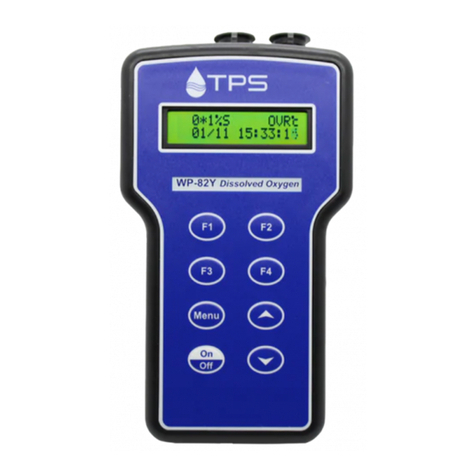
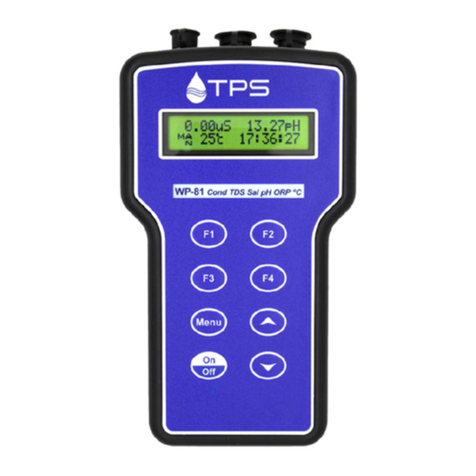
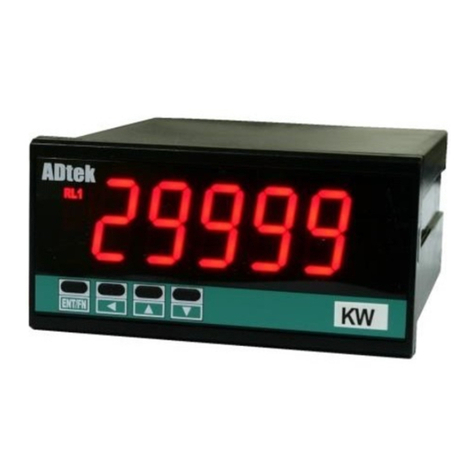
TPS WP-90 User manual

Congratulations !
You have purchased the latest in Handheld Specific Ion-pH-mV-Temperature
instrumentation. We trust that your new WP-90 will give you many years of
reliable service.
The WP-90 is a breeze to operate. This manual has been designed to help you
get started, and also contains some handy application tips. If at any stage you
require assistance, please contact either your local TPS representative or the
TPS factory in Brisbane.
The manual is divided into the following sections:
1. Table of Contents
Each major section of the handbook is clearly listed. Sub-sections have also
been included to enable you to find the information you need at a glance.
2. Introduction
The introduction has a diagram and explanation of the display and controls of
the WP-90. It also contains a full listing of all of the items that you should
have received with your WP-90. Please take the time to read this section, as
it explains some of items that are mentioned in subsequent sections.
3. Main Section
The main section of the handbook provides complete details of the WP-90,
including operating modes, calibration, troubleshooting, specifications, and
warranty terms.
4. Appendices
Appendices containing background information and application notes are
provided at the back of this manual.
TPS Pty Ltd
4 Jamberoo Street
Springwood, Brisbane,
Australia, 4127
Phone : (07) 32 900 400
International : 61 7 32 900 400
Fax : (07) 3808 4871
International : 61 7 3808 4871
E-mail : [email protected]
Web Site : www.tps.com.au Model WP-90
Specific Ion, pH,
mV, & Temp. Meter
Handbook Version : 1.1
Date : 07 Jun 01
Author : MS

Page 2Contents
1. Introduction.....................................................................................4
1.1 WP-90 Display and Controls.............................................................................4
1.2 Unpacking Information.....................................................................................6
1.3 Specifications....................................................................................................7
2. WP-90 Menu Structure ...................................................................9
3. Specific Ion Mode.........................................................................11
3.1 Selecting ppM or ppK Mode ...........................................................................11
3.2 Selecting Exponential Mode (e.g. Molar)........................................................13
4. Specific Ion Calibration................................................................15
4.1 Calibration Procedure .....................................................................................15
4.2 Calibration Notes............................................................................................17
4.3 Calibration Messages......................................................................................17
5. pH Calibration...............................................................................18
5.1 Calibration Procedure .....................................................................................18
5.2 Calibration Notes............................................................................................19
5.3 Calibration Messages......................................................................................19
6. mV Calibration ..............................................................................20
7. Relative mV Calibration................................................................20
7.1 Notes ..............................................................................................................20
8. Temperature Calibration ..............................................................21
8.1 Calibration Procedure .....................................................................................21
8.2 Calibration Notes............................................................................................22
8.3 Calibration Messages......................................................................................22
8.4 Manual Temperature Setting...........................................................................22
9. Good Laboratory Practices (GLP)...............................................23
9.1 To recall GLP information on the display........................................................23
9.2 Failed Calibration...........................................................................................25
9.3 Printing GLP Information to the RS232 Port...................................................25
9.4 Instrument Serial Number...............................................................................26
9.5 Additional GLP Features.................................................................................26
10. Notepad Function......................................................................27
10.1 Recording Readings into the Notepad .........................................................27
10.2 Recalling Records from the Notepad...........................................................27
10.3 Erasing Records from the Notepad..............................................................28
10.4 Printing Records from the Notepad to the RS232 Port.................................28

Page 3
11. Automatic Datalogging .............................................................29
12. RS232 Port................................................................................. 31
12.1 Setting the Baud Rate .................................................................................31
12.2 Sending Readings to the RS232 Port...........................................................31
12.3 RS232 Configuration..................................................................................31
12.4 Communication and Statistical Software.....................................................31
12.5 Commands..................................................................................................32
12.6 Data Format................................................................................................33
12.7 GLP Data Format........................................................................................34
13. Battery Saver Function.............................................................35
14. Recharging the Battery.............................................................35
15. Clock Function.......................................................................... 36
15.1 Setting the Clock ........................................................................................36
15.2 Displaying or Hiding the Clock...................................................................36
16. Selecting Buffers for Auto Buffer Recognition .......................37
17. Initialising the WP-90 ................................................................38
18. Instrument firmware version number.......................................38
19. Troubleshooting........................................................................39
19.1 General Errors............................................................................................39
19.2 Specific Ion, pH and mV Troubleshooting...................................................40
19.3 Temperature Troubleshooting.....................................................................41
20. pH Sensor Fundamentals......................................................... 43
20.1 Asymmetry of a pH Sensor..........................................................................43
20.2 Slope of a pH Sensor...................................................................................44
20.3 pH Temperature Compensation...................................................................45
20.4 Checking the reference junction of a pH sensor...........................................45
20.5 Determining if a pH meter or a sensor is faulty ...........................................46
21. Warranty ....................................................................................47

Page 4
1. Introduction
1.1 WP-90 Display and Controls

Page 5
¬
Press to record readings into memory. See section 10.1.
Also used at turn-on to select pH6.88 or pH7.00 as the primary pH buffer
(section 16).
-
Press to show or hide the date and time. See section 15.2.
®
Press to start or stop automatic logging. See section 11.
Alternatively, press to transmit current reading plus date and time to the
optional RS232 port. See section 12.2.
¯
Press to zero Relative mV, when Relative mV mode is selected (section 7).
°
Press to access the user-friendly menu system which makes the WP-90 easy
to operate.
±and ³
The and keys are used for calibrating temperature readout (section
8.1), setting the clock (section 15.1), setting the automatic logging period
(section 11), and displaying GLP information (section 9.1).
The key is also used to initialise the WP-90 at turn-on. See section 17.
²
Switches the WP-90 on and off.
´Display
32 character alpha-numeric display with user-friendly menu and prompting
system. Shows Specific Ion/pH/mV and Temperature simultaneously. Date
and time can also be displayed.

Page 6
1.2 Unpacking Information
Before using your new WP-90, please check that the following accessories have
been included…
Part No
1. WP-90 Specific Ion-pH-mV-Temp Instrument ...............121191
2. Temperature/ATC Sensor..............................................121247
3. Battery charger..............................................................130037
4. WP-90 Handbook..........................................................130050
Options that may have been ordered with your WP-90…
1. RS232 Serial Interface Option .......................................130039
(includes cable and communication software for DOS)
2. Communication software for Windows 3.1, 95 & NT.....130086
3. Hard Carry Case............................................................130059
4. Battery charger lead for 12V cigarette lighter socket.......130046
5. Solar Panel....................................................................130012
6. RS232 Printer................................................................130031
Sensors…
Your choice of a complete range of Ion Selective, Reference, pH and Redox
sensors.
Other spares…
1. 6V NiCad Battery ............................................................130038
2. RS232 Interface Cable .....................................................130041

Page 7
1.3 Specifications
Mode Ranges Resolution Accuracy
Specific Ions Auto-ranging, in
units of ppM, ppK
and Exponential
Notation
3 significant
digits ± least significant
digit
pH 0 to 14.00 pH 0.01 pH ±0.01 pH
mV & Relative mV 0 to +/-500.0 mV
0 to ±1500 mV 0.15 mV
1 mV ±0.3 mV
±1 mV
Temperature -10.0 to 120.0 OC±0.1 OC±0.2 OC
Specific Ion Specifications
Input Impedance :>3 x 10¹² Ω
Asymmetry Range :Auto detection
Slope Range :50.0 to 110.0 %
Temperature Compensation :Automatic, 0 to 100 OC
Calibration :Automatic calibration in user-definable
standards.
pH Specifications
Input Impedance :>3 x 10¹² Ω
Asymmetry Range :-1.00 to 1.00 pH
Slope Range :85.0 to 105.0 %
Temperature Compensation :Automatic, 0 to 100 OC
Calibration :Automatic calibration in pH4.00, pH6.88,
pH7.00, pH9.23 or pH10.00 buffers.
Temperature Specifications
Temp. Sensor Offset Range :-10.0oC to +10.0oC

Page 8
General Specifications
Memory :150 readings including date and time
Automatic Logging :User-set for one reading every 1 to 90
seconds, minutes or hours.
RS232 Output (optional) :300, 1200 & 9600 baud.
8 bits, no parity, 1 stop bit, XON/XOFF
Protocol.
Clock :Calendar clock displays date, month, hours,
minutes & seconds.
Year is recorded in memory and transmitted
to optional RS232 port, but is not displayed.
Battery Saver :On :Auto switch-off after 5 minutes
Off :Continuous use
Bar Graph display of battery charge level.
Readout of battery voltage available for
troubleshooting.
Good Laboratory Practices :Date, Time and results of last Specific Ion,
pH and Temperature calibration are stored in
memory. This information can be recalled or
sent to the optional RS232 port at any time.
Power :6V NiMH Rechargeable Battery for approx
75 hours operation.
Dimensions :187 x 110 x 51 mm
Mass :Instrument only :Approx 440g
Full Kit :Approx 2.0 kg
Environment Temperature :0 to 45 OC
Humidity :0 to 90 % R.H.

Page 9
2. WP-90 Menu Structure
A detailed breakdown of the menu system of the WP-90 is shown below. This
diagram provides a quick reference for the menu functions available for the
WP-90.
Press the function keys in normal display mode, to perform the following tasks:
:Press to record current data plus date and time into memory.
:Press to show or hide date and time.
:Press to start and stop automatic logging.
If logging period is set to zero, press to transmit current reading plus
date and time to the RS232 port.
:Press to zero Relative mV, when Relative mV mode is selected.
:Press to access the user-friendly menu system, as detailed over the page.

Page 10
WP-90 Menu Structure
Menu →F1:Cal. →F1:Ion Pri (only in Ion mode)
or F1:pH (only in pH mode)
F2:Temp (in all modes)
F3:Ion Sec (only in Ion mode)
→F2:Notepad →F1:Recall
F2:Erase
F3:Print *
F4:Prog. →F1:Min
F2:Sec
F3:Hr
↑↓:Period
→F3:Mode →F1:Ion
F2:pH
F3:mV
F4:Rel mV
→F4:Setup →F1:Batt →F1:OFF
F2:ON
F2:Clock
F3:GLP →F1:Recall
F3:Print *
F4:Baud * →F1:300
F2:1200
F3:9600
* These functions available when RS232 option is fitted.
Other manuals for WP-90
1
This manual suits for next models
1
Table of contents
Other TPS Measuring Instrument manuals