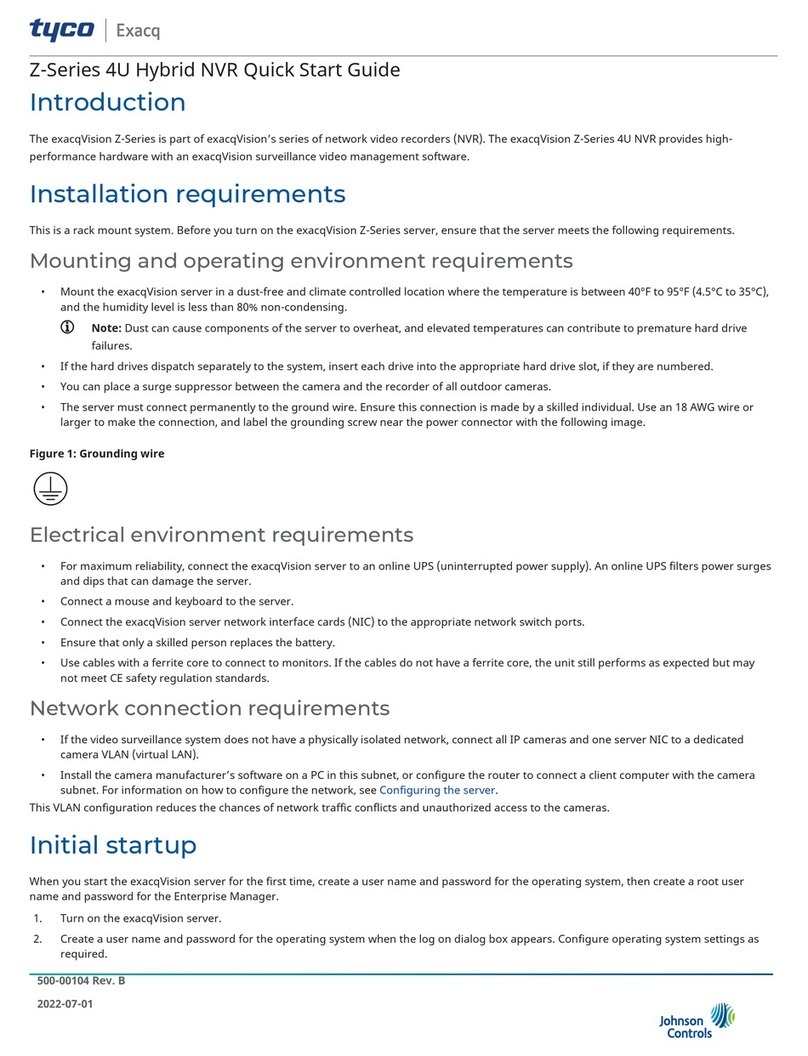
• Use cables with a ferrite core to connect to monitors. If the cables do not have a ferrite core, the unit still performs as expected but may
not meet CE safety regulation standards.
Network connection requirements
• If the video surveillance system does not have a physically isolated network, connect all IP cameras and one server NIC to a dedicated
camera VLAN (virtual LAN).
• Install the camera manufacturer’s software on a PC in this subnet, or configure the router to connect a client computer with the camera
subnet. For information on how to configure the network, see .
This VLAN configuration reduces the chances of network traffic conflicts and unauthorized access to the cameras.
Initial startup
When you start the exacqVision server for the first time, create a user name and password for the operating system, then create a root user
name and password for the Enterprise Manager.
1. Turn on the exacqVision server.
2. Create a user name and password for the operating system when the log on dialog box appears. Configure operating system settings as
required.
3. If prompted, log on again to the operating system with the user name and password you just created.
4. When you log on, an exacqVision dialog box appears on the desktop. Create the exacqVision admin user name and password.
Note: These are not the same as the credentials you created to log on to the operating system. Use these credentials to log on to the
exacqVision Server.
Configuring the server
1. Log on to the exacqVision server with an administration account.
2. Follow the instructions to configure settings such as the time zone and language.
3. When prompted, change the administrator password. The password must contain a minimum of 8 characters, use a combination of
numbers and uppercase letters. It is important to remember the password for future use.
Configuring the client
1. Start the exacqVision client application.
2. Click the Config (Setup) page icon.
3. From the navigation tree, select Add Systems.
4. In the System List select the server.
5. In the System Information area, type the exacqVision user name and password that you created during initial start up.
6. Select the Connection Speed.
Choose from the following options, Remote, WAN, LAN or Local.
7. Verify that the server appears in the Systems list with a status showing Connected.
Note: If the server does not connect to the client, check for antivirus software on the remote client machine that may block the
communication between the server IP addresses and ports.
8. Click Apply.
Setting up remote access to the server
Configure the server through a remote exacqVision client.
1. Download the latest exacqVision Client software from the Exacq website at: https://www.exacq.com/support/downloads.php
2. Install the client software on a system administrator computer.
3. Confirm the connectivity with the server using the ping command and the server's IP address. If the client PC can not communicate with
the server, contact your network administrator.
EV 2UA, F2A IP-Series H410/X1313 Quick Start Guide2