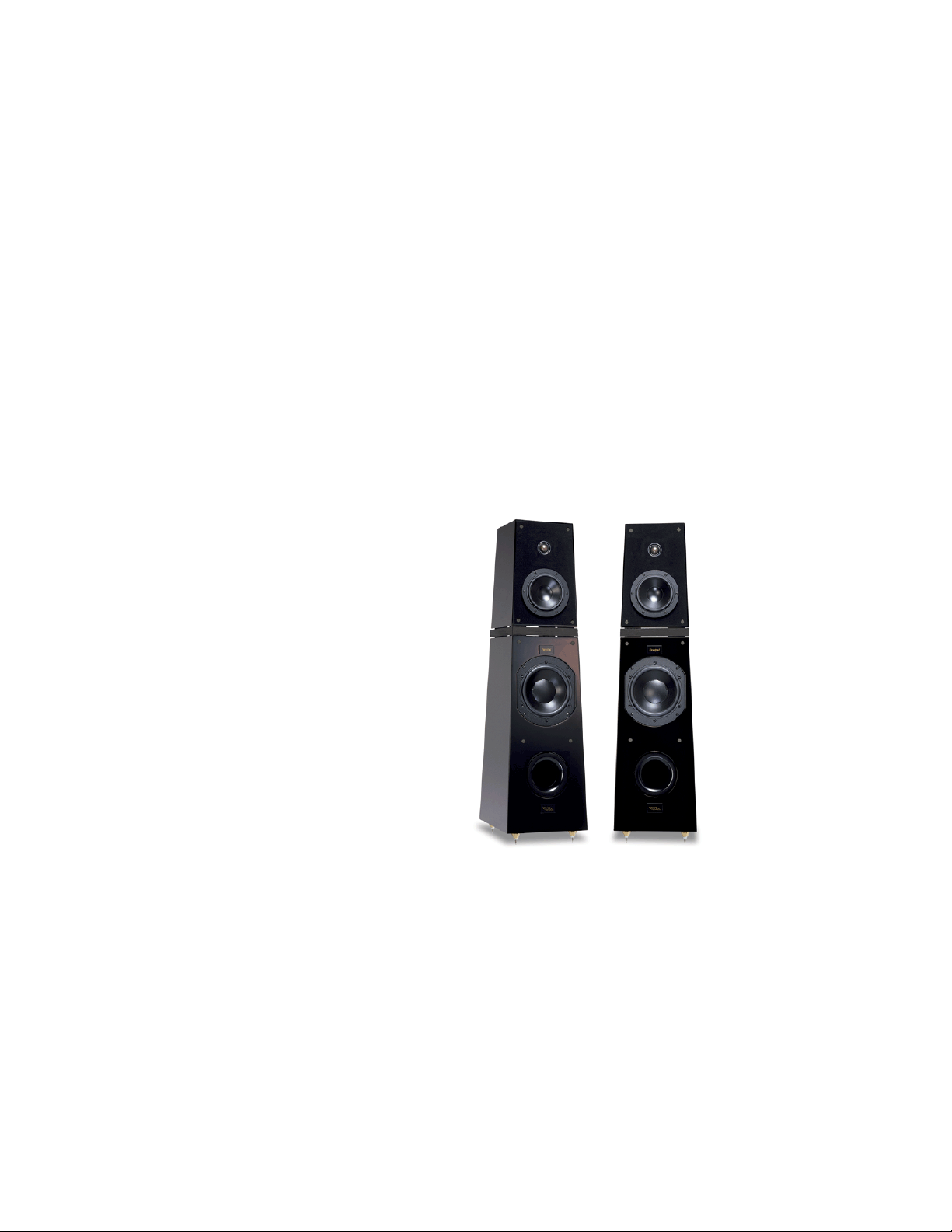
PARSIFAL OVATION OWNER’S MANUAL
R.1.0 April 2005
VERITY AUDIO PAGE 8
A flutter echo is a rapid (usually regular) succession of
reflected pulses resulting from a single pulse. They can be
easily identified by clapping your hands while walking in the
room. They are frequently located at the ceiling corners or at
the center of the ceiling-wall intersections. If flutter echos are
prominent, please consult your dealer to get proper assistance.
The reverberation in the room is the resulting tendency for
sound level in the room to persist after direct sound ceases.
The optimum reverberation time for a room depends upon
room volume, sound frequency, and the type of sound or
reproduced music. The Parsifal performs at its best in lively
listening rooms. Overly damped room will be detrimental to
the Parsifal performance. Optimum reverberation time (at 500
to 1,000 Hz) should be between 0.4 and 0.6 second.
Standing waves are reflections from opposing parallel surfaces
resulting in serious peaks in the reverberation-time / frequency
curve. In properly proportioned rooms, resonances can be
effectively reduced and standing waves practically eliminated
by introducing numerous sound treatment devices. The object
is to prevent sound reflection back to the point of origin until
after several reflections and/or after being considerably
attenuated. Once again if you feel having a standing wave
problem in your room, please consult your dealer to get proper
assistance.
Early reflections are the first sound reflections heard at the
listening position. They are usually intense and annoying. In
order of importance, they usually come from the floor, the side
walls and the ceiling. They can either be controlled by placing
diffusors or absorbers at their image location. Your dealer can
be of good assistance in properly helping you with this matter.
In an already well damped room, we recommend utilization of
diffusion instead of damping.
If you choose to work with a specialized room treatment
device, the included manufacturer’s instructions should be
followed.
Your new Parsifal Ovation is an extremely precise instrument
that can clearly reveal the qualities of your upstream
equipment. Your Parsifal performance will be closely related
to the excellence of its associated equipment. Subsequently, it
would be wise to invest in high-quality, ancillary equipment as
your enjoyment will be consequently rewarded.
The Parsifal shows an easy impedance load for most power
amplifiers. It has been evaluated with a wide variety of power
amplifiers and showed consistent results with quality solid state
and vacuum tube equipment. Superb performance can be
realized from either design.
The uniquely designed and manufactured binding-posts on the
Verity Audio Parsifal accept banana plugs, spade connectors or
bare wires. For best results, we recommend the use of spade
connectors.
When choosing speaker cables, experimentation is the best
way to find which ones will be the most satisfying in your
installation. Your Verity Audio Dealer can be of assistance in
making recommendations.
Power Handling
The Parsifal offers an outstanding power handling capacity and
yields astonishing dynamics.
The power tolerance of a loudspeaker is correlated to its
maximum voice-coil heat dissipation and to its maximum cone
displacement. These parameters are in turn stimulated by the
time, amplitude and spectral characteristics of the applied
musical energy. At low-frequencies, the maximum cone
displacement is normally reached before maximum voice-coil
temperature.
With the Parsifal transducers, because of their superior
ventilation system, the voice-coils will most likely never reach
critical temperatures. But, low-frequencies played at high levels
can ask for larger cone displacement than allowed by the
driver suspension. A driver reaching its maximum
displacement will not break unless this situation is maintained
for an inordinate period of time. Before a driver reaches its
maximum displacement, its distortion level will increase
greatly and will become audible. So when a speaker starts
sounding bright and hard or if any “cracking noise” can be
heard, just lower the level until it sounds comfortable again.
The Parsifal has to be played unexpectedly loud before any
occurrence of compression or distortion.
Cabinet Resonance
Cabinet resonances are controlled in a very special way. Their
amplitudes are lowered and their frequencies are increased.
Because higher frequencies are more directional, it will be
most unlikely that they get the chance to reach the listening
point. Of course, the listening room has to be properly treated.
Also, traveling high-frequency sonic waves attenuate faster than
their low frequency counterpart. A unique cabinet bracing
arrangement can break a wall resonance into multiple higher
frequency resonances that are not harmonically related. By
doing so, their amplitudes are greatly reduced. The cabinet
construction tolerances are so tight that only computer-
controlled tooling can cut panels with acceptable accuracy.
The cabinet rigidity lowers even more any chances of
coloration caused by unwanted vibrations. Special materials
are used to ensure stability of the cabinet in any acoustical
environment.