DESCO EUROPE - 2A DUNHAMS LANE, LETCHWORTH, HERTFORDSHIRE, SG6 1BE, UK
TB-7588 Page 3 of 7 © 2017 DESCO INDUSTRIES, INC.
Employee Owned
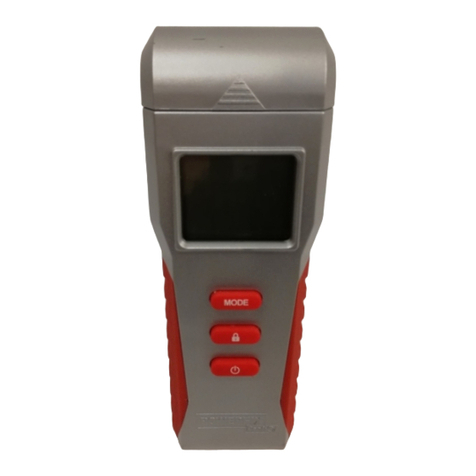
A. Test Jacks: The shielded test leads connect here. The
black test lead’s 3.5mm plug connects into the stereo jack,
and the white test lead’s banana plug connects into the
banana jack.
B. Liquid Crystal Display: Temperature, Relative Humidity
and Resistance Mantissa values appear on this display.
When the test button is depressed and the meter is set to
FULL test mode, the following information will display in
sequence:
• Temperature in degrees Fahrenheit (±10%)
• Temperature in degrees Celsius (±10%)
• Relative Humidity as a percentage (±10 integers)
• Surface Resistance Mantissa (with exponent displayed
via LED, measurement in ohms)
Surface resistance ohm values are expressed with a
mantissa and exponent (power) of the number. For example,
if the #8 exponent LED illuminates and the meter displays
“7.14”, the measurement is 7.14 x 10⁸ohms or 714,000,000
ohms.
If the measured surface resistance is over 1012 ohms, “1___”
will appear on the liquid crystal display.
C. Exponent Light Emitting Diodes (LED): These LEDs
indicate the surface resistance exponent value. They are
colour coded for quick checks.
Exponent Colour
<3, 3 Red
4, 5 Green
6, 7, 8 Blue
9, 10 Green
11, 12, >12 Yellow
Quick Checks
The surface resistance exponent number illuminates
immediately (i.e. 8 = 1 x 10⁸ohms to less than 1 x 10⁹ohms
or 100,000,000 to less than 1,000,000,000 ohms).
D. Function LEDs: These LEDs indicate the measurement
type displayed. The surface resistance mantissa is displayed
when either the “10V” or “100V” LED is illuminated.
The Function LEDs will flash when the battery voltage drops
to approximately 2 volts. Replace the batteries when this
occurs.
E. Test Voltage Button: When set to AUTO, the meter will
automatically switch to the appropriate test voltage for the
measured resistance range. The Function LEDs will indicate
the applied test voltage. Material that is 9 x 10⁵ohms or
less should be measured at 10 volts. Material that is 1 x
106ohms or greater should be tested at 100 volts. (Ref: IEC
61340-2-3) When the switch is set to 10V HOLD, the test
voltage will be fixed at 10 volts regardless of the measured
resistance value.
F. Quick Check Button: When set to FULL, the meter will
cycle through the approximate 15 second electrification
period that displays the temperature and relative humidity
before the surface resistance mantissa is displayed. When
set to QUICK, the meter will skip the 15 second period
and immediately display the measured surface resistance
mantissa.
G. Test Button: Push and hold this red button to make a
measurement with the meter. Testing in accordance with
IEC 61340-2-3 requires 15 seconds of electrification. These
15 seconds are included when the meter is set to FULL test
mode. The surface resistance mantissa will display on the
meter after temperature and relative humidity measurements
are displayed.
The surface resistance exponent number illuminates
immediately, and the meter first displays the temperature
and relative humidity during a 15 second electrification
period. The mantissa is then displayed at the end of the test
sequence. For example, if the #8 exponent LED illuminates
and the meter displays “7.14”, the measurement is 7.14 x 10⁸
ohms or 714,000,000 ohms.
H. Battery Compartment: Open this compartment to install
the two AA alkaline batteries needed to power the meter.
Replace the batteries once the Function LEDs begin flash.
Operation
Per IEC User Guide Testing of Installed ESD Control
Items
“Once the ESD ground reference has been verified it is
important to ensure that each of the ESD control items used
is connected to the ground reference. First ensure that each
ESD control item is connected to the ground reference. Next,
using the test method or standard and limits for each ESD
control item given in Tables 2 and 3 of IEC 61340-5-1,verify
that the resistance to ground (or to the common connection
point) meets the required limit”. (CLC/TR 61340-5-2 User
guide Grounding/bonding systems clause 4.4.5 Verification of
proper installation of ESD control items)
General Guidelines
• Use both 2 kg electrodes for Rp-p measurements.
• Use one 2 kg electrode and connect the black sensing
test lead to ground for Rg measurements.
• Ensure that the item being measured is electrically
isolated (placed on an insulative surface). The meter will
measure the lowest resistance path.
• Ensure that the test leads are separated and uncrossed
as a best practice.
• When using 2 kg electrodes:
• Place them no closer than 5 cm from the edge of
the surface being measured
• Place them no closer than 8 cm to any groundable
point
• Place them about 25 cm apart from each other for
Rp-p measurements of a worksurface
• Place them about 1 m apart from each other for
Rp-p measurement of a floor