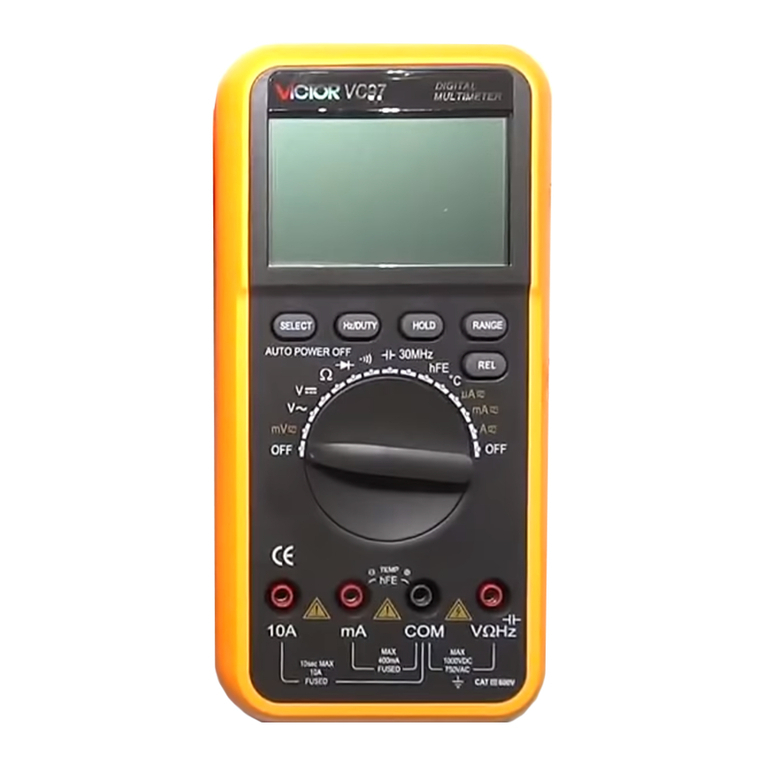
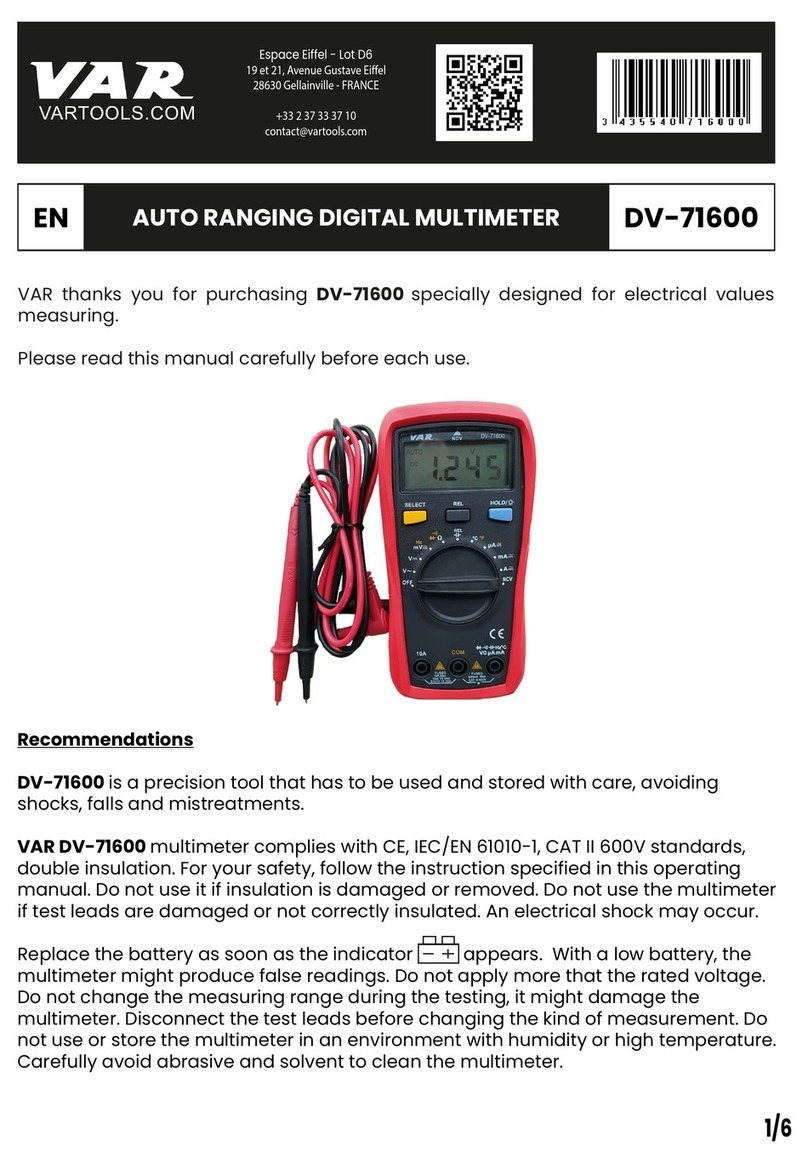
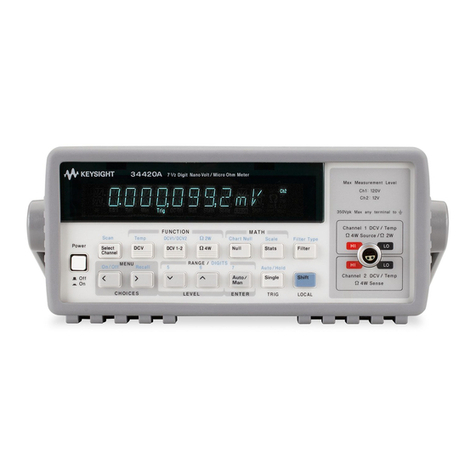
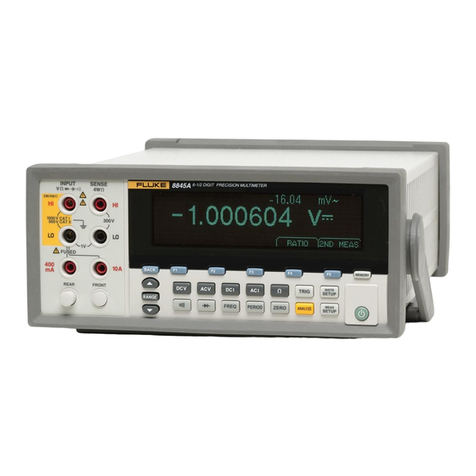
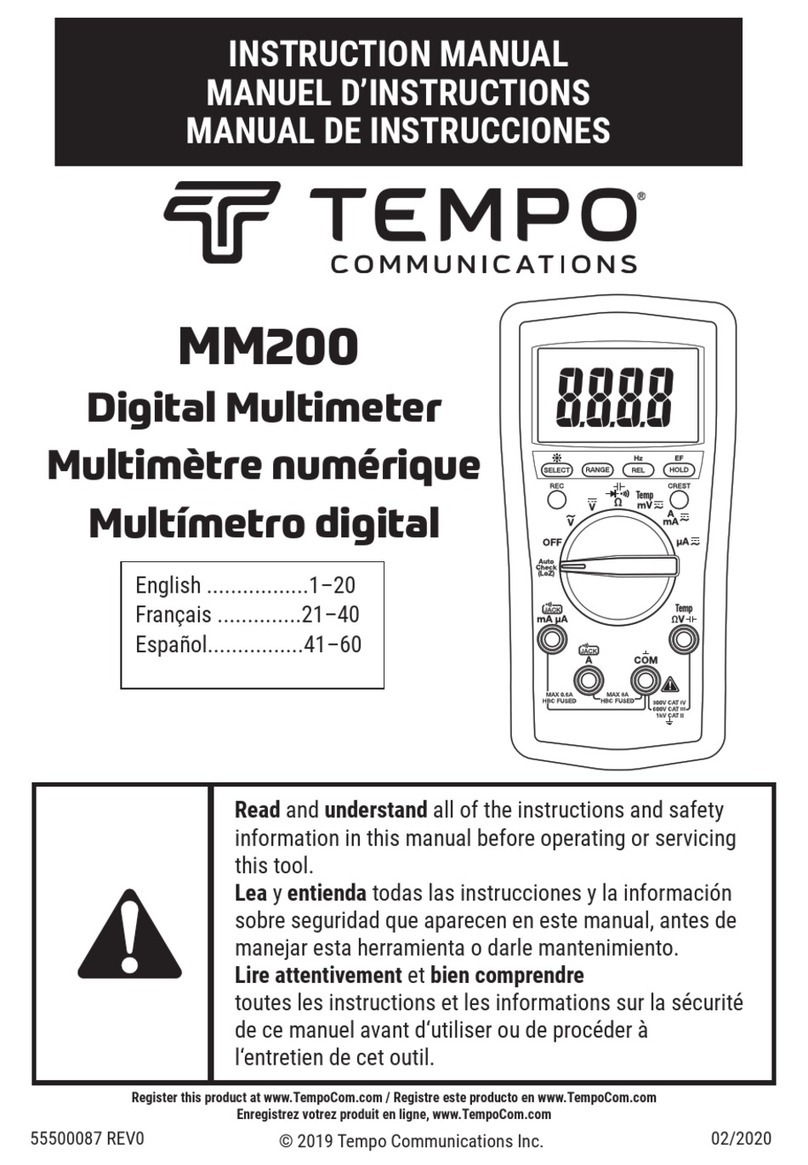
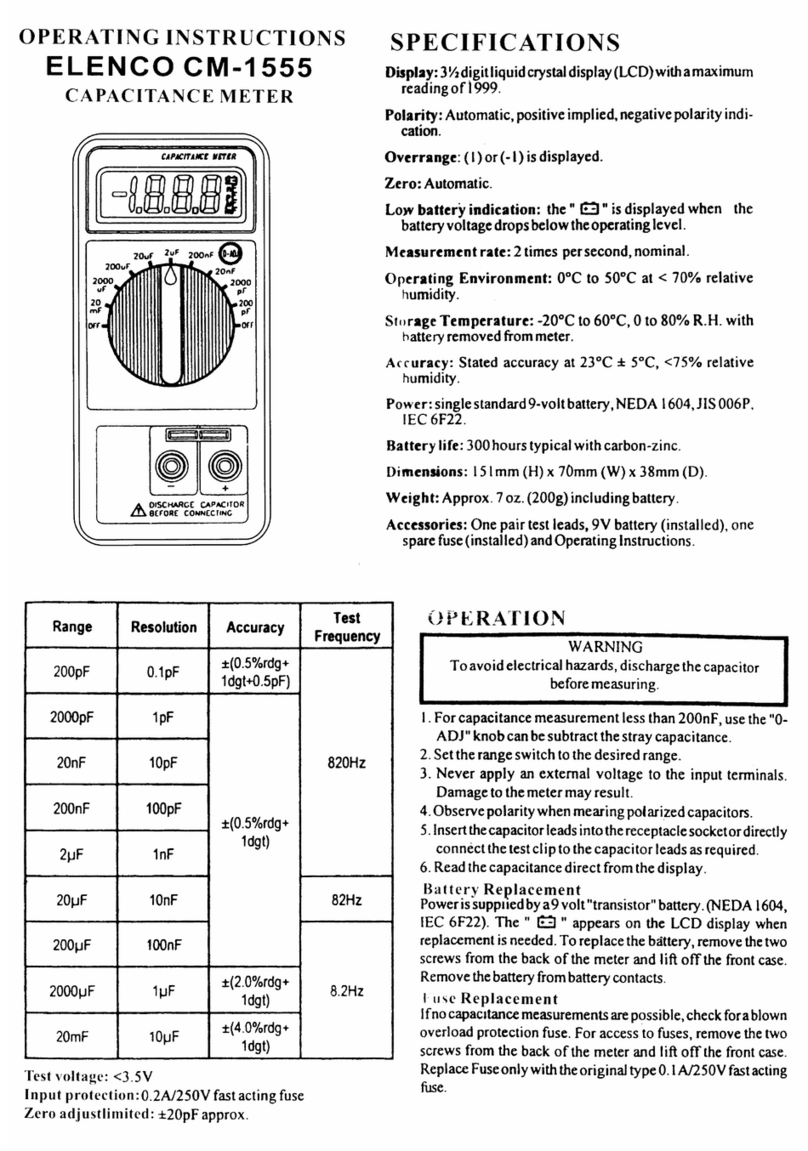
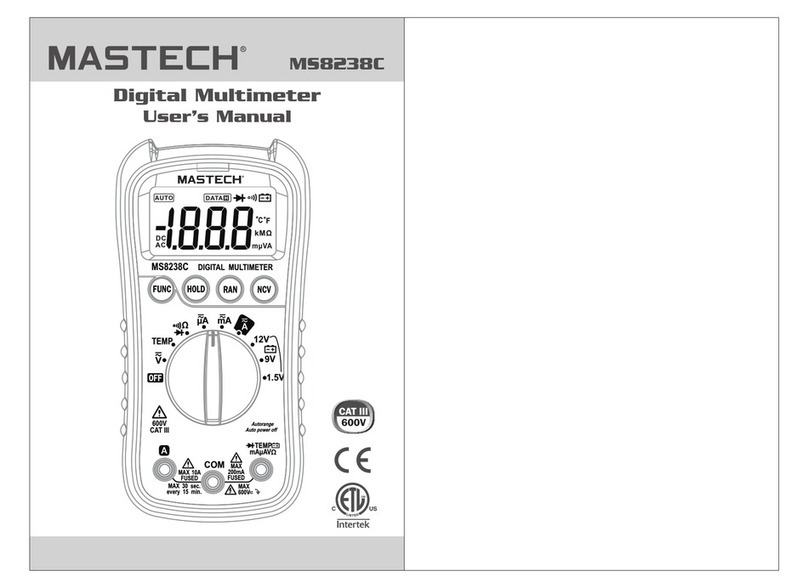
1.Insert the black test lead to “COM” terminal and the red one to “mA” terminal (the Max.
600mA) or to “20A”(the Max.20A);
2. Select the knob to a proper ACA range, press “DC/AC” key to select the measurement
mode ,and connect the leads crossly to the electric circuit under test. LCD displays current by
the test lead.
Note:
1 Firstly users should select the knob to the highest range, if users had no idea about the range
of current under test, and then select the proper range based on displaying value .
2.If the LCD displays “OL”,it means the current is over range. Now you need to select the
knob to the higher.
3.Max. input current is 600mAor 20A(subject to where the red test lead insert to), too large
current will damage the fuse.
4-6.Resistance measurement
1. Select the knob to a proper resistance range, and connect the leads crossly with the resistor
under tested.
2.insert the black lest lead to “COM” terminal and the red one to “V/Ω/Hz” terminal.;
3.Auto range is the original states ,press “RANGE”key change to manual range mode.
4.When measuring the min. resistance ,please short-circuit the test leads at first, press
“REL” ,then test the resistance ,it will display the actual resistance.
Note:
1 Firstly users should select the knob to the highest range, if users had no idea about the range
of resistance under test, and then select the proper range based on displaying value .
1. The LCD displays “OL” when the resistance is over the selected range. The knob should be
adjusted to a higher range. When measuring value is over 1MΩ, the reading will take a few
seconds to be stable. It’s normal for high resistance measuring.
2. When input terminal is in open circuit, overload displays “OL”.
3. When measuring in line resistor, be sure that the power is off and all capacitors are released
completely.
4. Do not input any voltage at resistance range even the meter has voltage protection functions
at this range!
4-7.Capacitance measurement
1.select knob to “ ”range;
2. insert the black lest lead to “COM” terminal and the red one to “V/Ω/Hz” terminal.;
3.if the LCD doesn’t display “0”, press “REL” to clear the reading;
4.Select the knob to proper capacitance range, and insert the measuring accessories or test leads
into “COM” and “VΩHz”” terminal.(Note :the red test leads is for positive pole ○
+).LCD
displays capacitance value.
Note:
1. Don’t input voltage or current to the “VΩHz”terminal when measuring the capacitance
or the capacitance isn’t away from the “Cx” terminal.
2. In order to assure the accuracy, please press “REL” to clear the reading before testing.
3. There is only the auto range mode under the capacitance range.
4. The capacitance must be complete discharge before testing.
5. The reading of 400uF range delay 15 seconds
4-8.Frequency measurement
1. Insert the black lest lead to “COM” terminal and the red one to “V/Ω/Hz” terminal.;
2.select the knob to“Hz”range,insert the test leads or shielded cable to the signal source or the
load which is tested.
3.Press“Hz/DUTY” key to switch frequency/duty cycle,it will display the frequency or duty
cycle of the signal source which is tested.
Note:
1. There is only the auto range mode under the frequency range;
2. The meter can still work if the input is higher than 10Vrms, but the accuracy is not
guaranteed;
3. In noise environment, you'd better use shield cable to measure a low signal;
4. When measuring high voltage circuit, any parts of your body should not touch the high
voltage circuit;
5. Don’t input voltage higher than 250V DC or AC peak value, or it may damage the meter.
4-9.Transistor hFE measuring
1.Select the knob to hFE range;
2.Define the transistor is NPN or PNP type, insert the emitter, base and collector separately to
the correct hole, the approx. value will be displayed on LCD.
4-10. Diode and Continuity performance test:
1. Insert the black test lead to “COM” terminal and the red one to “V/Ω/Hz” terminal (the
polarity of red lead is “+”)
2.Select the knob to range ,press “DC/AC” key to select the measurement mode,
connect test leads with the diode under tested,
3.Forwarder measuring :insert the red test leads connect to diode positive polarity, the black
test leads to diode cathode polarity, the reading is the approx. value of diode forward volt drop.
4.backward measuring: the red test connect to diode cathode polarity, the black test leads to
diode positive polarity ,the LCD display “OL”;
5.The complete diode testing include forward and backward measurement, if the result isn’t
meet the above, it means the diode is bad.
5. press “DC/AC” key to select the Continuity measurement mode.
6.Insert test leads to two points of tested circuit, if the inner buzzer sounds, the resistance is less
than (50±10)Ω.
Note:
1.Don’t input voltage at “ ” range.
2.Make sure be power off and discharge the capacitor,any AC signal
will make the buzzer sounds.
4-11.Temperature measurement
1.Select the knob to“℃/ ℉”range.
2.Insert the cold point of thermocouple to“K Temp”socket ,put the working end
(temperature measurement end) of thermocouple on the surface or inside the object to be tested.
Then you can read temperature from the screen, and the data is in Centigrade .press
“DC/AC”key to select Fahrenheit, the data is in Fahrenheit.
Note:
1.If insert the thermocouple opposited , it will display the mistake value ,when the temperature
is rising, the value will be down.
2.when the input terminal open-circuit ,it will display the normal temperature.
3.Don’t change the temperature probe optionally ,or the value accuracy isn’t guarantee.
4.Don’t input voltage at temperature range.
4-12.Data holding
Press HOLD key,presently measured value is held on LCD and HOLD symbol displays. press