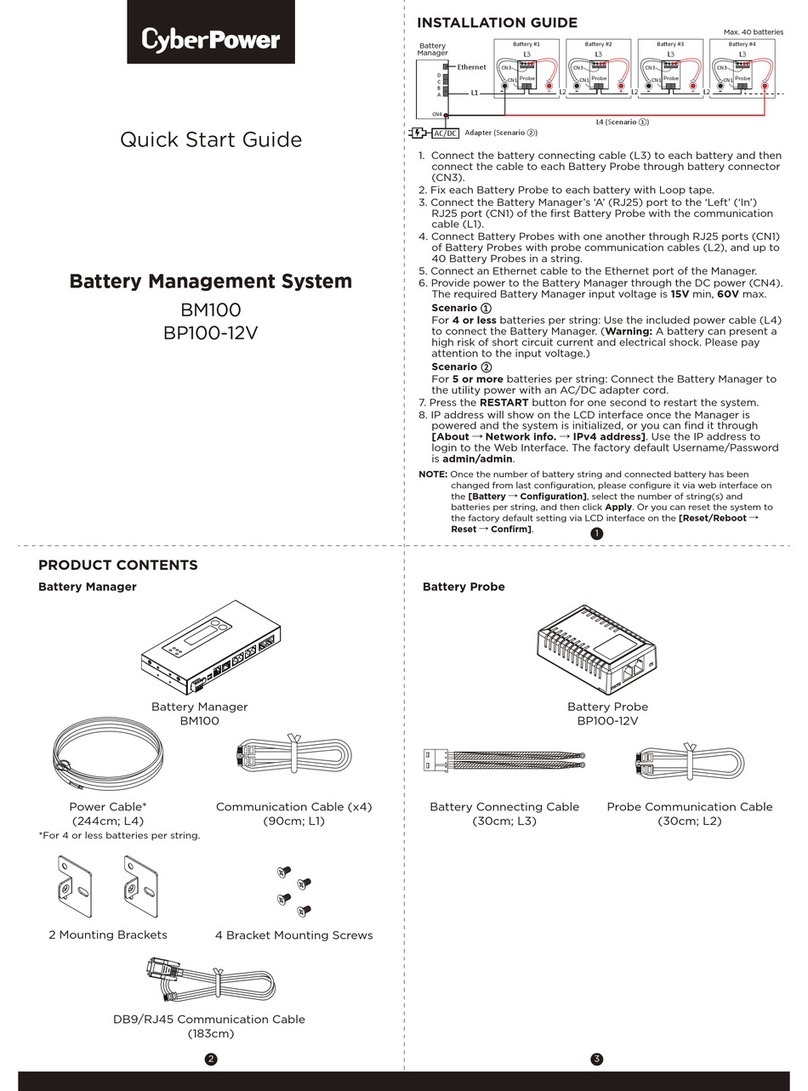
1
2
a
b
c
3
9
OUT
IN
5
6
7
4
ACC
Anzeigen und Parametrisieren über das Display
Setting the parameters using the display
A = mit diesem Befehl (linke Taste) kommen Sie zum nächs t en Menüpunk t
A = pressing t he le f t button means mov e to nex t menu point
Allgemeine Funktionen
Allgemein: Nur wenn die Tasten-Symbole AB im LC-
Display aufleuchten, ist die jeweilige Taste auch aktiv.
Standardanzeige: Betätigt man für 30 Sekunden
keine Taste, schaltet das Modul automatisch zur
Standard-Anzeige zurück.
Reset: Betätigt man für 5 Sekunden beide Tasten
gleichzeitig, erfolgt ein Reset aller parametrisierbaren
Parameter auf die Werkseinstellung. Dabei werden
alle gespeicherten Min/Max-Werte sowie der
letzte Fehler zurückgesetzt.
Zeitlimit: Wenn zwischen den Eingaben (auch
während des Parametrisierens) länger als 30
Sekunden keine Taste betätigt wird, werden alle
gemachten Eingaben zurückgesetzt und es erfolgt ein
automatischer Wechsel zur Standardanzeige.
Update: Falls Parameter über den PC verändert
werden, entsprechen diese neuen Parameter
automatisch der Reset-Konfiguration. Die
Werkseinstellung wird überschrieben.
1 Standardanzeige
Zeigt die aktuelle Eingangsspannung, die Ausgangs-
spannung und den Ausgangsstrom an. Zusätzlich
wird in der 2. Ze ile von oben der aktuelle Ladezu-
stand (im Normalbetrieb) bzw. die Restlaufzeit (im
Pufferbetrieb) angezeigt.
2 Ladespannung und -strom
Zeigt die aktuelle Ladespannung und den Ladestrom
an.
3 Minimal- und Maximalwerte
Die minimal gemessene Eingangsspannung und
der ma ximal gemessene Ausgangsstrom werden
angezeigt.
4 Temperaturgeführtes Akkuma-
nagement
In Abhängigkeit der Temperatur im Akkumodul
werden die optimalen Ladeparameter automatisch
eingestellt. Es ist ebenfalls möglich, eine konstante
Ladeerhaltungsspannung zu konfigurieren ( Phase 3
gemäß Ladekennlinie)
B = zum Deaktivieren des temperaturabhängigen
Akkumanagements
A = temperaturabhängiges Akkumanagement (de)
aktivieren (ON/OFF)
B = konstante Ladeerhaltungsspannung einstellen
(26 bis 29,5 Vdc)
B = Änderung speichern
5 Pufferzeit
Die Pufferzeit kann eingestellt werden.
B = zum Ändern der Pufferzeit
A = Pufferzeit ändern
(10 Sek. bis 10 Min. / dauerhaft)
B = Pufferzeit speichern
6 Erkennung der Akkumodule
Ak kumodul e mit „Bat t ery Contr ol“ w erd en automa-
tisch erkannt und der Kapazität swer t wir d ange-
zeigt. Wird anstelle des Kapazitätswertes für das
verwendete Akkumodul „---“ angezeigt, so konnte
kein Akkumodul erkannt werden. In diesem Fall wird
der maximale Ladestrom zur Verfügung gestellt
und die Ladung erfolgt mit konstanter Ladeerhal-
tungsspannung ( Phase 3 gemäß Ladekennlinie)
B = zum Deak tivieren der automa tis chen Er ken-
nung von verwendeten Akkumodulen
A = Erkennung (de)aktivieren (ON/OFF)
B = Änderung speichern
7 Betriebsstunden des
Akkumoduls
Die Betriebsstunden des verwendeten Akkumoduls
können abgelesen werden und auf Null zurückge-
setzt werden.
B = zum Zurücksetzen der Betriebsstunden
8 Fehlermanager
Anhand des Fehlercodes (siehe auch Aufkleber am
Gehäuse) kann anhand der blinkenden Segmente
eine Fehleranalyse vorgenommen werden.
Der letzte Fehler wird fest gespeichert, so dass
auch noch nach einem Neustart des Moduls eine
Fehlerursache detektiert werden kann.
B = letzten Fehler anzeigen
General functions
General: The buttons AB are only active when
the appropriate symbol in the display is alight.
Standard display: If no button is operated for 30
seconds the unit will return to the standard display
mode.
Reset: If both buttons are pressed simultaneously
for 5 seconds then all parameters settings will return
to the factory set condition. This means all saved
min/max. values and the last fault condition will
be reset.
Time limit: If between the input programming (also
parameter settings) a time interval of over 30
seconds has lapsed without pressing any button, then
all entries will be reset, and the display will return to
the standard display mode.
Update: If the parameters have been changed using a
PC then these settings will automatically be the reset
parameters. The factory settings will be lost.
1 Standard display
Shows the actual input voltage, output voltage and
output current.
Additional information on 2. row: Charge status
(normal operation) and remaining time of the
batteries (buffer operation).
2 Charging voltage and current
Shows the actual charging voltage and current.
3 Minimum and maximum values
The min. input voltage and the max. output current
are displayed.
4 Temperature tracked battery
management
The device regulates the optimal charge-voltage for
the battery module automatically. It is also possible
to adjust a fixed charge-voltage. (Only phase 3 will
be used for charging)
B = to change the temperature tracked battery
management
A = to (de)activate temperature tracked battery
management (ON/OFF)
B = to adjust a fixed charge-voltage
(26 to 29.5Vdc )
B = save changes
5 Puffer time setting
The time for puffer operat ion c an b e adjusted .
B = to adjust time for puffer operation
A = adjust puffer time setting
(10 seconds to 10 minutes / constant)
B = save puffer operat ion
6 Detection of battery module
Battery modules with „Battery Control“ will detect
automatically. The rated capacity will showed.
When displayed „---“instead of the capacity value,
no battery module was detected.
At this setting the maximal load current will be
supplied . The batter y will be c harged with a con-
stant charging voltage (Phase 3 according to the
loading chart)
B = to change the automatic detection
A = to (de)activate t he de t ecti on (ON/OFF )
B = save changes
7 Operational hours of the battery
module
The operational hours for the accumulators inside
of t he ba t t ery module can be displayed and reset .
B = to re set t he operational hour s and set i t to „0“
8 Fault manager
A fault analysis can be made according to the
blinking segments of the display (see ratings plate
on housing).
The last fault symptom will be automatically saved,
so that even after a new start of the module a fault
analysis can be made.
B = show last faul t condi tion.
1
2
3
LED: Die grüne L ED (a) leucht et, wenn kein Feh-
ler vorliegt. Die gelbe LED (b) zeigt Warnungen
an. Die gelbe LED (b) blinkt bei Pufferbetrieb
im 0,4 Sek.-Takt. Die gelbe LED (b) blinkt bei
geringer Akkuspannung im Pufferbetrieb im 0,2
Sek.-Takt. Die rote LED (c) zeigt Fehler an. Nach
Rücksetzen der Lebensdauer angeschlossener
Akkumodule der Baureihe 787-87x leuchten alle
LED für 5 Sekunden auf.
Display der Kontrolleinheit: Das Parametri-
sieren über das Display wird rückseitig erklärt.
Tasten: Linke Taste = vorwärts im Menü, rechte
Taste = Paramet risie ren.
ACC: Akku-Anschluss
Signale: siehe Anschlussplan rückseitig
Eingang: IN
Ausgang: OUT
Montage: Set zen Sie das Modul mit der Trag -
schienenf ührung an die Oberkante der Trag-
schiene an und rast en Sie es nac h unt en ein.
Demontage: Ziehen Sie den Schnappriegel
mit Hilfe eines Schraubendrehers auf und
hängen Sie das Modul an der Unterkante der
Tragschiene aus.
Schnittstelle und Signalausgänge: Die
Schutzkappe ist zur Vermeidung statischer
Entladungen nur unter Anwendung von ESD-
Schutzmaßnahmen abzunehmen. 1 Inaktiv bei
Pufferbetrieb, 2 Inaktiv, wenn kein Akkubetrieb
möglich oder Akkutausch empfohlen,
3 inaktiv bei Abschaltung durch Überstrom,
12 Frei belegbare Ausgänge, konfigurierbar
per PC mit Software, 1 Verknüpfung mit
potenzialfreiem Wechselkontakt, 568 Kom-
munikationsein- und Ausgänge,
7 Eingangsspannung des Moduls.
Die Schnittstelle ist nicht galvanisch getrennt.
Ein geeignetes Adapterkabel (787-890) können
Sie optional über WAGO beziehen. Die optionale
Konfigurations- und Visualisierungssoftware
(759-870) können Sie kostenlos unter
www.wago.com/epsitron herunterladen. Bei
Anschluss eines Relais an einen Signalausgang
muss zwingend eine Freilaufdiode vorhanden
sein.
8
4
5
6
7
1
2
3
LED: T he green LED ( a) ligh t s for normal ope -
ration. The yellow LED (b) shows a warning. The
yellow LED (b) blinks in 0,4 sec. cycle, indicating
puffer operation. The yellow LED (b) blinks when
the battery voltage is low in puffer operation at
0,2 sec. cycle. The red LED (c) indicates a fault
condition. Af t er resetting t he li fetime of c on-
nected battery modules from series 787-87x all
LED ligh t up f or 5 se conds .
The control unit display: The parameter
adjustments are described on the back of this
leaflet.
Buttons: Left button = forwards in the menu,
righ t but t on = to alter p arameter settings.
ACC: accumulator terminals
Signals: see connection plan on the reverse
side
Input: IN
Output: OUT
Mounting: Place the module with the DIN rail
guide on the upper edge of the DIN rail, and snap
it in with a
downward motion.
Removing: Pull the snap lever open with the aid
of a screwdriver and slide the module out at the
lower edge of the DIN rail.
Interface and signal por ts: The protective
cap is to reduce the risk of static discharge and
should only be removed with the use of ESD
protective measures 1 Inactive during puffer
operation, 2 inac tive, if bu f fer mode not pos-
sible or accu change recommended, 3 Inactive
if overload protection has operated, 12 free
output connections that can be configured per
PC with software, 1 link to a potential free
switch , 568 communication in and output,
7 output voltage.
The interface has no galvanic separation and
should be only conn ected with a suitable adap-
ter cable (787-890) that are optionally available
from WAGO. The optionally software required
for configuration and visualization (759-870)
can be downloaded free of charge from
www.wago.com/epsitron. If a relay is to be con-
nected to a signal output then it is imperative
that a fr ee running diode be used.
8
9
9
4
5
7
DIN 35 mm
rail
Anschluss
Connection
T Um Verwechslungen mit anderen
Anschlüssen zu vermeiden, verwenden Sie
ausschließlich die mitgelieferten Stecker.
T To reduce the risk of mistaking the
terminals, the supplied terminals must
be used.
12345678 Pin 2 = RxPC
Pin 3 = TxP C
Pin 5 = GND
RxPC TxPC
T
9Uin
Uin
S1 S2 S3
S1: of fen, w enn Modul im Pu f ferbetr ie b
S2: offen, wenn kein Pufferbetrieb möglich oder Akkutausch empfohlen
S3: of fen, wenn Ausgang au fgrund von Überstr om abgeschalt et hat
S1: op en , if the module is in b uffer mode
S2: open , if buf fer mo de not possible or accu change is r ecomme nded
S3: open, if th e output has been s wi t ched of f due to over-current
1
25,4Ui [V]
24,6Uo [V]
8,03Io [A]
BAT
25,7Uo [V]
0,43Io [A]
3
23,1Ui [V]
U.Lo
I.Hi
10,4Io [A]
120
bu.T
999
bu.T
STO
4
U.AC
SET STO
26.6
TEP
0n
TEP
OFF
6
AUT
BAT
On
3.2
OP.T
BAT
AUT
BAT
Off
SET
OP.T
BAT
STO 8
!!!
Err
$!!
Err
!!
I