Couverture d’hivernage
gonflabl
e
Aufblasbare Winterabdeckung
Inflatable winter cover
5. Gonflage de la couverture
Dévisser le bouchon de la valve. Connecter le gonfleur à la valve
à l’aide du tuyau et de l’embout de gonflage, puis procéder au
gonflage. Une fois gonflée, la couverture doit rester souple et
doit pouvoir s’enfoncer à la pression d’une main. Revisser le
bouchon de la valve. Un sur-gonflage pourrait endommager
les soudures de la couverture.
Important : Rester à proximité de la couverture pendant la
phase de gonflage pour éviter tout sur-gonflage ou autre
incident risquant de l’endommager.
6. Démontage de la couverture
Sortir simplement les cabiclics ou des ressorts des pitons,
puis les démonter de la couverture. Nettoyer la couverture à
l’aide d’un produit de nettoyage pour toile PVC, la laisser
sécher, la plier et la stocker dans un endroit sec, sipossible à
l’abri de la lumière. Important : Toujours garder la vue sur
le bassin pendant le montage et le démontage de la
couverture. Ces manœuvres doivent être effectuées par deux
adultes responsables après contrôle du bassin, dans lequel
ne doit se trouver aucun baigneur ou corps étranger.
7. Notice d’entretien
Le nettoyage de la couverture doit être effectué par vos soins
au minimum une fois par an (de préférence après l’hivernage
au moment du démontage de la couverture et de la mise en
route du bassin), à l’aide d’un produit de nettoyage spécifique
pour toile PVC. Le nettoyage courant s’effectue par simple
nettoyage au jet. Dans tous les cas, éviter les produits agressifs,
moussants ou solvants, ainsi que les éponges abrasives.
8. Notice de maintenance
L’ensemble de la couverture, y compris les fixations, doit être
inspecté tous les 3 mois. Une vérification supplémentaire est
nécessaire si la couverture a du être utilisée dans sa fonction
sécuritaire ou après une période où celle-ci a pu être sollicitée
dans des conditions extrêmes (vent fort, tempête, importante
chute de neige...). Suite à ces différentes vérifications, il
est impératif de remplacer tout élément présentant une
détérioration ou une usure quelconque. En cas de doute,
veuillez vous adresser à votre installateur piscinier.
Nota : Toutes les pièces détachées de remplacement doivent
être de provenance WALTER afin que votre couverture respecte
son cahier des charges initial, sa garantie et sa conformité à
la Norme. Prendre toutes les mesures afin d’empêcher l’accès
du bassin aux jeunes enfants et ce, jusqu’à la réparation de
la couverture ou lors d’un constat de dysfonctionnement
empêchant la fermeture et la sécurisation du bassin. Le service
après-vente est assuré en priorité par votre revendeur. Pour
tout autre renseignement notre SAV est à votre disposition au
numéro de téléphone suivant 03 90 29 51 17.
9. Spécifications particulières en période hivernale
WALU STAR AIR / WALU SAND AIR vous donnera toute
satisfaction en utilisation hivernale sous couvert du respect
des quelques règles énoncées ci-après :
- Le niveau d’eau dans le bassin étant impérativement
toujours à hauteur d’utilisation (2/3 haut des skimmers),
veiller à que les pièces à sceller et tuyauteries ne gèlent
pas ; pour ce faire, il est conseillé d’utiliser les gizzmos
et bouchons appropriés, ainsi qu’une ligne de flotteurs
d’hivernage en bout de bassin, sur une largeur, pour
éviter toute détérioration du bassin. Demander conseil
auprès de votre installateur piscinier.
- Au-dessus de 10 cm de neige, déneiger la couverture.
- Au cours de l’hiver, selon les conditions climatiques, il
peut être nécessaire de regonfler la couverture.
5. Aufblasen der Abdeckung
Ventildeckel abschrauben, Aufblasesystem mittels Rohr und
Aufblas Adapter auf dem Ventil anschließen, und mit Luft
befüllen. Einmal aufgeblasen, sollte die Abdeckung weich und
nachgiebig sein. Ventildeckel wieder anschrauben. Ein
Überdruck könnte die Schweißnähte der Abdeckung
beschädigen.
Wichtig: Beim Aufblasverfahren ist das Becken stets im Auge zu
halten, um Überdruck in der Abdeckung oder irgendein anderen
Vorfall der die Abdeckung beschädigen könnte zu verhindern.
6. Demontage der Abdeckung
Cabiclic-Spannbänder mit doppelter Befestigung oder
Feder von den Edelstahlstiften abhängen und anschließend
von der Abdeckung demontieren. Abdeckung mit einem
Reiniger für PVC-Folie reinigen, trocknen lassen, falten und an
einem trockenen und möglichst lichtgeschützten Ort lagern.
Wichtig: Bei Montage und Demontage der Abdeckung ist das
Becken stets im Auge zu halten. Montage und Demontage der
Abdeckung sind nach Sichtprüfung des Beckens durch zwei
verantwortliche Erwachsene vorzunehmen, wobei sich weder
ein Schwimmer noch ein Fremdkörper vor oder während des
Vorgangs im Becken befinden darf.
7. Pflegeanleitung
Die Abdeckung ist mindestens einmal jährlich (vorzugsweise
nach der Überwinterung, bei Demontage der Abdeckung und
Inbetriebnahme des Pools) mit Hilfe eines spezifischen PVC
-
Folienreinigers zu reinigen. Die laufende Reinigung erfolgt
einfach durch Abspritzen mit dem Gartenschlauch. Ätzende,
schaumbildende und lösemittelhaltige Produkte sowi
e
scheuernde Schwämme sind auf jeden Fall zu vermeiden.
8. Wartungsanleitung
Die gesamte Abdeckung nebst Befestigungselementen
ist mindestens alle 3Monate zu inspizieren. Eine
zusätzliche Überprüfung ist geboten, wenn die Abdeckung
zu Sicherheitszwecken dient, oder nach extremen
Witterungseinflüssen (starker Wind, Sturm, starke Schneefäll
e
usw.). Im Rahmen dieser Überprüfungen sind beschädigt
e
Bestandteile oder solche mit Verschleißerscheinungen
unverzüglich auszutauschen. Im Zweifelsfalle wenden Sie sich
an Ihren Pool-Installateur.
Hinweis: Es sind ausschließlich original WALTER-Ersatzteile zu
verwenden, damit die Vorgaben des Abdeckungs-Lastenhefts
eingehalten werden und die Garantiebedingungen sowie die
Übereinstimmung mit der Norm gewährleistet sind. Sollt
e
sich ein Defekt herausstellen, der den Verschluss und die
Absicherung des Beckens verhindert, sind alle gebotenen
Vorkehrungen zu treffen, um Kleinkindern den Zugang zum
Becken bis zur Reparatur der Abdeckung zu verwehren. Der
Kundendienst wird in erster Linie durch Ihre Vertriebsfirma
wahrgenommen.
9. Besondere Spezifikationen in der Überwinterungsphase
WALU STAR AIR / WALU SAND AIR wird Ihnen bei der
Überwinterung hervorragende Dienste leisten, vorausgesetzt,
die wenigen nachstehenden Regeln werden eingehalten:
- Der Wasserspiegel im Pool hat stets die gewöhnliche
Nutzungshöhe zu betragen (2/3 Oberflächensaugerplatte).
Einbauteile und Rohrleitungen dürfen nicht einfrieren.
Dafür sind Gizzmos und geeignete Stopfen sowie eine
Leine mit Eisdruckpolstern an einer Breitseite des
Pools zu verwenden. Lassen Sie sich von Ihrem Pool
-
Installateur beraten.
- Ab 10 cm Schneefall ist der Schnee auf der Abdeckung zu
räumen.
- Während der Wintermonate, je nach den klimatischen
Verhältnissen, könnte ein gelegentlichen Nachfüllen der
Luft nötig sein.
5. Inflation of the cover
Unscrew the valve cap, connect the inflator to the valve using
the pipe and the nozzle, and proceed to inflation. Once
onflated, the cover should remain flexible and shall not provide
any resistance to hand pressure. Tighten the valve cap again.
Overinflating could damage the cover’s welded seams.
Important: Always keep an eye on the cover while inflating it in
order to prevent any overinflating or incident that could damage
it.
6. Dismantlement of the cover
Simply take the cabiclic cords or springs out of the pegs, then
remove them from the cover. Clean the cover with a cleaning
product specifically suitable for PVC sheet, let it dry, fold it and
store it in a dry and preferably dark place.
Important: Always keep an eye on the pool during the assembly/
disasembly of the cover. These actions should be carried out
by two responsible adults after checking that no swimmer or
foreign body is still in the pool before and during the operation.
7. Care instructions
You should clean the cover at least once a year (preferably
after winterising when dismantling the cover while the re-
commissioning of the pool), with a cleaning product specifically
suitable for PVC. Day-to-day cleaning can be made using a
simple water jet. Always avoid using harsh or foam products,
or those that contain solvents, as well as scouring pads.
8. Maintenance instructions
The whole cover as well as its fastening systems should be
inspected every three months. Additional checks are necessary
if the safety function of the cover has been called on, or after
a period of stress under extreme conditions (storm, heavy
snowfall...). After carrying out these various checks it is
essential to replace any items subject to damage. In case of
doubt, please contact your pool installer.
Advice: All spare parts must be made by WALTER so that
your cover complies with its initial specification, the validity
of its guarantee is retained and it remains compliant with the
standard. Take all measures necessary to prevent access to
the pool by young children until the cover has been repaired or
when checking faults that prevent closure and the pool being
made secure. After sales service is provided by the reseller in
the first instance.
9. Special winter specifications
WALU STAR AIR / WALU SAND AIR will prove completely
satisfactory for use over winter as long as you follow the few
rules listed below:
- As it is essential that the water level in the pool is always
at its operational height (2/3 the height of the skimmers),
you should take precautions to ensure that the embedded
parts and pipework do not freeze. In order to achieve
this, we recommend using the appropriate gadgets and
stoppers, as well as a line of winter floats to avoid any
damage to the pool. In case of doubt, please contact your
pool installer.
- When there is more than 10 cm of snow, remove it from
the cover.
- During winter, according to the climatic conditions, you
may need to reinflate the cover.
3
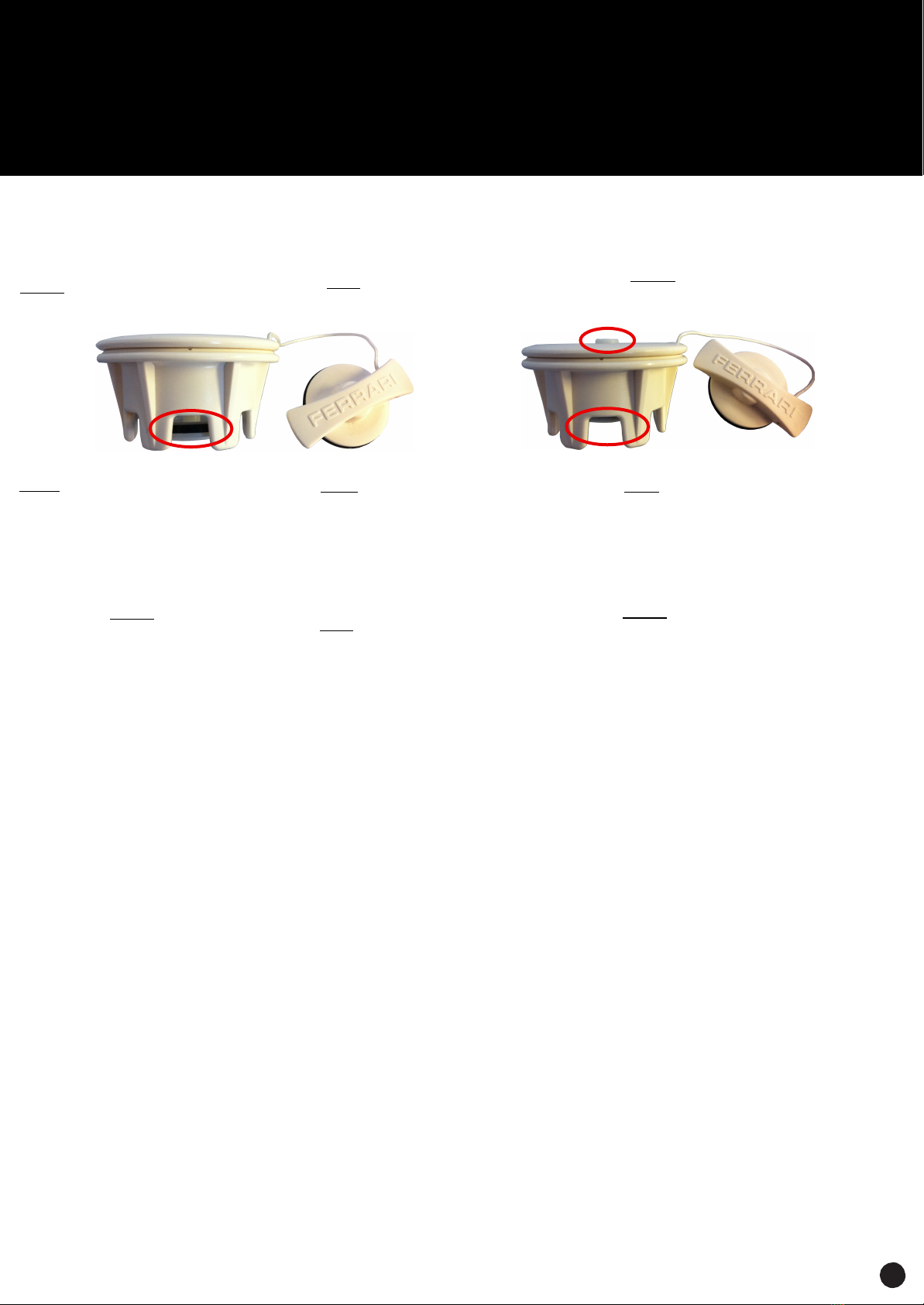
Valve de gonflage ouverte - Offene Aufblasventil - Inflation valve opened Valve de gonflage fermée- Geschlossene Aufblasventil- Inflation valve closed
Attention : Une fois la couverture gonflée et avant de refermer
le bouchon de la valve, vérifier bien que la valve de gonflage soit
sur position fermée (voir photo ci-dessus), pour éviter toute
sortie d’air.
Achtung: Einmal die Abdeckung aufgeblasen ist und bevor Sie
den Ventildeckel wieder anschrauben; prüfen Sie, dass das
Ventil in der geschlossenen Position (siehe Foto oben) ist, um
einen Luftaustritt zu vermeiden.
Caution: Once the cover is inflated and before closing the valve
cap, check that the valve is on the closed position (see picture
above), to avoid air loss.