15 - Preparing the ABPM 7100
Selecting a suitable cuff
Caution
Risk of injury caused by incorrect application of the cuff.
•Thedoctormustensurethat,duetothepatient’smedical condition, the use of the device and the
cuff does not result in impaired blood circulation.
•Ifthepatientishaslimitedcognitiveabilities,the device may only be used under supervision.
•Whenusedonchildren,thedevicemustonlybeapplied with special care and under permanent
supervision.
•Itisimperativethatyouinstructthepatientinthe correct seating of the cuff.
•Informthepatientthatthecuffmayonlybeusedon the upper arm.
•Ensurethatneithertheshoulderstrapnorthecuff tubing can ever wrap around the patient’s neck.
Always place the cuff tubing under the outer clothing (even at night).
•Instructthepatienttoplacethedeviceinsuchaway that, while the cuff is inflated, the tubing is not
compressed or kinked, especially during sleep.
•Petechiae,haemorrhagesorsubcutaneoushaematomamay occur in some patients.
•Instructthepatienttoturnoffthedevice,remove the cuff, and notify the doctor if they are
experiencing pain, swelling, redness or numbness in the limb where the cuff is placed. (It is expected
that the patient may experience some mild to moderate discomfort during a blood pressure
measurement.)
Caution
Intolerances caused by the use of disinfectants.
•Washtoremoveresidues.
•Washthecuffsleevewithamilddetergentinthewashing machine at max. 30°C without spinning.
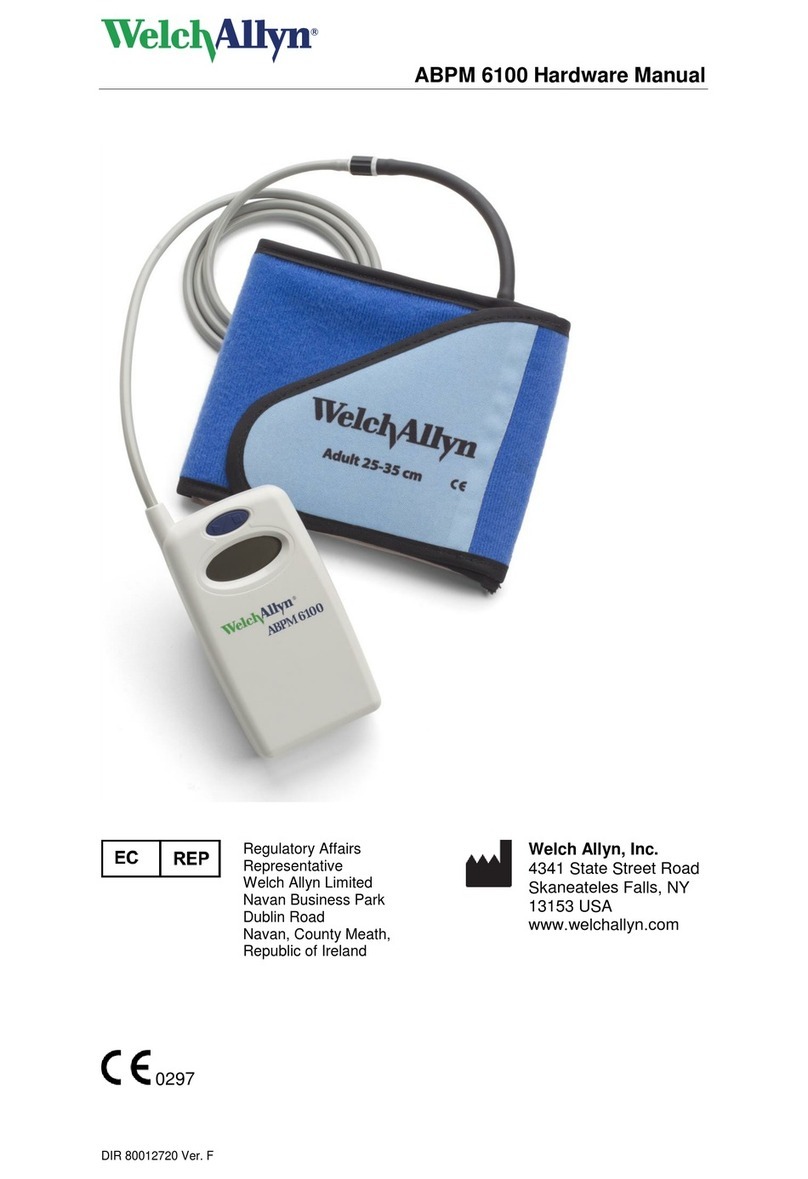
The correct cuff size is important for correct blood pressure measurement. To obtain reproducible
measurements, standardized measuring conditions are needed. Measure the circumference of the upper
arm and select the appropriate cuff:
Welch Allyn Size Number Upper Arm Circumference Cuff
09 14 – 20 cm Child
10 20 – 24 cm Small Adult
11 24 – 32 cm Adult
11L 32 – 38 cm Adult Plus
12 38 – 55 cm Large Adult
Applying the ABP Monitor and cuff
Risk of strangulation posed by the shoulder strap and cuff tubing.
•Ifthepatientishaslimitedcognitiveabilities,the device may only be used under supervision.
•Donotplacetheshoulderstrapandcufftubingaround the patient’s neck.
•Alwaysplacethecufftubingundertheouterclothing (even at night).
•Whenusedonchildren,thedevicemustonlybeapplied with special care and under permanent
supervision.
•Instructthepatienttoturnoffthedevice,remove the cuff, and notify the doctor if they are
experiencing pain, swelling, redness or numbness in the limb where the cuff is placed. (It is expected
that the patient may experience some mild to moderate discomfort during a blood pressure
measurement.)
•Measurementcanbeinterruptedatanystagebypushing any of the buttons. This automatically
deflates the cuff and the device can be removed.
Preparing the ABPM 7100 - 16
W a r n in g
Poor circulation caused by continuous cuff pressure.
•Donotkinktheconnectingtubing.
•Ifthepatienthaslimitedcognitiveabilities,the device may only be used under supervision.
•Ensurethecorrectplacementoftheshoulderstrapand cuff tubing.
•Alwaysplacethecufftubingundertheouterclothing (even at night).
•Whenusedonchildren,thedevicemustonlybeapplied with special care and under permanent
supervision.
•Instructthepatienttoturnoffthedevice,remove the cuff, and notify the doctor if they are
experiencing pain, swelling, redness or numbness in the limb where the cuff is placed. (It is expected
that the patient may experience some mild to moderate discomfort during a blood pressure
measurement.)
W a r n in g
Placement and inflation of the cuff over a wound may lead to further injuries.
Placement and inflation of the cuff on any limb with an intravascular access or under
intravascular treatment or an arteriovenous (A-V) shunt may lead to temporary interruption of
circulation and therefore to further patient injury.
Placement and inflation of the cuff on the arm at the side of a breast amputation may lead to
further injury.
•Examinethepatientforwounds,bandages,etc.
•Questionthepatientregardingprevioustreatments.
•Observethepatientclosely.
•Instructthepatienttoturnoffthedevice,remove the cuff, and notify the doctor if they are
experiencing pain, swelling, redness or numbness in the limb where the cuff is placed. (It is expected
that the patient may experience some mild to moderate discomfort during a blood pressure
measurement.)
Warning
In very rare cases materials used for and on the cuff may cause allergic reactions.
Do not use the cuff on patients with a known hypersensitivity to epoxy resin.
Caution
Intolerances caused by the use of disinfectants.
•Washtoremoveresidues.
•Washthecuffsleevewithamilddetergentinthewashing machine at max. 30°C without spinning.
Caution
Risk of injury caused by incorrect application of the cuff.
•Thedoctormustensurethat,duetothepatient’smedical condition, the use of the device and the
cuff does not result in impaired blood circulation.
•Ifthepatienthaslimitedcognitiveabilities,the device may only be used under supervision.
•Whenusedonchildren,thedevicemustonlybeapplied with special care and under permanent
supervision.
•Itisimperativethatyouinstructthepatientinthe correct seating of the cuff.
•Informthepatientthatthecuffmayonlybeusedon the upper arm.
•Ensurethatneithertheshoulderstrapnorthecuff tubing can ever wrap around the patient’s neck.
Always place the cuff tubing under the outer clothing (even at night).
•Instructthepatienttoplacethedeviceinsuchaway that, while the cuff is inflated, the tubing is not
compressed or kinked, especially during sleep.
•Petechiae,haemorrhagesorsubcutaneoushaematomamay occur in some patients.
•Instructthepatienttoturnoffthedevice,remove the cuff, and notify the doctor if they are
experiencing pain, swelling, redness or numbness in the limb where the cuff is placed. (It is expected
that the patient may experience some mild to moderate discomfort during a blood pressure
measurement.)