6 WA 12F, WA 15F Operation Manual rev 1.0.0
5. Polarity Checking
5. Polarity Checking
Checking the polarity of the wiring before the speaker system is mounted or own will help ensure satisfactory
performance. If you do not have a pulse based polarity checker, you may check LF units as follows: Connect
two wires to the + and - terminals of a PP3 (9 V) battery. Apply the wire connected to the positive (+) terminal
of the battery to the speaker cable leg which you believe to be connected to pin 1+ of the speaker connector;
likewise connect the negative (-) terminal of the battery to pin 1-. If you have wired it correctly, the LF drive unit
will move forward. At this point, connect the positive (+) speaker lead to the + terminal on the amplier and the
negative (-) lead to the - terminal on the amplier. However, if the LF driver moves backwards with the battery
test, the input connections need to be inverted before connecting the amplier. If problems are encountered,
inspect the cable wiring. Note that different amplier manufacturers may utilise different pin congurations and
polarity conventions; if you are using ampliers from more than one manufacturer, check the polarity at the
ampliers as well as at the loudspeakers.
6. Amplification & Power Handling
As with all professional loudspeaker systems, the power handling is a function of voice coil thermal capacity.
Care should be taken to avoid overdriving the amplier into clipping. Damage to the loudspeaker will be
sustained if the amplier is driven into clipping for any extended period of time. Headroom of at least 3 dB
should be allowed.
When evaluating an amplier, it is important to take into account its behaviour under low impedance load
conditions. A loudspeaker system is highly reactive, and with transient signals it can require more current than
the nominal impedance would indicate. Generally a higher power amplier running free of distortion will do less
damage to the loudspeaker than a lower power amplier that is continually clipping. A high powered amplier
running at less than 90% of output power generally sounds superior to a lower power amplier running at
100%. An amplier with insufcient drive capability will not allow the full performance or the loudspeaker to be
realised. (See technical specications section for recommended amplier power.)
When using ampliers from different manufacturers in a single installation, make certain that all have very
closely matched gains. (Variation should be less than +/- 0.5 dB.) This precaution is important to the overall
system balance when only a single active crossover is being used with multiple cabinets. When possible, it is
recommended that the same ampliers be used throughout.
7. Crossovers
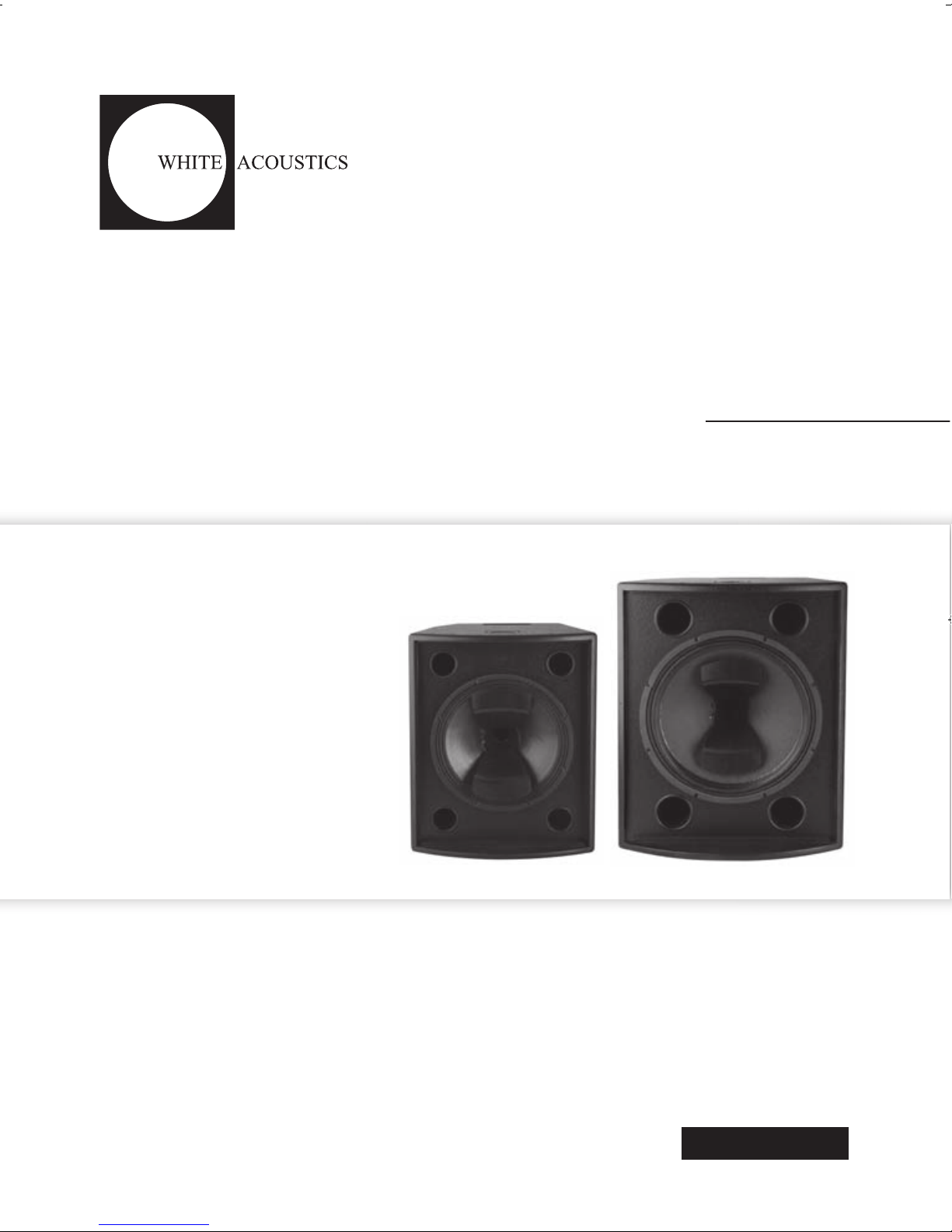
WA 12F and WA 15F loudspeakers are supplied as standard for passive operation via the internal crossover
network. If higher peak outputs and additional low frequency output is required then the WA 12F and WA 15F
can be used in conjunction with the WA 2.6X System Controller which provides high-pass ltering and a degree
of parametric equalisation, as well as a xed crossover point for use with sub-bass loudspeakers (See the
WA 2.6X Operation Manual for further information.)