manuals.online logo
Brands
  1. Home
  2. •
  3. Brands
  4. •
  5. White Rodgers
  6. •
  7. Thermostat
  8. •
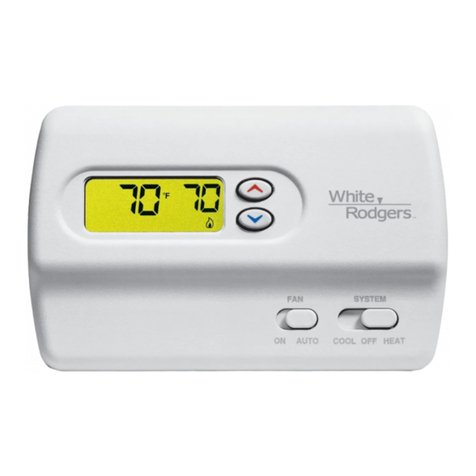
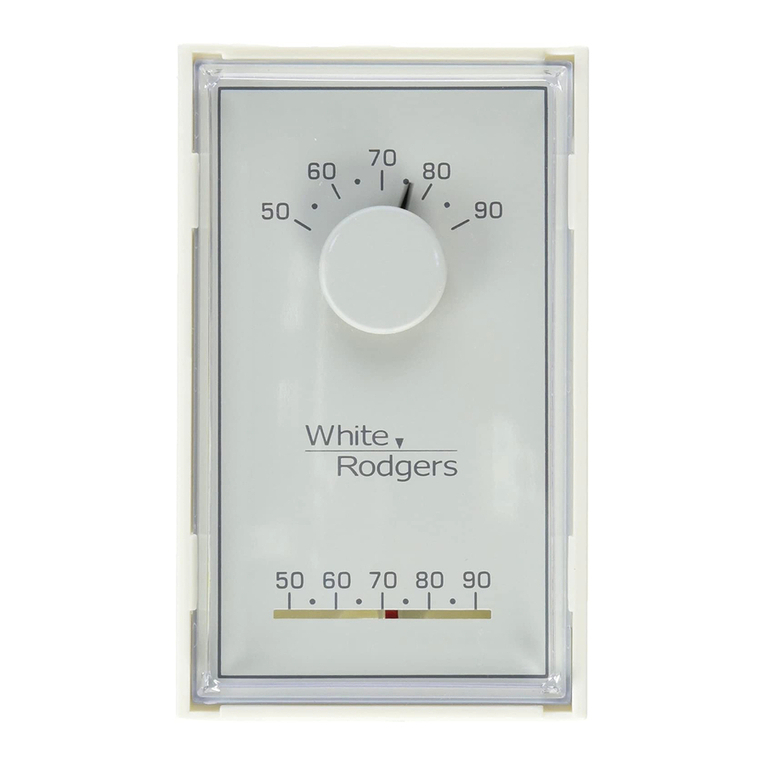
  9. White Rodgers 1E56 User manual

White Rodgers 1E56 User manual

Other White Rodgers Thermostat manuals

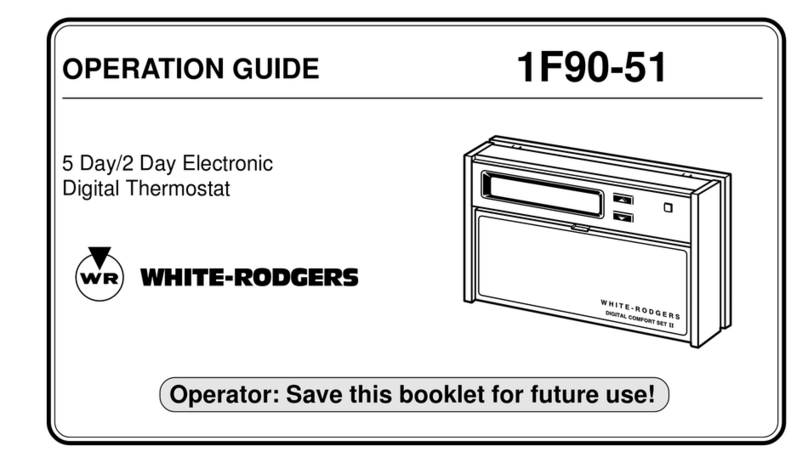
White Rodgers 1F89EZ-0251 Mounting instructions

White Rodgers

White Rodgers 1F89EZ-0251 Mounting instructions

White Rodgers 1F85-277 User manual

White Rodgers

White Rodgers 1F85-277 User manual

White Rodgers 1F83-0471 User manual

White Rodgers

White Rodgers 1F83-0471 User manual

White Rodgers SuperStat Pro SuperStat Pro Programmable... User manual

White Rodgers

White Rodgers SuperStat Pro SuperStat Pro Programmable... User manual

White Rodgers 70 Series User manual

White Rodgers

White Rodgers 70 Series User manual

White Rodgers EMERSON BLUE 1F98EZ-1421 Product information sheet

White Rodgers

White Rodgers EMERSON BLUE 1F98EZ-1421 Product information sheet

White Rodgers 1F59-13 Installation instructions

White Rodgers

White Rodgers 1F59-13 Installation instructions

White Rodgers 700 User manual

White Rodgers

White Rodgers 700 User manual

White Rodgers 1F87-361 User manual

White Rodgers

White Rodgers 1F87-361 User manual

White Rodgers BLUE EASY 1F86EZ-0251 Mounting instructions

White Rodgers

White Rodgers BLUE EASY 1F86EZ-0251 Mounting instructions

White Rodgers Comfort-Set III User manual

White Rodgers

White Rodgers Comfort-Set III User manual

White Rodgers EMERSON BLUE 1F98EZ-1421 User manual

White Rodgers

White Rodgers EMERSON BLUE 1F98EZ-1421 User manual

White Rodgers 1D56 User manual

White Rodgers

White Rodgers 1D56 User manual

White Rodgers 1F83-261 User manual

White Rodgers

White Rodgers 1F83-261 User manual

White Rodgers 1F85-0471 User manual

White Rodgers

White Rodgers 1F85-0471 User manual

White Rodgers 1F89-211 User manual

White Rodgers

White Rodgers 1F89-211 User manual

White Rodgers 875 User manual

White Rodgers

White Rodgers 875 User manual

White Rodgers 1F85-277 User manual

White Rodgers

White Rodgers 1F85-277 User manual

White Rodgers 1F90W-51 User manual

White Rodgers

White Rodgers 1F90W-51 User manual

White Rodgers 1F95W-71 User manual

White Rodgers

White Rodgers 1F95W-71 User manual

White Rodgers 1f86-244 User manual

White Rodgers

White Rodgers 1f86-244 User manual

White Rodgers 1F86-241 User manual

White Rodgers

White Rodgers 1F86-241 User manual

White Rodgers 1A10 Series User manual

White Rodgers

White Rodgers 1A10 Series User manual

White Rodgers 1F95-71 User manual

White Rodgers

White Rodgers 1F95-71 User manual

Popular Thermostat manuals by other brands

Full Gauge TIC-17C product manual

Full Gauge

Full Gauge TIC-17C product manual

Imit Chronomix S manual

Imit

Imit Chronomix S manual

ChiliTec ST-35 ana instruction manual

ChiliTec

ChiliTec ST-35 ana instruction manual

Salus VS05 Installer's/user's manual

Salus

Salus VS05 Installer's/user's manual

Azel D-500 user guide

Azel

Azel D-500 user guide

Honeywell Chronotherm III owner's manual

Honeywell

Honeywell Chronotherm III owner's manual

Charmeg MP-R user manual

Charmeg

Charmeg MP-R user manual

dixell WING XW40LS Installing and operating instructions

dixell

dixell WING XW40LS Installing and operating instructions

Network Thermostat NetX X7C-WIFI Installation and programming manual

Network Thermostat

Network Thermostat NetX X7C-WIFI Installation and programming manual

Radio Thermostat CT80 Operation guide

Radio Thermostat

Radio Thermostat CT80 Operation guide

HAI Omnistat RC-120 installation manual

HAI

HAI Omnistat RC-120 installation manual

Lennox iComfort E30 Installation and setup guide

Lennox

Lennox iComfort E30 Installation and setup guide

Lux Products PSD011Ba Installation and operating instructions

Lux Products

Lux Products PSD011Ba Installation and operating instructions

Computherm Q20 operating instructions

Computherm

Computherm Q20 operating instructions

Heatmiser neoStat user manual

Heatmiser

Heatmiser neoStat user manual

Mars HEAT CONTROLLER IR Wireless Thermostat user manual

Mars

Mars HEAT CONTROLLER IR Wireless Thermostat user manual

LUX LP0511D user manual

LUX

LUX LP0511D user manual

Saswell SAS920XWHB-7-S-RF User manual and warranty card

Saswell

Saswell SAS920XWHB-7-S-RF User manual and warranty card

manuals.online logo
manuals.online logoBrands
  • About & Mission
  • Contact us
  • Privacy Policy
  • Terms and Conditions

Copyright 2025 Manuals.Online. All Rights Reserved.

Printed in U.S.A.
FAILURE TO READ AND FOLLOW ALL INSTRUCTIONS CAREFULLY
BEFORE INSTALLING OR OPERATING THIS CONTROL COULD CAUSE
PERSONAL INJURY AND/OR PROPERTY DAMAGE.
DESCRIPTION
Operator: Save these instructions for future use!
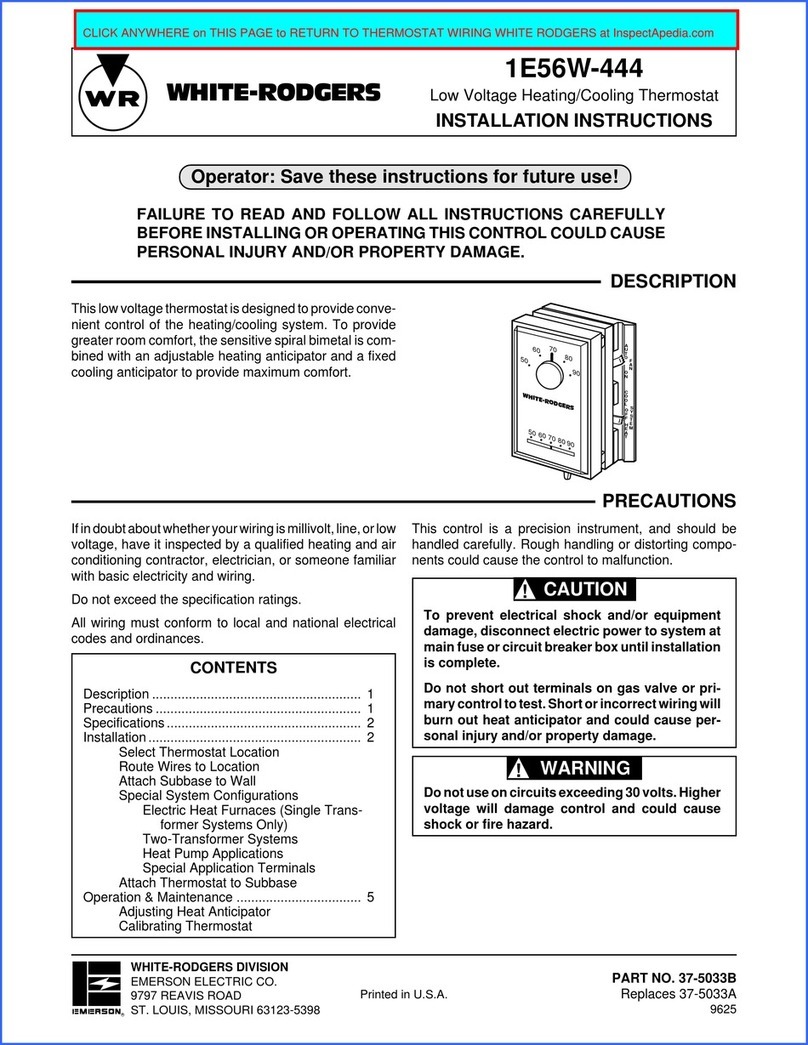
TYPE 1E56
Low Voltage Heating/Cooling Thermostat
INSTALLATION INSTRUCTIONS
WHITE-RODGERS
WHITE-RODGERS DIVISION
EMERSON ELECTRIC CO.
9797 REAVIS ROAD
ST. LOUIS, MISSOURI 63123-5398
CONTENTS
Description......................................................... 1
Precautions........................................................ 1
Installation.......................................................... 2
Select Thermostat Location
Route Wires to Location
Attach Subbase to Walls
Attach Thermostat to Subbase
Operation & Maintenance .................................. 5
Adjusting Heat Anticipator
Calibrating Thermostat
Thislowvoltagethermostatisdesignedtoprovideconve-
nient control of the heating/cooling system. To provide
greater room comfort, the sensitive spiral bimetal is com-
bined with an adjustable heating anticipator and a fixed
cooling anticipator to provide maximum comfort.
PRECAUTIONS
PART NO. 37-2196B
Replaces 37-2196
9509
Ifindoubtaboutwhetheryourwiringismillivolt,line,orlow
voltage, have it inspected by a qualified heating and air
conditioning contractor, electrician, or someone familiar
with basic electricity and wiring.
Do not exceed the specification ratings.
All wiring must conform to local and national electrical
codes and ordinances.
This control is a precision instrument, and should be
handled carefully. Rough handling or distorting compo-
nents could cause the control to malfunction.
To prevent electrical shock and/or equipment
damage, disconnect electric power to system at
mainfuseor circuit breakerboxuntil installation
is complete.
Do not short out terminals on gas valve or pri-
marycontroltotest.Shortorincorrectwiringwill
burn out heat anticipator and could cause per-
sonal injury and/or property damage.
Donotuseoncircuitsexceeding30volts.Higher
voltage will damage control and could cause
shock or fire hazard.
WARNING
!
CAUTION
!
CLICK ANYWHERE on THIS PAGE to RETURN TO THERMOSTAT WIRING WHITE RODGERS at InspectApedia.com
2
INSTALLATION
SELECT THERMOSTAT LOCATION
Proper location insures that the thermostat will provide a
comfortable home temperature. Observe the following
general rules when selecting a location:
1. Locate thermostat about 5 ft. above the floor.
2. Install thermostat on a partitioning wall, not on an
outside wall.
3. Never expose thermostat to direct light from lamps,
sun, fireplaces or any temperature radiating equip-
ment.
4. Avoid locations close to windows, adjoining outside
walls, or doors that lead outside.
5. Avoid locations close to air registers or in the direct
path of air from them.
6. Make sure there are no pipes or duct work in that part
of the wall chosen for the thermostat location.
7. Never locate thermostat in a room that is warmer or
cooler than the rest of the home, such as the kitchen.
8. Avoid locations with poor air circulation, such as be-
hind doors or in alcoves.
9. The living or dining room is normally a good location,
provided there is no cooking range or refrigerator on
opposite side of wall.
ROUTE WIRES TO LOCATION
All wiring must conform with local and national electrical
codes and ordinances.
1. If an old thermostat being replaced is in a satisfactory
location, and the wiring appears to be in good condi-
tion, use existing wiring. If in doubt, re-wire.
2. Ifanewlocationischosenorifthisisanewinstallation,
thermostat wiring must first be run to the location
selected.
3. Probe for obstructions in partition before drilling 1⁄2”
hole in wall at selected location. Take up quarter
round and drill a small guide hole for sighting (see
fig. 1). From basement, drill 3⁄4” hole in partition floor
next to guide hole. In houses without basements, drill
1⁄2” hole through ceiling and into partition from above
(see fig. 1).
4. Through this hole drop a light chain, or 6” chain
attachedto astrong cord. Snagcord inbasementwith
hooked wire. In houses without basements, drop cord
through hole in ceiling and down partitioning; snag
cord at the thermostat location.
5. Attach thermostat wires to cord and pull thermostat
wires through hole in wall so that 6” of wire protrudes.
NOTE
Approximately
5 feet from floor
1
⁄
2
” hole for
thermostat wire
Stout cord with 6”
chain attached
Baseboard
strip moulding
1
⁄
4
” guide hole
for sighting
Quarter round
removed
3
⁄
4
” hole in floor of partition
Hooked wire for snagging chain
Figure 1. Routing thermostat wires
ATTACH SUBBASE TO WALL
To prevent electrical shock and/or equipment
damage, disconnect electric power to system at
mainfuseor circuit breakerboxuntil installation
is complete.
1. Disconnect electrical power at main fuse or circuit
breaker.
2. Pullwiresthroughopeningnearcenterofsubbaseand
connect wires beneath terminal screws (see figs. 2
and 3 for typical wiring for each application.
3. Push excess wiring into wall and plug hole with fire-
resistant material (such as fiberglass insulation) to
prevent drafts from affecting thermostat operation.
4. Positionsubbaseoverholeinwall andmark mounting
hole locations on wall.
5. Drill mounting holes.
6. Fasten subbase loosely to wall, as shown, using two
mounting screws. Place a level against bottom of
subbase, adjust until level, and then tighten mounting
screwstosecuresubbase.Ifholesinwallaretoolarge
and do not allow you to tighten subbase snugly, use
plastic screw anchors to secure subbase.
CAUTION
!

3
G4
W
ON
Fan
Switch
Cooling
Anticipator Heating
Anticipator
AUTO
RCY
24 VAC 120 VAC
Hot
Neutral
Heating
System
Cooling
System
Fan
Relay
Thermostat
Contacts COOL
HEAT
System
COOL HEAT
Field Installed
Jumper
In “OFF” position
system switch breaks
both heating and
cooling circuits
Figure 2. For installations where heating and
cooling systems are powered by the same transformer
24 VAC 120 VAC
Hot
Neutral
Heating
System
Cooling
System
Fan
Relay
24 VAC 120 VAC
Hot
Neutral
Cooling Transformer
Heating Transformer
G4
W
ON
Fan
Switch
Cooling
Anticipator Heating
Anticipator
AUTO
RCY
Thermostat
Contacts COOL
HEAT
System
COOL HEAT
In “OFF” position
system switch breaks
both heating and
cooling circuits
Figure 3. For installations where heating system
is powered by a separate transformer
ATTACH THERMOSTAT TO SUBBASE
1. Remove cover from thermostat base by gripping the
base in one hand. Use the other hand to pull gently at
the top or bottom of the cover.
2. Carefullyremovetheshippingprotectivepackingfrom
the switch.
3. Attachthermostatbasetosubbase,being surethat all
captive screws are tightened snugly, since they serve
as electrical connections between thermostat and
subbase (see fig. 4).
4. Snap cover on thermostat and set switches and tem-
perature lever to desired setpoint (see OPERATION
section).
5. Turn on power to the system.
Figure 4. Attach thermostat to subbase
Captive
screws
COVER
THERMOSTAT
BASE
S
Y
S
T
E
M
C
O
O
L
O
F
F
H
E
A
T
A
U
T
O
O
N
F
A
N
GRC
Y
W
B
ARH
O
50
60 70 80
90
50 60 70 8090
OPERATION &
MAINTENANCE
FAN
AUTO ON
SYSTEM
COOL OFF HEAT
Shows switch position
OPERATION
No heating; no cooling; no fan
No heating; no cooling; fan runs continuously
Cooling system cycles from thermostat; fan runs
continuously
Cooling system and fan cycle from thermostat
Heating system cycles from thermostat; fan cycles
from fan control on furnace
Heating system cycles from thermostat; fan runs
continuously
Figure 5. Subbase switching and thermostat/system operation
Thisthermostatiseasy tooperate.Fig. 5
shows how the heating/cooling system
andfanoperatewhentheswitchesarein
variouspositions. Use the system switch
to select either heating or cooling, or to
turn the heating/cooling system off. Use
the fan switch to control fan operation.
When the fan switch is in the AUTO
position,thefanwillcyclewiththeheating
or cooling system (the fan will not run if
the system switch is in the OFF position
and the fan switch is in the AUTO posi-
tion). When the fan switch is in the ON
position, the fan will run continuously,
regardlessofsystemswitchposition(even
ifthe system switchis set toOFF, thefan
will run if the fan switch is in the ON
position).
ADJUSTING HEAT ANTICIPATOR
Theadjustable heat anticipator WILL BURNOUT
if 25 VAC is applied directly to the thermostat by
shorting out the primary control during testing.
This may cause personal injury and/or property
damage.
This thermostat is equipped with an adjustable heat
anticipator and was preset at the factory to provide
satisfactoryoperationoftheheatingsystemundernormal
conditions. If additional adjustments are necessary, they
may be made as follows (see fig. 6):
1. Remove thermostat cover.
2. Ifheatcycleistoolong,setheatanticipatortoaslightly
lower dial setting (1⁄2division).
3. If heat cycle is too short, set heat anticipator to a
slightly higher dial setting (1⁄2division).
4. Replace thermostat cover.
CALIBRATING THERMOSTAT
Thisthermostathasbeencarefullyadjustedatthefactory
and should not require recalibration.
Duetoenvironmentalconditions,duringnormaloperation
there may be a few degrees of difference between the
indicator setting of the thermostat and actual room tem-
perature. If the disagreement is appreciable, however,
firstmakesurethatthethermostatisproperlylocatedand
leveled. Then, if recalibration still seems necessary, pro-
ceed as follows:
To prevent electrical shock and/or equipment
damage, disconnect electrical power to the sys-
tem until recalibration is complete.
1. Theanticipator’sheatmayadverselyaffectthermostat
recalibration. To prevent this, disconnect electrical
power to the thermostat at the furnace, main fuse, or
breaker box.
2. Move temperature adjustment lever to a setting about
5°above room temperature.
3. Remove thermostat cover. Slip 7⁄32” wrench onto hex
nut beneath bimetal. While holding temperature ad-
justment lever stationary, turn hex nut clockwise until
mercury shifts to the right end of the tube (see fig. 7).
4. Move temperature adjustment lever to lowest setting.
5. Replacethermostatcover.Wait10minutesforbimetal
temperaturetostabilize.Donotstandnearthethermo-
stat during this period, as your breath and body heat
will affect bimetal temperature.
6. Move temperature adjustment lever to correspond to
actual room temperature. Then remove thermostat
cover.
7. Slip
7⁄32” wrench onto hex nut. While holding tempera-
tureadjustment lever stationary, turn hex nut counter-
clockwiseuntilmercuryjustbarelyshiftstotheleftend
of the tube (see fig. 7).
8. Replacethermostatcoverandsettemperatureadjust-
ment lever to desired temperature. Turn on electrical
power to system.
CAUTION
!
CAUTION
!
.18
.25
.3
.4
.2
.15
1.
.8
.6
.5
Arrow points to the
matched current rating
of the primary control
Move this lever
to adjust heat
anticipator
Figure 6. Anticipator adjustment
L
O
N
G
E
R
C
Y
C
L
E
S
Bimetal
7
⁄
32
”
Calibration
wrench
Temperature
adjustment
lever
Figure 7. Calibrating thermostat