WINDTECH EVO Series Technical specifications

EVO
manual


3
Windtech
w w w . w i n d t e c h . e s
EVO
23-25-27-30
flight manual

4
> index
> congratulations ––––––––––––––––––––––––––––––– 5
> warning &liability ––––––––––––––––––––––––––––– 6
> design materials ––––––––––––––––––––––––––––––– 6
> best glide –––––––––––––––––––––––––––––––––––– 9
-- un-powered flight ––––––––––––––––––––––––––– 9
-- powered flight––––––––––––––––––––––––––––––– 10
> flight –––––––––––––––––––––––––––––––––––––– 10
-- inflation and take off ––––––––––––––––––––––– 11
> flying in turbulence –––––––––––––––––––––––––– 12
-- asymmetrical tuck/collapse –––––––––––––––––––– 13
-- front/symmetrical tuck collapse ––––––––––––––– 13
-- asymmetric stall (spin) ––––––––––––––––––––––––– 14
-- landing –––––––––––––––––––––––––––––––––––– 14
> weather to fly ––––––––––––––––––––––––––––––– 15
> emergency procedures &quick descent techniques –15
-- big ears ––––––––––––––––––––––––––––––––––– 15
-- spiral drive ––––––––––––––––––––––––––––––––– 16
-- b stall ––––––––––––––––––––––––––––––––––––– 17
> maintenance –––––––––––––––––––––––––––––––– 18
> warranty ––––––––––––––––––––––––––––––––––– 18
> technical specifications–––––––––––––––––––––––––19
> speed system –––––––––––––––––––––––––––––––– 21
> line measurements –––––––––––––––––––22-23-24-25
> flight log ––––––––––––––––––––––––––––––––––– 26

5
> congratulations
Congratulations on the purchase of your new EVO.
The EVO has been carefully thought out and designed to make paramotor flying as sim-
ple and enjoyable as possible.
We strongly recommend that before you fly the EVO you carefully read this manual in
order to be aware of any limitations, performances, take off and flight characteristics,
landing procedures, emergency situation and maintenance.
We always appreciate your feedback, so please send us your comments, positive or neg-
ative, in regard to the
Windtech
range.
You are the best feedback and support for future products, and please remember that we
are always happy to give you any help &advice.
Best winds
>
Windtech
team

6
> warning &liability
We have produced this manual so that you can get to know your EVO better, with some
helpful tips to help you feel comfortable with it from the very first day.
Windtech
assumes that the purchasing pilot has the appropriate pilot's licence, has taken a train-
ing course, and has the suitable ability and enough experience to safely fly the EVO.
THIS INSTRUCTION
MANUAL IS NOT
INTENDED AS A “TEACH
YOURSELF PARAMO-
TORING” BOOKLET. We
have to make it very
clear that to fly this
wing safely and profi-
ciently IT IS NOT
ENOUGH JUST TO READ
THIS MANUAL, and
that you, the pilot,
MUST complete a suit-
able paramotor flying
course, and gain a good
understanding of the
concepts of flight, both
powered and un-pow-
ered. It is also impera-
tive that you gain a
good understanding of
the weather and flying
conditions, so that you
know when it is safe to
fly, and WHEN IT IS
NOT SAFE TO FLY.
This manual cannot be used for operational purposes. The flight log ®istration card
must be filled and stamped by the dealer &returned to in order to claim on the guar-
antee.
The use of this paraglider is entirely at the user's own risk. As with any adventure sport
paragliding is a high risk activity-especially without taking the appropriate precautions-
therefore it must be absolutely understood that
Windtech
&the dealer do not accept
any responsibility for accidents, losses, injuries, direct or indirect damage following the
use or misuse of this product.

7
> design materials
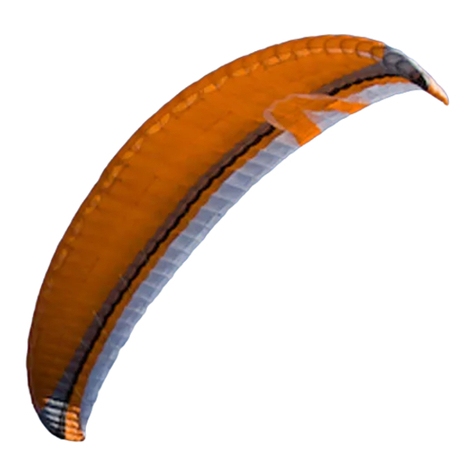
The EVO is a glider that offers total security with beautiful handling &perfomance. The
performance is very high due to a well-defined structure with 52 cells, with an internal
structure comprised of diagonals of different types, depending on the width of the cell
and an optimized line layout to reduce the overall number of lines.
This specifically designed paramotor wing has been reinforced in key areas of the wing,
especially at all of the attachment points on both the under-surface and the cell walls.
The EVO is equipped with a double leading edge designed by
Windtech
that it provides
with higher performance and security at high speed and which enables a better take-off.
It disposes also of a mayor zone of aspiration (area) at the key areas in a different posi-
tion regarding the profile thus enabling a better take-off behaviour and re-opening after
collapse. Due to this characteristic and the double leading-edge and the design of the
speed-bar, we can fly a higher speed with total security and beautiful performance.
-- cloth
The upper and lower panels are made with 45 gr. Porcher Marine Skytex nylon. The ribs
are made with stronger nylon of to prevent airofoil deformation, even after several years
of intensive use. Rib (cell wall) reinforcements are made of Dacron 310 &180 gr. Line
attachment points are made of polyester.
-- lines
The EVO´s lines are made from the highest quality Kevlar, with a polyester outer sheath
to protect the inner Kevlar core from abrasion and UV. The main (lower cascade) “A” and
“B” lines are 2.2mm, rated at 240kg, and the main “C” and “D” lines, are 1.7mm.
-- risers
We have designed the EVO´s paramotor riser system to help overcome the various com-
plexities that powered flight entails.
The risers are shorter than usual (42cm), to allow for the different flying position and
help minimise the effects of the chassis of the engine.
Independent of using the trimmers or the spee-bar (not in combination), the risers sub-
mit the centre of gravitiy of the wing and, together wit the new profile, this offers more
pressure in the leading edge enabling us to fly at higher speed with total security.
The construction and materials have been made stronger, especially the stitching of the
main attachment points of the wing.
The travel of the webbing of the trimmers is on a pulley system, which means a greatly
reduced chance that they will slip (a big problem with normal trimmers) in normal flight
or after a sudden shock or under high pressure, such as a collapse or steep turn, offering

8
a greater amount of security with a very effective and easy to use system.
The A-riser is splitted into two: one of them holds the central lines, marked in blue colour
and the other one which holds the exterior, marked in red colour; you should pull this
riser down to induce the big-ears; when releasing them, the big ears will open
autonomously.
Both dispose of a velcro fastener to put them together as one during take-off process.
This is important as we hold in the same hand the two risers, the handle of the speed-
system of the paramotor and the brake handle of the wing.
In order to avoid a bulk, the tape has only 20 mm.
The brake handles have not any rigid part and they are extremely conformable to wrap
it around the hand or to grab it in a more classical way.
The left handle is 25 mm. in width and it is covered with neoprene, so it is very com-
fortable. The right handles is in red color to easily difference in case you have to repeat
the lunch procedure and set the risers and gas throttle handle.
The rises have an elastic band that goes from the trim end to the bottom of the risers to
prevent any impact from the leftover webbing when the trim is fully closed.
The ‘trimmers’ are used to set the ‘trim speed’ of the wing and bring forward the center
of gravity, and have been carefully designed to give the best combination of efficiency
and stability across the whole speed range. When the trimmers are pulled fully ON
(pulled all the way through the ratchet, so that the rear risers are effectively pulled down
to their shortest position) the glider will fly at full slow trim speed. When the risers are
released all the way OFF (ratchet pressed, so that the webbing slips all the way and the
rear risers are in their longest position) the glider will fly at full fast speed. It is vitally
important that that you fully understand all of the effects and implications of flying at
different trim speeds, as this changes the handling, safety and performance character-
istics of any wing.
There are two lines of stitching on the webbing of the trimmers which are set at “nor-
mal” trim and a faster “powered flying” position. When the trim is set to the first stitch-
ing line (normal trim), this is the speed that should be used for taking off, landing and
flying in turbulence.
If you then raise the trimmers up to the second line of stitching, this is the faster “pow-
ered flying” trim position (the actual speed will depend a lot on wing loading), in which
the trimmers are set to compensate for the pitching back effect caused by the push of
the motor, bringing the wing into a more overhead position and giving increased speed
and performance. Of course, caution should always be used when low down and one
should always fly with the trimmers in the “normal” trim position in turbulence and
when near the ground.
The trim travel will continue slightly further than the “powered flying” setting, to “full

9
trim speed”, but one should only ever use this trim position in very smooth conditions,
and with plenty of height, due to the greatly reduced angle of attack of the wing. If the
pilot requires more speed in turbulent conditions, we recommend that the pilot leaves
the glider in “normal” trim position and makes use of the speed system.
We recommend setting the trim in the take off position and use the speed system.
We don't recommend the use of the speed system and the trims in rouge air.
The trim lock is covered with neoprene to prevent any damage in the arms during take
off. To release the lock place the forefinger and the thumb in the back of the lock, press
the lock release tab and rotate the hand the tab 90º up. This way the trim webbing slides
easily.
> best glide
-- un-powered flight
Best glide in nil wind, and still air, is obtained at “trim” speed that is brakes fully released
and no accelerator (speed bar) applied. It is always best to fly with a light pressure on
the brakes, keeping a “feel” on the wing in case of unexpected turbulence.
When flying into (against the) wind a better glide can be obtained by using the speed
system. The following is rough guide line as to how much to apply.
-With around 10 km/h of head wind, best glide is obtained with 25% accelerator applied.
-With around 15-25 km/h of head wind, best glide is obtained with 50% accelerator.
-With around +25 km/h of head wind, best glide is obtained with 75-100% accelerator.
When flying downwind (wind from behind ) the best glide is obtained between 0% brake
and 10% of brake.
The trim travel of the glider has been limited to a point where the security/safety of the
wing is still high and yet permits a gain of 12km/h. In any case it is recommended not
to use the trimmers close to the ground, or when conditions are turbulent. If turbulent
conditions are encountered, or if you are nearing the ground we recommend that you
return the trimmers without delay to the “normal” trim position, for take-off, landing and
flying turbulence.
Always fly a glider that is the correct size for you, and remember that if your flying
weight is below the stated minimum, the speed range will diminish and inflation prob-
lems may appear. Also the handling will degrade in turbulent conditions, and it will be
easier to sustain collapses. If your flying weight is above the stipulated weight range, this
will result in a higher minimum speed and faster landing speed and the stall speed of the
glider will also be higher.

10
-- powered flight
The concept of performance under power is considerably different to that in free-flight
(without power). Factors that affect this include: thrust; power and size of the engine;
diameter of the cage; flight altitude; meteorological conditions, such as density of the
air; wing loading, etc.
We STRONGLY recom-
mend that you try to
learn all about these
effects, by reading
books about paramotor-
ing and speaking with
more experienced
paramotor pilots,
coaches and instructors,
BEFORE you start flying.
What is certain is that,
due to an increase in
wing loading and the
extra drag caused by
the chassis of the
motor, the sink rate, fly-
ing and handling char-
acteristics, and per-
formance of the glider
will be affected. For this reason we consider it extremely important that the pilot choos-
es a motor that is most suited to the pilot’s weight, abilities, and intended uses in flight,
etc. When one takes into consideration all of the factors, one will arrive at one set of
performances and flight characteristics, or another.
> flight
Each and every glider has a checklist note passed though our strict quality control in the
factory. This includes line measurement, ground inflation and flight testing. Contact your
distributor for more information about this, and if your glider has not been pre-inflated
ask them to do so for you. Every glider should be test flown before it is sold.
Note that each glider has a unique sticker attached to the centre cell with the serial
number, type of glider, size and weight range.
We recommend that your first flight on your new glider will be realized without motor
be on a gentle slope in calm conditions before making any further higher flights, just to
check the glider and for you to get used to flying it.
This manual suits for next models
4
Table of contents
Other WINDTECH Aircraft manuals
WINDTECH
WINDTECH Windsos 16 User manual

WINDTECH
WINDTECH ARIAL XS Technical specifications
WINDTECH
WINDTECH RALLY User manual

WINDTECH
WINDTECH MAD MAX-2 User manual
WINDTECH
WINDTECH KALi Series User manual
WINDTECH
WINDTECH WINDSOS DRIVE User manual
WINDTECH
WINDTECH ZEPHYR-2 S Technical specifications
WINDTECH
WINDTECH Pulsar Series Technical specifications
WINDTECH
WINDTECH TUAREG User manual
WINDTECH
WINDTECH Tecno Series Technical specifications