Installation and Operation
4975-0265-01-01
Installation and Operation
To install PowerSource 400:
1. Plug the power cord directly into a wall outlet (not into a surge protector or
power strip).
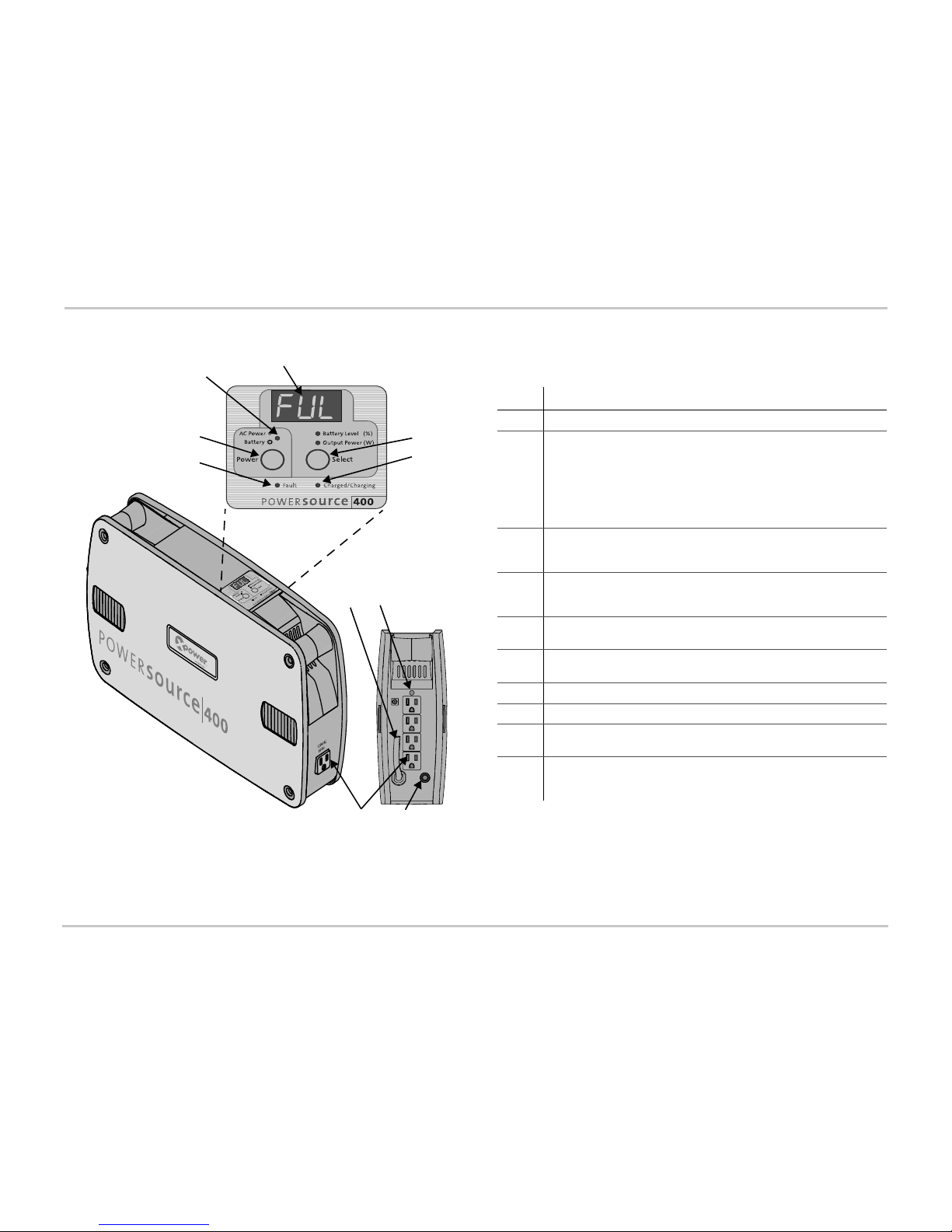
2. Connect your electronic devices or small household appliances to the five
AC outlets of the PowerSource 400.
3. Turn on the unit by pressing the Power button for at least 2 seconds. The
green AC Power LED confirms that the PowerSource 400 is on and ready to
provide backup power.
When the battery needs recharging, the LED screen flashes “CHG” five
times, then the battery capacity (%) once. This pattern of flashing continues
until the battery capacity reaches 100% and “FUL” appears on the screen.
Backup Power Feature
The unit’s five 120 VAC outlets are permanently backed up by the internal battery.
To activate the AC outlets, turn on the unit using the Power button. During a
power outage or other utility problem (such as brownouts and over-voltages),
PowerSource 400 will keep running the connected products for up to 8 hours,
depending on the power draw of your application. When utility power is restored,
the unit automatically recharges its internal battery.
Operation Guide
Important:
PowerSource 400 should be used or stored in a temperature-controlled,
indoor area away from direct sunlight, moisture or conductive contaminants. Allow a
minimum of 3 inches of space around the unit for optimal ventilation.
Important:
PowerSource 400 must be charged immediately before storage or
use. This will protect the battery inside from damage and will ensure extended usage run
time. A complete charge may take up to 20 hours when recharged from a 120 VAC wall
outlet.
CAUTION
• Do not plug surge-protected power bars into the unit’s 120 VAC outlets.
• Do not connect an AC power source to the 120 VAC outlets.
• Do not connect the unit’s AC power cord to its 120 VAC outlets.
Important:
When connected to utility power, the unit automatically provides AC
power from its internal battery when the utility voltage falls outside the 105–135 VAC
range. The blue LED also turns on automatically to illuminate the rear AC outlets.
Condition LED status Alarm status Alarm stops sounding when…
Normal operation—Unit is on and supplies utility power
to the application. The internal battery is fully charged.
AC Power LED and Charged/Charging
LED are solid green. Screen shows “FUL.”
None Not applicable
Backup power—Unit supplies power from its internal
battery.
Battery LED is flashing amber. One beep when the power outage
occurs.
Unit beeps once when it returns to normal
operation or when it is turned off.
Low battery warning—Unit is supplying battery power to
the application connected to its AC outlets and the battery is
close to complete discharge status.
Battery LED is flashing amber. Begins beeping once every
10 seconds 10 minutes before
unit shuts down.
Unit returns to normal operation, or when it is
turned off.
Overload shutdown—During normal operation or backup
power operation an AC outlet overload was detected.
Fault LED on. Screen shows Error code
E03.
One beep per second. Unit shuts
down after 5 seconds/beeps.
Not applicable
Under-voltage shutdown—During backup power
operation the battery power has been completely exhausted.
No power is available at the AC outlets.
No LED on. No sound Not applicable. Unit starts recharging the internal
battery when utility power is restored. Turn on the
unit to restore normal operation.
Over-temperature shutdown—Unit has shut down to
protect its internal circuitry from high temperatures.
Fault LED on. Screen shows error code
E04.
One beep per second for two
minutes before shutdown, then
sounds continuously for five
seconds upon shutdown.
The unit is turned off or when the unit shuts down.
Recharging internal battery—Unit is recharging its
internal battery after utility power has been restored.
AC Power LED is green. Charged/Charging
LED flashes amber. Screen shows “CHG”
alternating with battery capacity (%).
No sound Not applicable. Screen shows “FUL” when unit is
completely charged.