manuals.online logo
Brands
  1. Home
  2. •
  3. Brands
  4. •
  5. Adler
  6. •
  7. Control Unit
  8. •
  9. Adler FA1 Operating and maintenance manual

Adler FA1 Operating and maintenance manual

Other manuals for FA1

1

This manual suits for next models

37

Other Adler Control Unit manuals

Adler FA1 User manual

Adler

Adler FA1 User manual

Adler FA2 Operating and maintenance manual

Adler

Adler FA2 Operating and maintenance manual

Popular Control Unit manuals by other brands

Seitz 14A80 user manual

Seitz

Seitz 14A80 user manual

Wilo RS485 Installation and operating instructions

Wilo

Wilo RS485 Installation and operating instructions

Becker CentralControl CC41 Commissioning Instruction

Becker

Becker CentralControl CC41 Commissioning Instruction

SICK CDB650 operating instructions

SICK

SICK CDB650 operating instructions

Panduit NetKey NKP5E88M Series installation instructions

Panduit

Panduit NetKey NKP5E88M Series installation instructions

MX Options Concentric Petite Fitting instructions

MX

MX Options Concentric Petite Fitting instructions

Clean Water Systems Fleck 2510 Installation & start?up guide

Clean Water Systems

Clean Water Systems Fleck 2510 Installation & start?up guide

Fairchild FSB44104A user guide

Fairchild

Fairchild FSB44104A user guide

LEGRAND Wattstopper LMIN-104 installation instructions

LEGRAND

LEGRAND Wattstopper LMIN-104 installation instructions

PMK ATT10BNCS instruction manual

PMK

PMK ATT10BNCS instruction manual

Tektronix TDS3FFT user manual

Tektronix

Tektronix TDS3FFT user manual

Woodward easYgen Technical manual

Woodward

Woodward easYgen Technical manual

Balluff BNI EIP-502-105-R015 user guide

Balluff

Balluff BNI EIP-502-105-R015 user guide

NXP Semiconductors TWR-LS1021A Getting started

NXP Semiconductors

NXP Semiconductors TWR-LS1021A Getting started

Advantech PCM-3117 Startup manual

Advantech

Advantech PCM-3117 Startup manual

Danfoss MCO 101 manual

Danfoss

Danfoss MCO 101 manual

Moons' Lin Engineering R701P user manual

Moons'

Moons' Lin Engineering R701P user manual

Aventics RV1 operating instructions

Aventics

Aventics RV1 operating instructions

manuals.online logo
manuals.online logoBrands
  • About & Mission
  • Contact us
  • Privacy Policy
  • Terms and Conditions

Copyright 2025 Manuals.Online. All Rights Reserved.

ADLER S.p.A. VALVOLE A SFERA, V.le Borletti 14, 20010 S.Stefano Ticino (MI) ITALY
Tel. +39 02974842.11 Fax. +39 0297271698 E-mail [email protected] http:// www.adlerspa.com
Pag. 1 of 14
BALL VALVES
KUGELHÄHNE
INSTALLATION, MAINTENANCE AND
OPERATING MANUAL INSTRUCTION
EINBAU-, WARTUNGS- UND
BETRIEBSANLEITUNG
ADLER S.p.A. VALVOLE A SFERA, V.le Borletti 14, 20010 S.Stefano Ticino (MI) ITALY
Tel. +39 02974842.11 Fax. +39 0297271698 E-mail [email protected] http:// www.adlerspa.com
Pag. 2 of 14
1. INTRODUCTION
2. MARKING
3. BALL VALVES START UP
4. INSTALLATION OF VALVE
5. DISASSEMBLY AND ASSEMBLY OF COMPONENTS
6. COMPONENTS OF SPECIAL EXECUTIONS
7. DISPOSAL OF VALVE
8.
TROUBLE SHOOTING
1. EINFÜHRUNG
2. MARKIERUNG
3. INBETRIEBNAHME DER KUGELHÄHNE
4. EINBAU DER KUGELHÄHNE
5. DEMONTAGE UND MONTAGE VON KOMPONENTEN
6. KOMPONENTEN SONDERAUSFÜHRUNGEN
7. ENTSORGUNG DER KUGELHÄHNE
8. FEHLERSUCHE
1 INTRODUCTION
Adler S.p.A. ball valves, if provided of CE marking are manufactured in accordance with
P.E.D. directive (2016/68/UE) and/or ATEX directive (2016/34/UE) and/or machinery directive
(06/42/EC), but they don’t consider in their design the following factors of risk:
1) Adler S.p.A. “Standard” ball valves can be used in a temperature range between –28.8 /
+ 250 °C.For temperatures between – 28.8 °C & + 250 °C ball valves have to be
provided with seats & seals able to withstand the temperature required (Adler S.p.A.
technical support is suggested to select the suitable seats & seal material).
2) Adler S.p.A. “Standard” ball valves are not equipped with devices suitable to avoid
internal over-pressures caused by incorrect operations of process or by fluids & liquids
subjected to an increase of volume and/or pressure. (These devices, such as the over-
pressure hole into the ball or the safety relief seats are available upon request).
3) Adler S.p.A. “Standard” ball valves are not designed with special devices to withstand a
sudden thermal jump (thermal Shock).
4) Adler S.p.A. “Standard” ball valves are not equipped with “Fire Safe” seals. (“Fire Safe”
ball valves certified BS 6755 or ISO 10497 are supplied upon request).
5) In general Adler S.p.A. “Standard” ball valves are not mechanically designed to bear
over loads due to exceptional atmospheric or natural phenomenon’s (Ex. earthquakes).
6) In general Adler S.p.A. “Standard” ball valves are not designed to bear loads on flanges,
on pipe connections or pipe-line.
7) In general Adler S.p.A. “Standard” ball valves can’t withstand with ice inside their
bodies. (In this case user has to consider the optional stem extension for insulating,
avoiding the presence of residual product inside the valve).
8) Adler S.p.A. ball valves are suitable for low temperature service (up to – 196°C) when
provided of cryogenic stem extension (available on request).
9) Adler S.p.A. ball valves are suitable “industrial” oxygen service when supplied degreased
and packed in polyethylene bags only.
N.B. For “medical” oxygen service please contact Adler S.p.A.
10) The compatibility between ball valves construction materials and mediums is selected by
the user. Adler S.p.A. personnel are at your disposal for additional technical aid, but the
user is ultimately responsible for verifying the compatibility between medium and
materials.
1. EINFÜHRUNG
Adler-Kugelhähne, die ein CE-Kennzeichen tragen, werden in Übereinstimmung mit der
Druckgeräterichtlinie (2016/68/UE) ; der ATEX Richtlinie (2016/34/UE) und der
Maschinenricht-linie (2006/42/EC) hergestellt.
Folgende Risikofaktoren sind in der Konstruktionsauslegung jedoch nicht berücksichtigt:
1) ADLER S.p.A. Standard Kugelhähne können für einen Temperaturbereich von minus
28,8 ° C bis 250 ° C eingesetzt werden. Bei Einsatztemperaturen von minus 28,8°C bis +
250 ° C sind die Kugelhähne mit entsprechenden, temperaturbeständigen Sitzen und
Dichtungen auszustatten. (Zwecks Auswahl der geeigneten Sitz- und
Dichtungsmaterialien ist das Fachpersonal von ADLER zu kontaktieren).
2) ADLER S.p.A. Standard Kugelhähne sind nicht ausgerüstet, um Überdrücke im Inneren
des Kugelhahnes auszugleichen, entweder hervorgerufen durch unsachgemäßen
Verfahrensablauf oder durch Medien, die im Totraum zur Expansion oder zum
Druckaufbau neigen. (Diese Ausführungen, wie z. B. Druckentlastungsbohrung in der
Kugel sind auf Wunsch erhältlich).
3) ADLER S.p.A. Standard Kugelhähne sind nicht konzipiert für plötzliche
Temperaturschwankungen. (Temperaturschock)
4) ADLER S.p.A. Standard-Kugelhähne haben keine *Fire-Safe*Abnahme.
*Fire-Safe* Kugelhähne zertifiziert nach API 6FA, BS6755 oder ISO 10497
sind auf Anfrage erhältlich.
5) Generell sind ADLER S.p.A. Standard Kugelhähne nicht so konstruiert, dass sie
Überbelastungen durch außergewöhnliche Witterungsverhältnisse oder Naturkatastrophen
standhalten. (z. B.Explosionen, Erdbeben).
6) Generell sind ADLER S.p.A Standard Kugelhähne nicht dafür konstruiert, dass sie
Lasten an den Flanschen , an Rohrverbindungen und Rohrleitungen standhalten.
7) Generell sind ADLER S.p.A Standard Kugelhähne nicht gegen Eisbildung im Innenraum
des Kugelhahnes beständig. (In diesen Fällen sollte der Betreiber auf die optionale
Wellenverlängerung bzw. Stopfbuchsverlängerung zur Isolierung zurückgreifen und
Produktrückstände im Innenraum des Kugelhahnes vermeiden).
8) Kugelhähne der Firma ADLER S.p.A. können mit einer Tieftemperatur-
Stopfbuchsverlängerung in niedrigen Temperaturbereichen (bis -196°C) eingesetzt
werden (auf Anfrage erhältlich).
9) Kugelhähne der Firma ADLER S.p.A. können entsprechend den Anforderungen für
Sauerstoff (Industrie) öl- und fettfrei, in PE-Beuteln verpackt geliefert werden.
Kugelhähne entsprechend den Anforderungen für Sauerstoff (Medizintechnik) erhalten
Sie auf Anfrage.
10) Die Auswahl der Werkstoffe der Kugelhähne bezüglich Beständigkeit und Verträglichkeit
mit den Medien erfolgt durch den Anwender. Die Mitarbeiter der ADLER S.p.A stehen
Ihnen für zusätzliche technische Beratung zur Verfügung, aber der Anwender ist
letztendlich verantwortlich für die Überprüfung der Beständigkeit und Verträglichkeit der
Werkstoffe mit den Medien.
2 MARKING
Each ball valve is identified with the following data: date of production, type, nominal diameter,
rating, materials and heat number. Further P.E.D. ball valve is marked with CE logo followed
by the notified body identification number, serial number and theoretical minimum and
maximum temperature limits of the valve. For real working conditions valve, please contact
ADLER specifying all the real use parameters of the valve.
If the ball valves has to be also ATEX certified, the CE marking will be followed by explosion-
proof logo Ex, the number of the group, the category, the letter “G” (relative to the explosive
atmosphere due to the presence of gas, vapours or fogs) and/or by the letter “D” (relative to the
explosive atmosphere due to the presence of dusts).
2 MARKIERUNG
Jeder Kugelhahn ist mit folgenden Daten gekennzeichnet: Produktionsdatum, Typ, Nennweite,
Druckstufe, Material und Chargen Nr. Weiterhin sind Kugelhähne, die unter die
Druckgeräterichtlinie fallen, mit dem CE Kennzeichen und der Prüfstellennummer , Serien
Nummer und den theoretischen Temperatureinsatzgrenzen minimum/maximum gekennzeichnet.
Um die tatsächlichen Betriebsbedingungen abzuklären, bitten wir Sie, ADLER zu
kontaktieren and alle Betriebsparameter für den Einsatz des Kugelhahnes anzugeben.
Sollen die Kugelhähne zusätzlich nach ATEX zertifiziert sein, wird die CE-Kennzeichnung
ergänzt durch das Ex Zeichen , die Nummer der Gruppe, der Kategorie, dem Buchstaben “G”
(bezogen auf explosive Atmosphäre durch das Vorhandensein von Gasen, Dämpfen oder Nebel)
und /oder dem Buchstaben “D” (bezogen auf explosive Atmosphäre durch das Vorhandensein
von Stäuben).
3 BALL VALVES STAR UP
Before installing the ball valve on the pipe-line it is mandatory, for the user, to verify the
compatibility of the ball valve with service conditions (medium, temperature and pressure).
With reference to standard ball valves stocked on shelves by wholesalers they will have to
assure themselves about the compatibility with the use conditions required by the customer.
Alternatively with reference to the “consideration of technical risk”, they’ll have to ask to Adler
S.p.A. to suggest the suitable product for the specific utilization required.
Adler S.p.A. Ball Valves must be only used for on-off (fully open/ fully close) service.
It’s mandatory to consult Adler S.p.A. Technical Department before using ball valves for
regulating service.
Before using the ball valve in a potential explosive atmosphere it’s necessary:
•To verify the compatibility between the ball valve and the zone in which the ball valves
should be installed (see directive 99/92/CE);
•To foresee the ground connection on which the ball valve should be installed;
•To check that the temperature of the ball valve surface is not higher than the flammable point
of the atmosphere in which the ball valve is installed (in this case foresee an insulating cover
device for the valve and an extension for the wrench) ;
•To avoid mechanical knocks during the installation that may cause sparks.
3. INBETRIEBNAHME DER KUGELHÄHNE
Vor Einbau der Kugelhähne in die Rohrleitung ist die Überprüfung der Eignung der Kugelhähne
für die bestehenden Betriebsbedingungen unerlässlich (Medium Temperatur und Druck). Bei
Standard Kugelhähnen , die bei Großhändlern gelagert werden, haben diese sicherzustellen, dass
die Kugelhähne für die Betriebsbedingungen des Kunden geeignet sind. Alternativ ist in bezug auf
die "Berücksichtigung technischer Risiken" mit ADLER S.p.A. Rücksprache zu halten, um das
geeignete Produkt für die spezifische Anwendung vorschlagen zu können. ADLER S.p.A.
Kugelhähne dürfen nur für AUF/ZU Betrieb eingesetzt werden (Kugel vollständig geöffnet oder
vollständig geschlossen). Sollen die Kugelhähne als Drossel-
oder Regelarmatur eingesetzt werden,
ist es zwingend erforderlich, vorher mit ADLER S.p.A. Rücksprache zu halten.
Bevor die Kugelhähne in einem potentiell explosionsgefährdeten Bereich eingesetzt werden, sind
folgende Schritte notwendig :
•Überprüfung der Kompatibilität zwischen Kugelhahn und der Zone, in welcher dieser
eingesetzt
werden soll (siehe Richtlinie 99/92/CE).
•Es muss sichergestellt werden, dass eine Erdung der Rohrleitung vorgesehen bzw. vorhanden
ist, in welche der Kugelhahn eingebaut werden soll.
•Es ist zu überprüfen, dass die Temperatur der Kugelhahnoberfläche nicht höher liegt als der
Zündpunkt der Atmosphäre, in welcher dieser eingesetzt wird. (Sollte dies der Fall sein, ist eine
Einisolierung des Kugelhahnes und eine Wellenverlängerung für den Handhebel vorzusehen).
•Während der Installation der Kugelhähne sind mechanische Schläge zu vermeiden, die zur
Funkenbildung führen könnten.
BALL VALVES
KUGELHÄHNE

ADLER S.p.A. VALVOLE A SFERA, V.le Borletti 14, 20010 S.Stefano Ticino (MI) ITALY
Tel. +39 02974842.11 Fax. +39 0297271698 E-mail [email protected] http:// www.adlerspa.com
Pag. 3 of 14
FIELD OF USE OF BALL VALVES AVAILABLE AT THE FOLLOW LINK:
FÜR DIE EINSATZGRENZEN DER KUGELHÄHNE BEACHTEN SIE BITTE FOLGENDEN LINK:
http://www.adlerspa.com/linkmanuale/ptfe.pdf
http://www.adlerspa.com/linkmanuale/rptfe.pdf
REMARK :
Adler S.p.A. cannot be held responsible for damage caused by improper use or modification of the product.
HINWEIS :
ADLER S.p.A. haftet nicht für Schäden, die durch unsachgemäßen Gebrauch oder Veränderung der Produkte hervorgerufen werden.
4 BALL VALVES INSTALLATION
Before installation it is necessary:
•To verify that the rating marked on the body valve is higher than the working pressure;
•To be sure that the pipe-line is free from residual of welding, rubbish, shavings and
every kind of extraneous materials;
•To check for the absence of extraneous particles (ground, dust, etc.) in the passage, on
seat and ball surface if ball valve has been stocked without plastic caps of protection.
•To remove plastic caps of protection and to operate the ball valve twice (open and
close);
•To verify if the weight or the dimension of the ball valve require more workers for
transport and installation.
•Flanged ball valves need gaskets interposed between them and counter-flanges. (These
gaskets are not supplied by Adler S.p.A.).
To assemble flanged ball valves to the pipe-line it’s necessary to use screws or stud bolts fixed
by a torque meter key following the recommended tightening torque “Table 1” or in “Table2”
4 EINBAU DER KUGELHÄHNE
Vor Einbau der Kugelhähne ist folgendes zu beachten :
•Stellen Sie sicher, dass die auf dem Kugelhahngehäuse angegebene Druckstufe höher ist als
der Betriebsdruck.
•Stellen Sie sicher, dass die Rohrleitung frei von Schweißrückständen, Schmutz, Spänen und
jeglicher Art von Fremdkörpern ist.
•Stellen Sie sicher, dass sich keine störenden Partikel (Staub, Feststoffe) im Durchgang und
an den Sitzen der Kugelhähne befinden, sofern diese ohne Schutzkappen gelagert wurden.
•Entfernen Sie die Kunststoff-Schutzkappen an den Kugelhähnen, Betätigen Sie den
Kugelhahn zweimal. (Öffnen und Schließen)
•Prüfen Sie, ob auf Grund der Größe oder des Gewichts des Kugelhahnes weitere
Arbeitskräfte/Hilfsmittel für Transport oder Einbau benötigt werden.
•Für Flanschkugelhähne werden Flanschdichtungen zum Einbau benötigt. (Diese Dichtungen
gehören nicht zum Lieferumfang der ADLER S.p.A.).
Beim Einbau von Flanschkugelhähnen in die Rohrleitung sind die Schrauben oder
Gewindebolzen mittels eines Drehmomentschlüssels anzuziehen. Die zulässigen Drehmomente
finden Sie auf Tabelle 1 oder Tabelle 2
TABLE 1 / TABELLE 1
Metric Threads
Metrische
Gewindebohrungen
Abmessungen:
Carbon Steel screws torque (Nm)
Drehmoment (Nm) Schrauben aus Stahl Stainless Steel screw torque (Nm)
Drehmoment (Nm) Schrauben aus Edelstahl
M5
6
3.8
M6
10.4
6.5
M8
24.6
15.4
M10
50.1
31.3
M12
84.8
53
M14
135
84.3
M16
205
128
M18
283
177
M20
400
250
M22
532
322
M24
691
432
M27
1010
631
M30
1370
857
M33
1795
1230
TABLE 2 / TABELLE 2
Use these tables to tightening all assembly screws.Bitte beachten Sie diese Tabelle für das Anziehen der Montageschrauben
TORQUE FOR STEM NUTS / ANZUGSDREHMOMENT FÜR WELLENMUTTERN
ND TORQUE / ANZUGSDREHMOMENT Nm
06 – 10 11
15 – 20 15
25 – 32 20
40 – 50 40
65 – 80 70
100 – 125 170
150 500
200 500
250 – 300 800
UNC Threads
UNC-Gewindebohrungen
Abmessungen
Carbon Steel screws torque (Nm)
Drehmoment (Nm) Schrauben Stahl Stainless Steel screw torque (Nm)
Drehmoment (Nm) Schrauben Edelstahl
1/2”
84.8
53
5/8”
205
128
3/4”
400
250
1”
691
432
BALL VALVES
KUGELHÄHNE
ADLER S.p.A. VALVOLE A SFERA, V.le Borletti 14, 20010 S.Stefano Ticino (MI) ITALY
Tel. +39 02974842.11 Fax. +39 0297271698 E-mail [email protected] http:// www.adlerspa.com
Pag. 4 of 14
5 DISASSEMBLY AND ASSEMBLY OF COMPONENTS
To avoid damages to people or things before to service, the ball valve must be depressurised. Then
follow these indications:
-Turn the lever (ref. 15) to 45° so the ball is opened (or closed) at 50%;
-Clear-up the pipe-line on which the ball valve is mounted and verify that the pipe-line is
depressurized
-Take the necessary precautions to avoid possible accident. During operations of disassembly wear
always appropriate clothes & shoes, anti-acid rubber gloves, glasses, powder/gas-mask evaluating
the degree of danger of the medium;
-Wash accurately the ball valves and the heating jacket;
a) Turn the lever (Ref. 15) up to close the ball;
b) Dismantling the insert (Ref. 2) from the body (Ref. 1);
c) Remove the ball (Ref. 6), replacing it if the external surface results damaged;
d) Unscrew and remove the second nut on the stem (Ref. 14B), the wrench (Ref. 15), the first nut
(Ref. 14A), spring washers (Ref. 12A, 12B) and the pressing bush (Ref. 11);
e) Remove the stem (Ref. 8) from the bottom , remove the chevron rings (Ref. 10A, 10B, 10C) on
body (Ref. 1) and the stem seal (Ref. 9) from stem (Ref. 8);
f) Replace seats (Ref. 5) of the body (Ref. 1) and of the insert (Ref. 2) and if necessary the seal
(Ref. 4) and the O-Ring (Ref. 3)of the body (Ref. 1);
g) Reassemble the stem (Part. 8) from body (Ref. 1) with the bush (Ref. 9), replace them if
damaged;
h) Keeping the stem on closed position put the ball (Ref. 6) into the body (Ref. 1), then fix the insert
(Ref. 2) to the body (Ref. 1) pay attention that the seal (Ref. 4) and the O-Ring (Ref. 4) are on the
correct position;
i) Reassemble the chevron rings (Ref. 10A, 10B, 10C) on the stem (Ref. 8), replacing it if damaged
observing the following drawing;
j) Reassemble the pressing bush (Ref. 11), spring washers (Ref. 12A, 12B) observing the following
drawing, the first nut (Ref. 14A), the lever (Ref. 15) and the second nut (Ref. 14B);
Open and close 3-4 times in order to check that the rotation is free from defects (appropriate torque
and uniformity of the ball rotation).
5. DEMONTAGE UND MONTAGE VON KOMPONENTEN
Um die Verletzung von Personen und Sachbeschädigungen zu vermeiden, müssen Rohrleitung und
Kugelhahn vor dem Ausbau drucklos gemacht werden.. Danach ist wie folgt vorzugehen :
-Drehen Sie den Handhebel (Ref.15) um 45 °, so dass die Kugel halb geöffnet (bzw. geschlossen)
ist.
-Reinigen Sie die Rohrleitung in welcher der Kugelhahn eingebaut ist, von vorhandenem Medium
und machen Sie diese dann drucklos
-Treffen Sie die nötigen Vorkehrungen, um mögliche Unfälle zu vermeiden. Tragen Sie während
der Demontage geeignete Kleidung und Schuhe, säurefeste Handschuhe, Schutzbrille, Staub- oder
Gasmaske, unter Berücksichtigung der Gefährlichkeit des Mediums.
-Reinigen Sie den Kugelhahn und den Heizmantel (falls vorhanden) sorgfältig.
a) Bringen Sie die Kugel mittels Handhebel (Ref. 15) in Stellung ZU;
b) Entfernen Sie den Gewindedruckring (Ref. 2) vom Körper (Ref. 1);
c) Entnehmen Sie die Kugel (Ref. 6). Sollte die Kugeloberfläche beschädigt sein, ist die Kugel
auszutauschen;
d) Lösen und entfernen Sie die zweite Wellenmutter (Ref. 14B), den Handhebel (Ref. 15), die erste
Wellenmutter (Ref. 14A), die Tellerfedern (Ref. 12A, 12B) und den Stopfbuchsdruckring (Ref. 11);
e) Welle (Ref. 8) in des Gehäuse hineindrücken und vorsichtig von der Unterseite ausbauen, entfernen
Sie die 3 fache Dachmanschette (Ref. 10A, 10B, 10C) vom Gehäuse (Ref. 1) und den Friktionsring
(Ref. 9) von der Welle(Ref. 8); ;
f) Ersetzen Sie die Sitzringe (Ref. 5) im Gehäuse (Ref. 1) und Gewindedruckring (Ref. 2) wenn nötig
die Gehäusedichtung (Ref. 4) und den O-Ring (Ref . 3) am Gehäuse(Ref. 1);
g) Wenn beschädigt, Welle(Ref.8) auswechseln, Friktionsring (Ref.9) aufsetzen und die Welle von
innen in das Gehäuse (Ref.1) einbauen
h) Bringen Sie die Welle (Ref. 8) in Stellung ZU und bauen Sie die Kugel (Ref. 6) in das Gehäuse(Ref.
1) ein, dann schrauben Sie den Gewindedruckring (Ref. 2), wieder in das Gehäuse (Ref. 1) ein.
Achten Sie darauf, dass die Gehäusedichtung (Ref.4) und der O-Ring (Ref.3) richtig
eingelegt. sind.
i) Montieren Sie die 3 fache Dachmanschette (Ref. 10A, 10B, 10C) auf der Welle (Ref. 8), ersetzen
wenn Sie diese, falls beschädigt, Beachten Sie die folgende Zeichnung.
j) Montieren Sie den Stopfbuchsdruckring (Ref. 11),die Tellerfedern (Ref. 12A, 12B) unter
Berücksichtigung der folgenden Zeichnung, die erste Mutter (Ref. 14A), den Hebel (Ref. 15), und
die zweite Mutter (Ref. 14B);
Öffnen und Schließen Sie den Kugelhahn 3 bis 4mal, um zu überprüfen, ob sich der Kugelhahn
fehlerfrei schalten lässt. (angemessenes Drehmoment und gleichmäßige Kugelbewegung).
N° DESCRIPTION
BESCHREIBUNG MATERIAL*
WERKSTOFFE*
1 Body / Gehäuse C.S. – S.S.
2 Insert / Gewindedruckring C.S. – S.S.
3 O Ring FKM (viton)
4 Seal / Gehäusedichtung P.T.F.E.
5 Seat / Sitzring P.T.F.E. – R.P.T.F.E.
6 Ball / Kugel S.S.
7 Antistatic device / Antistatikvorrichtung S.S.
8 Stem / Welle S.S.
9 Stem seal / Friktionsring P.T.F.E.
10A Chevron rings / Dachringmanchette P.T.F.E.
10B Chevron rings / Dachringmanschette P.T.F.E.
10C Chevron rings / Dachringmanschette P.T.F.E.
11 Pressing bush / Stopfbuchsdruckring S.S.
12A Spring washer / Tellerfeder C.S. – S.S.
12B Spring washer / Tellerfeder C.S. – S.S.
13A Pin / Anschlag C.S. – S.S.
13B Stop pin / Anschlagschraube C.S. – S.S.
14A First nut / Erste Mutter C.S. – S.S.
14B Second nut / Zweite Mutter C.S. – S.S.
15 Wrench / Handhebel C.S. – S.S.
NOTE C.S. PAINTED
LACKIERT C.S. GALVANIZED
VERZINKT
*Standard material: C.S. or S.S. Special materials: on request
* Standard Werkstoffe: C.S. oder S.S.. Sonderwerkstoffe: Auf Anfrage
*For valves type FB1-FY1 from ND 65 to 125 the O-Ring (Ref. 3)
is mounted on the insert (Ref. 2).
*
Bei Kugelhähnen FB1-FY1 von DN 65 bis 125 wird der O-Ring (Pos. 3),
auf dem Gewindedruckring (Pos. 2)montiert.
BALL VALVES
KUGELHÄHNE

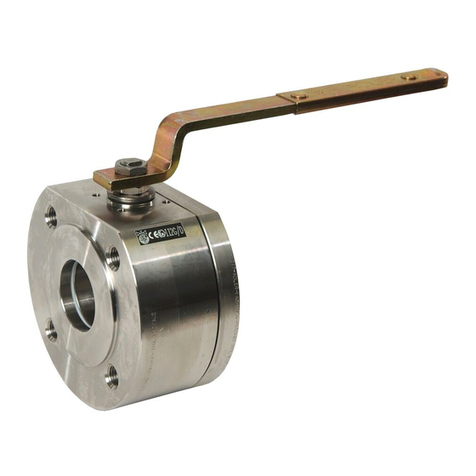
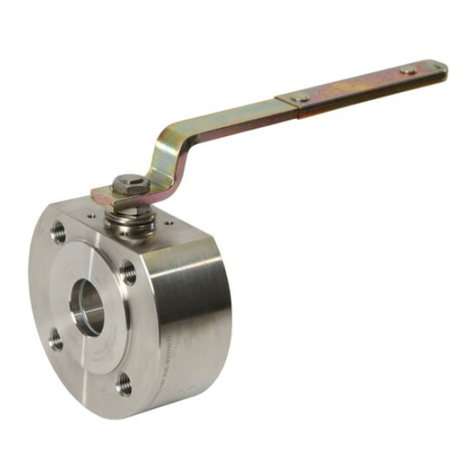
WAFER
FA1 – FA8 – FB1– FC1 – FX1 – FY1
ADLER S.p.A. VALVOLE A SFERA, V.le Borletti 14, 20010 S.Stefano Ticino (MI) ITALY
Tel. +39 02974842.11 Fax. +39 0297271698 E-mail [email protected] http:// www.adlerspa.com
Pag. 5 of 14
5 DISASSEMBLY AND ASSEMBLY OF COMPONENTS
To avoid damages to people or things before to service, the ball valve must be depressurised. Then
follow these indications:
-Turn the lever (ref. 15) to 45° so the ball is opened (or closed) at 50%;
-Clear-up the pipe-line on which the ball valve is mounted;
-Take the necessary precautions to avoid possible accident. During operations of disassembly wear
always appropriate clothes & shoes, anti-acid rubber gloves, glasses, powder/gas-mask evaluating
the degree of danger of the medium;
-Wash accurately the ball valves and the heating jacket;
a) Turn the lever (Ref. 15) up to close the ball;
b) Dismantling the end (Ref. 2) from the body (Ref. 1) unscrew the screw (Ref. 16) ;
c) Remove the ball (Ref. 6), replacing it if the external surface results damaged;
d) Unscrew and remove the second nut on the stem (Ref. 14B), the wrench (Ref. 15), the first nut
(Ref. 14A), spring washers (Ref. 12A, 12B) and the pressing bush (Ref. 11);
e) Remove the stem (Ref. 8) from the bottom , remove the chevron rings (Ref. 10A, 10B, 10C) on
body (Ref. 1) and the stem seal (Ref. 9) from stem (Ref. 8);
f) Replace seats (Ref. 5) of the body (Ref. 1) and of the end/insert (Ref. 2) and if necessary the seal
(Ref. 4) and the O-Ring (Ref. 3)of the body (Ref. 1);
g) Reassemble the stem (Part. 8) from body (Ref. 1) with the bush (Ref. 9), replace them if damaged;
h) Keeping the stem on closed position put the ball (Ref. 6) into the body (Ref. 1), then fix the end
(Ref. 2) to the body (Ref. 1) with the screw (Ref. 16);
i) Reassemble the chevron rings (Ref. 10A, 10B, 10C) on the stem (Ref. 8), replacing it if damaged
observing the following drawing;
j) Reassemble the pressing bush (Ref. 11), spring washers (Ref. 12A, 12B) observing the following
drawing, the first nut (Ref. 14A), the lever (Ref. 15) and the second nut (Ref. 14B);
Open and close 3-4 times in order to check that the rotation is free from defects (appropriate torque
and uniformity of the ball rotation).
5. DEMONTAGE UND MONTAGE VON KOMPONENTEN
Um die Verletzung von Personen und Sachbeschädigungen zu vermeiden, müssen Rohrleitung und
Kugelhahn vor dem Ausbau drucklos gemacht werden.. Danach ist wie folgt vorzugehen :
-Drehen Sie den Handhebel (Ref.15) um 45 °, so dass die Kugel halb geöffnet(bzw. geschlossen)
ist.
-Reinigen Sie die Rohrleitung in welcher der Kugelhahn eingebaut ist, von vorhandenem Medium
und machen Sie diese dann drucklos
-Treffen Sie die nötigen Vorkehrungen, um mögliche Unfälle zu vermeiden. Tragen Sie während
der Demontage geeignete Kleidung und Schuhe, säurefeste Handschuhe, Schutzbrille, Staub- oder
Gasmaske, unter Berücksichtigung der Gefährlichkeit des Mediums.
-Reinigen Sie den Kugelhahn und den Heizmantel (falls vorhanden) sorgfältig.
a) Bringen Sie die Kugel mittels Handhebel (Ref. 15) in Stellung ZU;
b) Entfernen Sie das Gegengehäuse (Ref. 2) vom Gehäuse (Ref. 1) durch Lösen der Schrauben (Ref.
16);
c) Entnehmen Sie die Kugel (Ref. 6). Sollte die Kugeloberfläche beschädigt sein, ist die Kugel
auszutauschen;
d) Lösen und entfernen Sie die zweite Wellenmutter (Ref. 14B), den Handhebel (Ref. 15), die erste
Wellenmutter (Ref. 14A), die Tellerfedern (Ref. 12A, 12B) und den Stopfbuchsdruckring (Ref. 11);
e) Welle (Ref. 8) in des Gehäuse hineindrücken und vorsichtig von der Unterseite ausbauen,
entfernen Sie die 3 fache Dachmanschette (Ref. 10A, 10B, 10C) vom Gehäuse (Ref. 1) und den
Friktionsring (Ref. 9) von der Welle (Ref. 8); ;
f) Ersetzen Sie die Sitzringe (Ref. 5) im Gehäuse (Ref. 1) und Gegengehäuse (Ref. 2) wenn nötig die
Gehäusedichtung (Ref. 4) und den O-Ring (Ref . 3) am Gehäuse (Ref. 1);
g) Wenn beschädigt, Welle(Ref.8) auswechseln, Friktionsring (Ref.9) aufsetzen und die Welle von
innen in das Gehäuse (Ref.1) einbauen
h) Bringen Sie die Welle (Ref. 8) in Stellung ZU und bauen Sie die Kugel (Ref. 6) in das
Gehäuse(Ref. 1) ein, danach Gehäuse (Ref. 1) und Gegengehäuse (Ref. 2) mittels
Gehäuseschrauben (Ref. 16) wieder verschrauben.. Achten Sie darauf, dass die Gehäusedichtung
(Ref.4) und der O-Ring (Ref.3) richtig eingelegt. sind.
i) Montieren Sie die 3 fache Dachmanschette (Ref. 10A, 10B, 10C) auf der Welle (Ref. 8), ersetzen
wenn Sie diese, falls beschädigt, Beachten Sie die folgende Zeichnung.
j) Montieren Sie den Stopfbuchsdruckring (Ref. 11),die Tellerfedern (Ref. 12A, 12B) unter
Berücksichtigung der folgenden Zeichnung, die erste Mutter (Ref. 14A), den Hebel (Ref. 15), und
die zweite Mutter (Ref. 14B);
Öffnen und Schließen Sie den Kugelhahn 3 bis 4mal, um zu überprüfen, ob sich der Kugelhahn
fehlerfrei schalten lässt. (angemessenes Drehmoment und gleichmäßige Kugelbewegung).
*Standard material: C.S. or S.S. Special materials: on request
* Standard Werkstoffe: C.S. oder S.S.. Sonderwerkstoffe: Auf Anfrage
Tightening torque see Table 1
Schraubenanzugsmomente siehe Tabelle 1
N° DESCRIPTION
BESCHREIBUNG MATERIAL*
WERKSTOFFE*
1 Body / Gehäuse C.S. – S.S.
2 End / Gegengehäuse C.S. – S.S.
3 O Ring FKM (viton)
4 Seal / Gehäusedichtung P.T.F.E.
5 Seat / Sitzring P.T.F.E. – R.P.T.F.E.
6 Ball / Kugel S.S.
7 Antistatic device / Antistatikvorrichtung S.S.
8 Stem / Welle S.S.
9 Stem seal / Friktionsring P.T.F.E.
10A Chevron rings / Dachringmanschette P.T.F.E. / GRAPHITE
10B Chevron rings / Dachringmanschette P.T.F.E. / GRAPHITE
10C Chevron rings / Dachringmanschette P.T.F.E. / GRAPHITE
11 Pressing bush / Stopfbuchsdruckring S.S.
12A Spring washer / Tellerfeder C.S. – S.S.
12B Spring washer / Tellerfeder C.S. – S.S.
13A Pin / Anschlag C.S. – S.S.
13B Stop pin / Anschlagschraube C.S. – S.S.
14A First nut / Erste Mutter C.S. – S.S.
14B Second nut / Zweite Mutter C.S. – S.S.
15 Wrench / Handhebel C.S. – S.S.
16 Screw / Schraube C.S. – S.S.
NOTE C.S. PAINTED
LACKIERT C.S. GALVANIZED
VERZINKT
BALL VALVES
KUGELHÄHNE
WAFER SPLIT BODY
FA2 – FB2 – FB8 – FC2 – FX2 – FY2
ADLER S.p.A. VALVOLE A SFERA, V.le Borletti 14, 20010 S.Stefano Ticino (MI) ITALY
Tel. +39 02974842.11 Fax. +39 0297271698 E-mail [email protected] http:// www.adlerspa.com
Pag. 6 of 14
5 DISASSEMBLY AND ASSEMBLY OF COMPONENTS
To avoid damages to people or things before to service, the ball valve must be depressurised. Then
follow these indications:
-Turn the lever (ref. 15) to 45° so the ball is opened (or closed) at 50%;
-Clear-up the pipe-line on which the ball valve is mounted;
-Take the necessary precautions to avoid possible accident. During operations of disassembly wear
always appropriate clothes & shoes, anti-acid rubber gloves, glasses, powder/gas-mask evaluating
the degree of danger of the medium;
-Wash accurately the ball valves and the heating jacket;
a) Turn the lever (Ref. 15) up to close the ball;
b) Dismantling the end (Ref. 2) from the body (Ref. 1) removing screws (Ref. 16);
c) Remove the ball (Ref. 6), replacing it if the external surface results damaged;
d) Unscrew and remove the second nut on the stem (Ref. 14B), the wrench (Ref. 15), the first nut
(Ref. 14A), spring washers (Ref. 12A, 12B) and the pressing bush (Ref. 11);
e) Remove the stem (Ref. 8) from the bottom , remove the chevron rings (Ref. 10A, 10B, 10C) on
body (Ref. 1) and the stem seal (Ref. 9) from stem (Ref. 8);
f) Replace seats (Ref. 5) of the body (Ref. 1) and of the end (Ref. 2) and if necessary the seal (Ref. 4)
on end (Ref. 2) & the O-Ring (Ref. 3)of the body (Ref. 1);
g) Reassemble the stem (Part. 8) from body (Ref. 1) with the bush (Ref. 9), replace them if damaged;
h) Keeping the stem on closed position put the ball (Ref. 6) into the body (Ref. 1), then fix the end
(Ref. 2) to the body (Ref. 1) with screws (Ref. 16);
i) Reassemble the ‘V’ seal (Ref. 10A, 10B, 10C) on the stem (Ref. 8), replacing it if damaged
observing the following drawing;
j) Reassemble the pressing bush (Ref. 11), spring washers (Ref. 12A, 12B) observing the following
drawing, first nut (Ref. 14A), the lever (Ref. 15), the “ISO” plate (Ref. 17) with the valves type
FM2-FN2-FK2, and the second nut (Ref. 14B);
Open and close 3-4 times in order to check that the rotation is free from defects (appropriate torque
and uniformity of the ball rotation).
5. DEMONTAGE UND MONTAGE VON KOMPONENTEN
Um die Verletzung von Personen und Sachbeschädigungen zu vermeiden, müssen Rohrleitung und
Kugelhahn vor dem Ausbau drucklos gemacht werden.. Danach ist wie folgt vorzugehen :
-Drehen Sie den Handhebel (Ref.15) um 45 °, so dass die Kugel halb geöffnet(bzw. geschlossen)
ist.
-Reinigen Sie die Rohrleitung in welcher der Kugelhahn eingebaut ist, von vorhandenem Medium
und machen Sie diese dann drucklos
-Treffen Sie die nötigen Vorkehrungen, um mögliche Unfälle zu vermeiden. Tragen Sie während
der Demontage geeignete Kleidung und Schuhe, säurefeste Handschuhe, Schutzbrille, Staub- oder
Gasmaske, unter Berücksichtigung der Gefährlichkeit des Mediums.
-Reinigen Sie den Kugelhahn und den Heizmantel (falls vorhanden) sorgfältig.
a) Bringen Sie die Kugel mittels Handhebel (Ref. 15) in Stellung ZU;
b) Entfernen Sie das Gegengehäuse (Ref. 2) vom Gehäuse (Ref. 1) durch Lösen der Schrauben (Ref.
16);
c) Entnehmen Sie die Kugel (Ref. 6). Sollte die Kugeloberfläche beschädigt sein, ist die Kugel
auszutauschen;
d) Lösen und entfernen Sie die zweite Wellenmutter (Ref. 14B), den Handhebel (Ref. 15), die erste
Wellenmutter (Ref. 14A), die Tellerfedern (Ref. 12A, 12B) und den Stopfbuchsdruckring (Ref. 11);
e) Welle (Ref. 8) in des Gehäuse hineindrücken und vorsichtig von der Unterseite ausbauen,
entfernen Sie die 3 fache Dachmanschette (Ref. 10A, 10B, 10C) vom Gehäuse (Ref. 1) und den
Friktionsring (Ref. 9) von der Welle (Ref. 8); ;
f) Ersetzen Sie die Sitzringe (Ref. 5) im Gehäuse (Ref. 1) und Gegengehäuse (Ref. 2) wenn nötig die
Gehäusedichtung (Ref. 4) und den O-Ring (Ref . 3) am Gehäuse (Ref. 1);
g) Wenn beschädigt, Welle(Ref.8) auswechseln, Friktionsring (Ref.9) aufsetzen und die Welle von
innen in das Gehäuse (Ref.1) einbauen
h) Bringen Sie die Welle (Ref. 8) in Stellung ZU und bauen Sie die Kugel (Ref. 6) in das
Gehäuse(Ref. 1) ein, danach Gehäuse (Ref. 1) und Gegengehäuse (Ref. 2) mittels
Gehäuseschrauben (Ref. 16) wieder verschrauben.. Achten Sie darauf, dass die Gehäusedichtung
(Ref.4) und der O-Ring (Ref.3) richtig eingelegt. sind.
i) Montieren Sie die 3 fache Dachmanschette (Ref. 10A, 10B, 10C) auf der Welle (Ref. 8), ersetzen
wenn Sie diese, falls beschädigt, Beachten Sie die folgende Zeichnung.
j) Montieren Sie den Stopfbuchsdruckring (Ref. 11),die Tellerfedern (Ref. 12A, 12B) unter
Berücksichtigung der folgenden Zeichnung, die erste Mutter (Ref. 14A), den Hebel (Ref. 15),
die ISO Kopfflanschplatte (Ref. 17A, 17B) (nur bei Kugelhähnen FM2, FN2, FK2) und die zweite
Mutter (Ref. 14B);
Öffnen und Schließen Sie den Kugelhahn 3 bis 4mal, um zu überprüfen, ob sich der Kugelhahn
fehlerfrei schalten lässt. (angemessenes Drehmoment und gleichmäßige Kugelbewegung).
*Standard material: C.S. or S.S. Special materials: on request
* Standard Werkstoffe: C.S. oder S.S.. Sonderwerkstoffe: Auf Anfrage
Tightening torque see Table 1
Schraubenanzugsmomente siehe Tabelle 1
N° DESCRIPTION
BESCHREIBUNG MATERIAL*
WERKSTOFFE*
1 Body / Gehäuse C.S. – S.S.
2 End / Gegengehäuse C.S. – S.S.
3 O Ring FKM (viton)
4 Seal / Gehäusedichtung P.T.F.E.
5 Seat / Sitzring P.T.F.E. – R.P.T.F.E.
6 Ball / Kugel S.S.
7 Antistatic device / Antistatikvorrichtung S.S.
8 Stem /Welle S.S.
9 Stem seal / Friktionsring P.T.F.E.
10A Chevron rings / Dachringmanschette P.T.F.E. / GRAPHITE
10B Chevron rings /Dachringmanschette P.T.F.E. / GRAPHITE
10C Chevron rings / Dachringmanschette P.T.F.E. / GRAPHITE
11 Pressing bush / Stopfbuchsdruckring S.S.
12A Spring washer / Tellerfeder C.S. – S.S.
12B Spring washer / Tellerfeder C.S. – S.S.
13A Pin / Anschlag C.S. – S.S.
13B Stop pin / Anschlagschraube C.S. – S.S.
14A First nut / Erste Mutter C.S. – S.S.
14B Second nut / Zweite Mutter C.S. – S.S.
15 Wrench / Handhebel C.S. – S.S.
16 Screw / Schraube C.S. – S.S.
17 A “ISO” plate / “ISO” Platte S.S.
17B Screw / Schraube
NOTE C.S. PAINTED
LACKIERT C.S. GALVANIZED
VERZINKT
SPLIT BODY
FE2 – FF2 – FG2 – FH2 – FM2- FN2 – FK2 – FJ2 – VE2 – VG2 – VM2 – VN2
2
–
FM2
-
FN2
–
FK2
–
FJ2
–
VE2
–
VG2
–
VM2
–
VN2
BALL VALVES
KUGELHÄHNE
ADLER S.p.A. VALVOLE A SFERA, V.le Borletti 14, 20010 S.Stefano Ticino (MI) ITALY
Tel. +39 02974842.11 Fax. +39 0297271698 E-mail [email protected] http:// www.adlerspa.com
Pag. 7 of 14
5 DISASSEMBLY AND ASSEMBLY OF COMPONENTS
To avoid damages to people or things before to service, the ball valve must be depressurised. Then
follow these indications:
-Turn the lever (ref. 15) to 45° so the ball is opened (or closed) at 50%;
-Clear-up the pipe-line on which the ball valve is mounted;
-Take the necessary precautions to avoid possible accident. During operations of disassembly wear
always appropriate clothes & shoes, anti-acid rubber gloves, glasses, powder/gas-mask evaluating
the degree of danger of the medium;
-Wash accurately the ball valves and the heating jacket;
a) Turn the lever (Ref. 15) up to close the ball;
b) Unscrew the insert (Ref. 2) from the body (Ref. 1);
c) Remove the ball (Ref. 6), replacing it if the external surface results damaged;
d) Unscrew and remove the second nut on the stem (Ref. 14B), the wrench (Ref. 15), the first nut
(Ref. 14A), spring washers (Ref. 12A, 12B) and the pressing bush (Ref. 11);
e) Remove the stem (Ref. 8) from the bottom , remove the chevron rings (Ref. 10A, 10B, 10C) on
body (Ref. 1) and the stem seal (Ref. 9) from stem (Ref. 8);
f) Replace seats (Ref. 5) of the body (Ref. 1) and of the insert (Ref. 2) and if necessary the seal (Ref.
4) on insert (Ref. 2) & the O-Ring (Ref. 3)of the body (Ref. 1);
g) Reassemble the stem (Part. 8) from body (Ref. 1) with the bush (Ref. 9), replace them if damaged;
h) Keeping the stem on closed position put the ball (Ref. 6) into the body (Ref. 1), then fix the insert
(Ref. 2) directly on the body (Ref. 1);
i) Reassemble the chevron rings (Ref. 10A, 10B, 10C) on the stem (Ref. 8), replacing it if damaged
observing the following drawing;
j) Reassemble the pressing bush (Ref. 11), spring washers (Ref. 12A, 12B) observing the following
drawing, first nut (Ref. 14A), the lever (Ref. 15 and the second nut (Ref. 14B);
Open and close 3-4 times in order to check that the rotation is free from defects (appropriate torque
and uniformity of the ball rotation).
5. DEMONTAGE UND MONTAGE VON KOMPONENTEN
Um die Verletzung von Personen und Sachbeschädigungen zu vermeiden, müssen Rohrleitung und
Kugelhahn vor dem Ausbau drucklos gemacht werden.. Danach ist wie folgt vorzugehen :
-Drehen Sie den Handhebel (Ref.15) um 45 °, so dass die Kugel halb geöffnet(bzw. geschlossen)
ist.
-Reinigen Sie die Rohrleitung in welcher der Kugelhahn eingebaut ist, von vorhandenem Medium
und machen Sie diese dann drucklos
-Treffen Sie die nötigen Vorkehrungen, um mögliche Unfälle zu vermeiden. Tragen Sie während
der Demontage geeignete Kleidung und Schuhe, säurefeste Handschuhe, Schutzbrille, Staub- oder
Gasmaske, unter Berücksichtigung der Gefährlichkeit des Mediums.
-Reinigen Sie den Kugelhahn und den Heizmantel (falls vorhanden) sorgfältig.
a) Bringen Sie die Kugel mittels Handhebel (Ref. 15) in Stellung ZU;
b) Lösen Sie den Gewindedruckring (Ref. 2) und entfernen Sie diesen vom Gehäuse (Ref. 1);
c) Entnehmen Sie die Kugel (Ref. 6). Sollte die Kugeloberfläche beschädigt sein, ist die Kugel
auszutauschen;
d) Lösen und entfernen Sie die zweite Wellenmutter (Ref. 14B), den Handhebel (Ref. 15), die erste
Wellenmutter (Ref. 14A), die Tellerfedern (Ref. 12A, 12B) und den Stopfbuchsdruckring (Ref. 11);
e) Welle (Ref. 8) in des Gehäuse hineindrücken und vorsichtig von der Unterseite ausbauen,
entfernen Sie die 3 fache Dachmanschette (Ref. 10A, 10B, 10C) vom Gehäuse (Ref. 1) und den
Friktionsring (Ref. 9) von der Welle (Ref. 8); ;
f) Ersetzen Sie die Sitzringe (Ref. 5) im Gehäuse (Ref. 1) und Gehäuseverschraubung (Ref. 2) wenn
nötig die Dichtung (Ref. 4) an der Gehäuseverschraubung (Ref. 2) und den O-Ring (Ref . 3) am
Gehäuse (Ref. 1);
g) Wenn beschädigt, Welle(Ref.8) auswechseln, Friktionsring (Ref.9) aufsetzen und die Welle von
innen in das Gehäuse (Ref.1) einbauen
h) Bringen Sie die Welle (Ref. 8) in Stellung ZU und bauen Sie die Kugel (Ref. 6) in das
Gehäuse(Ref. 1) ein, dann schrauben Sie Gehäuseverschraubung (Ref. 2), wieder in das Gehäuse
(Ref. 1) ein. Achten Sie darauf, dass die Gehäusedichtung (Ref.4) und der O-Ring (Ref.3) richtig
eingelegt. sind.
i) Montieren Sie die 3 fache Dachmanschette (Ref. 10A, 10B, 10C) auf der Welle (Ref. 8), ersetzen
wenn Sie diese, falls beschädigt, Beachten Sie die folgende Zeichnung.
j) Montieren Sie den Stopfbuchsdruckring (Ref. 11),die Tellerfedern (Ref. 12A, 12B) unter
Berücksichtigung der folgenden Zeichnung, die erste Mutter (Ref. 14A), den Hebel (Ref. 15), und
die zweite Mutter (Ref. 14B);
Öffnen und Schließen Sie den Kugelhahn 3 bis 4mal, um zu überprüfen, ob sich der Kugelhahn
fehlerfrei schalten lässt. (angemessenes Drehmoment und gleichmäßige Kugelbewegung).
*Standard material: C.S. or S.S. Special materials: on request
* Standard Werkstoffe: C.S. oder S.S.. Sonderwerkstoffe: auf Anfrage
Notes: On valve type FP2 there isn’t the O-Ring (Ref. 3).
Hinweis: Bei Kugelhähnen Typ FP2 ist der O-Ring (Ref.. 3) nicht vorhanden.
Notes: On valve type FS2-FR2 there isn’t the intermediate Chevron ring(Ref. 10B).
Hinweis: Bei Kugelhähne Typ FS2-FR2 ist die mittlere Dachringmanschette (Ref. 10B)
nicht vorhanden
N° DESCRIPTION
BESCHREIBUNG MATERIAL*
WERKSTOFFE*
1 Body / Gehäuse C.S. – S.S.
2 Insert / Gegengehäuse C.S. – S.S.
3 O Ring FKM (viton)
4 Seal / Gehäusedichtung P.T.F.E.
5 Seat / Sitzring P.T.F.E. – R.P.T.F.E.
6 Ball / Kugel S.S.
7 Antistatic device / Antistatikvorrichtung S.S.
8 Stem / Welle S.S.
9 Stem seal / Friktionsring P.T.F.E.
10A Chevron rings / Dachringmanschette P.T.F.E. / GRAPHITE
10B Chevron rings / Dachringmanschette P.T.F.E. / GRAPHITE
10C Chevron rings / Dachringmanschette P.T.F.E. / GRAPHITE
11 Pressing bush / Stopfbuchsdruckring S.S.
12A Spring washer / Tellerfeder C.S. – S.S.
12B Spring washer / Tellerfeder C.S. – S.S.
13A Pin / Anschlag C.S. – S.S.
13B Stop pin / Anschlagschraube C.S. – S.S.
14A First nut / Erste Mutter C.S. – S.S.
14B Second nut / Zweite Mutter C.S. – S.S.
15 Wrench / Handhebel C.S. – S.S.
NOTE C.S. PAINTED
LACKIERT C.S. GALVANIZED
VERZINKT
BALL VALVES
KUGELHÄHNE
2 PIECES THREADED-WELDED / 2-teilig Gewinde - Schweißende
FP2 – FS2 – FR2
2
–
FM2
-
FN2
–
FK2
–
FJ2
–
VE2
–
VG2
–
VM2
–
VN2
ADLER S.p.A. VALVOLE A SFERA, V.le Borletti 14, 20010 S.Stefano Ticino (MI) ITALY
Tel. +39 02974842.11 Fax. +39 0297271698 E-mail [email protected] http:// www.adlerspa.com
Pag. 8 of 14
5 DISASSEMBLY AND ASSEMBLY OF COMPONENTS
To avoid damages to people or things before to service, the ball valve must be depressurised. Then
follow these indications:
-Turn the lever (ref. 15) to 45° so the ball is opened (or closed) at 50%;
-Clear-up the pipe-line on which the ball valve is mounted;
-Take the necessary precautions to avoid possible accident. During operations of disassembly wear
always appropriate clothes & shoes, anti-acid rubber gloves, glasses, powder/gas-mask evaluating
the degree of danger of the medium;
-Wash accurately the ball valves;
-For valves FP3 with welded connections (B.W.-S.W.) before to weld the valve on plant is
necessary to made a welding in 3 points, unscrew the screws (Ref. 16) and remove the body (Ref.
1) and the seats (Ref. 5) and after made the complete welding.
a) Turn the lever (Ref. 15) up to close the ball;
b) Dismantling the ends (Ref. 2) from the body (Ref. 1) removing screws (Ref. 16);
c) Remove the ball (Ref. 6), replacing it if the external surface results damaged;
d) Unscrew and remove the second nut on the stem (Ref. 14B), the wrench (Ref. 15), the first nut
(Ref. 14A), spring washers (Ref. 12A, 12B) and the pressing bush (Ref. 11);
e) Remove the stem (Ref. 8) from the bottom , remove the chevron rings (Ref. 10A, 10B, 10C) on
body (Ref. 1) and the stem seal (Ref. 9) from stem (Ref. 8);
f) Replace seats (Ref. 5) of the body (Ref. 1) and if necessary the seal (Ref. 4) of the body (Ref. 1);
g) Reassemble the stem (Part. 8) from body (Ref. 1) with the bush (Ref. 9), replace them if damaged;
h) Keeping the stem on closed position put the ball (Ref. 6) into the body (Ref. 1), then fix the ends
(Ref. 2) to the body (Ref. 1) with screws (Ref. 16);
i) Reassemble the ‘V’ seal (Ref. 10A, 10B, 10C) on the stem (Ref. 8), replacing it if damaged
observing the following drawing;
j) Reassemble the pressing bush (Ref. 11), spring washers (Ref. 12A, 12B) observing the following
drawing, first nut (Ref. 14A), the lever (Ref. 15 and the second nut (Ref. 14B)
Open and close 3-4 times in order to check that the rotation is free from defects (appropriate torque
and uniformity of the ball rotation).
5. DEMONTAGE UND MONTAGE VON KOMPONENTEN
Um die Verletzung von Personen und Sachbeschädigungen zu vermeiden, müssen Rohrleitung und
Kugelhahn vor dem Ausbau drucklos gemacht werden.. Danach ist wie folgt vorzugehen :
-Drehen Sie den Handhebel (Ref.15) um 45 °, so dass die Kugel halb geöffnet(bzw. geschlossen)
ist.
-Reinigen Sie die Rohrleitung in welcher der Kugelhahn eingebaut ist, von vorhandenem Medium
und machen Sie diese dann drucklos
-Treffen Sie die nötigen Vorkehrungen, um mögliche Unfälle zu vermeiden. Tragen Sie während
der Demontage geeignete Kleidung und Schuhe, säurefeste Handschuhe, Schutzbrille, Staub- oder
Gasmaske, unter Berücksichtigung der Gefährlichkeit des Mediums.
-Reinigen Sie den Kugelhahn und den sorgfältig.
-Bei Kugelhähnen FP3 mit Schweißenden (B.W – S.W) sind zuerst 3 Schweißpunkte zu setzen,
dann lösen Sie die Schrauben (Ref.. 16) und entnehmen das Gehäuse(Ref. 1) mit den
Sitzen(Ref.5) , danach führen Sie die gesamte Schweißnaht aus.
a) Bringen Sie die Kugel mittels Handhebel (Ref. 15) in Stellung ZU;
b) Entfernen Sie Enden (Ref. 2) vom Gehäuse (Ref. 1) durch Lösen der Schrauben (Ref. 16);
c) Entnehmen Sie die Kugel (Ref. 6). Sollte die Kugeloberfläche beschädigt sein, ist die Kugel
auszutauschen;
d) Lösen und entfernen Sie die zweite Wellenmutter (Ref. 14B), den Handhebel (Ref. 15), die erste
Wellenmutter (Ref. 14A), die Tellerfedern (Ref. 12A, 12B) und den Stopfbuchsdruckring (Ref. 11);
e) Welle (Ref. 8) in des Gehäuse hineindrücken und vorsichtig von der Unterseite ausbauen,
entfernen Sie die 3 fache Dachmanschette (Ref. 10A, 10B, 10C) vom Gehäuse (Ref. 1) und den
Friktionsring (Ref. 9) von der Welle (Ref. 8); ;
f) Ersetzen Sie die Sitzringe (Ref. 5) im Gehäuse (Ref. 1) und , wenn nötig, die Gehäusedichtungen
(Ref. 4) am Gehäuse
g) Wenn beschädigt, Welle(Ref.8) auswechseln, Friktionsring (Ref.9) aufsetzen und die Welle von
innen in das Gehäuse (Ref.1) einbauen
h) Bringen Sie die Welle (Ref. 8) in Stellung ZU und bauen Sie die Kugel (Ref. 6) in das
Gehäuse(Ref. 1) ein, dann verschrauben Sie das Gehäuse (Ref.1) mit den Enden (Ref. 2) mit den
Schrauben (Ref. 16)
i
)
Montieren Sie die 3 fache Dachmanschette (Ref. 10A, 10B, 10C) auf der Welle (Ref. 8), ersetzen
wenn Sie diese, falls beschädigt, Beachten Sie die folgende Zeichnung.
j) Montieren Sie den Stopfbuchsdruckring (Ref. 11),die Tellerfedern (Ref. 12A, 12B) unter
Berücksichtigung der folgenden Zeichnung, die erste Mutter (Ref. 14A), den Hebel (Ref. 15), und
die zweite Mutter (Ref. 14B);
Öffnen und Schließen Sie den Kugelhahn 3 bis 4mal, um zu überprüfen, ob sich der Kugelhahn
fehlerfrei schalten lässt. (angemessenes Drehmoment und gleichmäßige Kugelbewegung).
*Standard material: C.S. or S.S. Special materials: on request
* Standard Werkstoffe: C.S. oder S.S.. Sonderwerkstoffe: Auf Anfrage
N° DESCRIPTION
BESCHREIBUNG MATERIAL*
WERKSTOFFE*
1 Body / Gehäuse C.S. – S.S.
2 End / Ende C.S. – S.S.
4 Seal / Gehäusedichtung P.T.F.E.
5 Seat / Sitzring P.T.F.E. – R.P.T.F.E.
6 Ball / Kugel S.S.
7 Antistatic device / Antistatik vorrichtung S.S.
8 Stem / WElle S.S.
9 Stem seal / Friktionsring P.T.F.E.
10A Chevron rings / Dachringmanschette P.T.F.E. / GRAPHITE
10B Chevron rings / Dachringmanschette P.T.F.E. / GRAPHITE
10C Chevron rings / Dachringmanschette P.T.F.E. / GRAPHITE
11 Pressing bush / Stopfbuchsdruckring S.S.
12A Spring washer / Tellerfeder C.S. – S.S.
12B Spring washer / Tellerfeder C.S. – S.S.
13A Pin / Anschlag C.S. – S.S.
13B Stop pin / Anschlagschraube C.S. – S.S.
14A First nut / Erste Mutter C.S. – S.S.
14B Second nut / Zweite Mutter C.S. – S.S.
15 Wrench / Handhebel C.S. – S.S.
16 Screw / Schraube C.S. – S.S.
NOTE C.S. PAINTED
LACKIERT C.S. GALVANIZED
VERZINKT
BALL VALVES
KUGELHÄHNE
3 PIECES THREADED-WELDED / 3-teilig Gewinde – Schweißende
FP3 – FR3
2
–
FM2
-
FN2
–
FK2
–
FJ2
–
VE2
–
VG2
–
VM2
–
VN2
ADLER S.p.A. VALVOLE A SFERA, V.le Borletti 14, 20010 S.Stefano Ticino (MI) ITALY
Tel. +39 02974842.11 Fax. +39 0297271698 E-mail [email protected] http:// www.adlerspa.com
Pag. 9 of 14
5 DISASSEMBLY AND ASSEMBLY OF COMPONENTS
To avoid damages to people or things before to service, the ball valve must be depressurised. Then
follow these indications:
-Turn the lever (ref. 15) to 45° so the ball is opened (or closed) at 50%;
-Clear-up the pipe-line on which the ball valve is mounted;
-Take the necessary precautions to avoid possible accident. During operations of disassembly wear
always appropriate clothes & shoes, anti-acid rubber gloves, glasses, powder/gas-mask evaluating
the degree of danger of the medium;
-Wash accurately the ball valves and the heating jacket;
a) Turn the lever (Ref. 15) and put the ball (Ref.6) in 1/2/3 position, if necessary remove the pin
(Ref. 13A) and the screw (Ref. 13B);
b) Dismantling the insert (Ref. 2A, 2B, 2C) from the body (Ref. 1);
c) Remove the ball (Ref. 6), replacing it if the external surface results damaged;
d) Unscrew and remove the second nut on the stem (Ref. 14B), the wrench (Ref. 15), the first nut
(Ref. 14A), spring washers (Ref. 12A, 12B) and the pressing bush (Ref. 11);
e) Remove the stem (Ref. 8) from the bottom , remove the chevron rings (Ref. 10A, 10B, 10C) on
body (Ref. 1) and the stem seal (Ref. 9) from stem (Ref. 8);
f) Replace seats (Ref. 5) of the body (Ref. 1) and of the inserts (Ref. 2) and if necessary the seals
(Ref. 4A, 4B, 4C) and the O-Rings (Ref. 3A, 3B) of the body (Ref. 1);
g) Reassemble the stem (Part. 8) from body (Ref. 1) with the bush (Ref. 9), replace them if damaged;
h) Keeping the stem in axis with the position 2/3 put the ball (Ref. 6) into the body (Ref. 1), and keep
the ball in position 1/2/0, screwing the insert of way n°3 (Ref. 2A) on the body (Ref. 1) up to
mechanical ledge;
i) Screw the insert of way N°1 (Ref. 2B) and the insert of blind way (Ref. 2C) on the body (Ref. 1)
without reaching the mechanical ledge;
j) Keep the ball in position 0/2/3 and screw up to mechanical ledge the insert of way N°1 (Ref. 2B),
keep the ball in position 1/2/3 and screw up to mechanical ledge the insert of blinded way (Ref.
2C);
k) Rotate the ball for 2-3 times in order to be sure that the ball is centred with the body (Ref. 1);
l) Reassemble the chevron rings (Ref. 10A, 10B, 10C) on the stem (Ref. 8), replacing it if damaged,
following the drawing;
m) Reassemble the pressing bush (Ref. 11), spring washers (Ref. 12A, 12B) following the drawing, the
first nut (Ref. 14A), the lever (Ref. 15 and the second nut (Ref. 14B);
Open and close 3-4 times in order to check that the rotation is free from defects (appropriate torque
and uniformity of the ball rotation).
In case of valves with ball “L” port, put the insert (Ref. 2A, 2B 2C) up to mechanical ledge positioning
the ball (Ref. 6) with the round part in line with the insert to be assembled.
5 DEMONTAGE UND MONTAGE VON KOMPONENTEN
Um die Verletzung von Personen und Sachbeschädigungen zu vermeiden, müssen Rohrleitung und
Kugelhahn vor dem Ausbau drucklos gemacht werden.. Danach ist wie folgt vorzugehen :
-Drehen Sie den Handhebel(Ref.15) um 45 °, so dass die Kugel halb geöffnet(bzw. geschlossen)
ist.
-Reinigen Sie die Rohrleitung in welcher der Kugelhahn eingebaut ist, von vorhandenem Medium
und machen Sie diese dann drucklos
-Treffen Sie die nötigen Vorkehrungen, um mögliche Unfälle zu vermeiden. Tragen Sie während
der Demontage geeignete Kleidung und Schuhe, säurefeste Handschuhe, Schutzbrille, Staub- oder
Gasmaske, unter Berücksichtigung der Gefährlichkeit des Mediums.
-Reinigen Sie den Kugelhahn und den Heizmantel (falls vorhanden) sorgfältig.
-
a) Bringen Sie die Kugel (Ref. 6) mit dem Handhebel (Ref. 15 )in Stellung 1/2/3 (Weg 1,2,3 offen)
entfernen Sie, wenn nötig, den Anschlag und die Schraube (Ref. 13a,13b)
b) Lösen und entfernen–Sie die Gehäuseverschraubungen (Ref. 2a, 2b, 2c) vom Gehäuse (Ref.1)
c) Entnehmen Sie die Kugel (Ref. 6). Sollte die Kugeloberfläche beschädigt sein, ist die Kugel
auszutauschen;
d) Lösen und entfernen Sie die zweite Wellenmutter (Ref. 14B), den Handhebel (Ref. 15), die erste
Wellenmutter (Ref. 14A), die Tellerfedern (Ref. 12A, 12B) und den Stopfbuchsdruckring (Ref. 11);
e) Welle (Ref. 8) in des Gehäuse hineindrücken und vorsichtig von der Unterseite ausbauen,
entfernen Sie die 3 fache Dachmanschette (Ref. 10A, 10B, 10C) vom Gehäuse (Ref. 1) und den
Friktionsring (Ref. 9) von der Welle (Ref. 8); ;
f) Ersetzen Sie die Sitzringe (Ref. 5) im Gehäuse (Ref. 1) und den Gehäuseverschraubungen (Ref. 2)
wenn nötig die Dichtungen (Ref. 4a/b/c) und die O-Ringe (Ref . 3a/b) am Gehäuse (Ref. 1);
g) Wenn beschädigt, Welle(Ref.8) auswechseln, Friktionsring (Ref.9) aufsetzen und die Welle von
innen in das Gehäuse (Ref.1) einbauen
h) Bringen Sie die Welle(Ref. 8) in Stellung 2/3, setzen Sie die Kugel (Ref.6) in das Gehäuse (Ref.1)
ein, bringen Sie die Kugel in Stellung 1/2/0 und schrauben Sie die Gehäuseverschraubung Seite 3.
(Ref. 2a) in das Gehäuse bis zum Erreichen des mechanischen Anschlags.
i) Schrauben Sie die Gehäuseverschraubung Seite 1 (Ref..2b) und die Gehäuseverschraubung Seite
0 (Part. 2C) in das Gehäuse (Ref. 1) jedoch nicht bis zum Erreichen des mechanischen Anschlags.
j) Bringen Sie die Kugel (Part. 6) in Position 0/2/3, und ziehen Sie die Gehäuseverschraubung Seite
1 (Ref. 2b) bis zum mechanischen Anschlag an. Bringen Sie die Kugel (Part. 6) in Stellung 1/2/3
und ziehen Sie den Gewindedruckring Seite 0 (Part. 2C) bis zum mechanischen Anschlag an.
k) Drehen Sie die Kugel 2-3 mal, um sicherzustellen, dass diese zentrisch eingebaut ist;
l) Dachringmanschetten (Ref. 10a, 10b, 10b) wenn nötig, wechseln und auf der Welle(Ref. 8), unter
Berücksichtigung der folgenden Zeichnung montieren.
m) Montieren Sie den Stopfbuchsdruckring (Ref. 11),die Tellerfedern (Ref. 12A, 12B) unter
Berücksichtigung der folgenden Zeichnung, die erste Mutter (Ref. 14A), den Hebel (Ref. 15), und
die zweite Mutter (Ref. 14B);
Öffnen und Schließen Sie den Kugelhahn 3 bis 4mal, um zu überprüfen, ob sich der Kugelhahn
fehlerfrei schalten lässt. (angemessenes Drehmoment und gleichmäßige Kugelbewegung).
Bei Kugelhähnen mit Kugel mit L-Bohrung ziehen Sie die Gehäuseverschraubungen ( Ref. 2a,2b,2b)
bis zum mechanischen Anschlag an, dabei bringen Sie die geschlossene Seite der Kugel (Ref. 6) zu
der jeweils anzuziehenden Gehäuseverschraubung.
*Standard material: C.S. or S.S. Special materials: on request
* Standard Werkstoffe: C.S. oder S.S.. Sonderwerkstoffe: auf Anfrage
Ref. 3 A,B,C not available on valve type FT6
Ref. 3 a/b/c nicht vorhanden bei Typ FT6
Ref. 3 A not available on valves type FT4 ND 15,50,65.
Ref. 3 a nicht vorhanden bei Typ FT4 DN 15,50,65
Ref. 3 C not available on valves type FT4 from ND 15 to ND 50.
Ref. 3 c nicht vorhanden bei Typ FT4 DN 15 bis DN 50
N° DESCRIPTION
BESCHREIBUNG MATERIAL*
WERKSTOFFE*
1 Body / Gehäuse C.S. – S.S.
2A Insert way N°3 / Gehäuseverschraubung 3 C.S. – S.S.
2B Insert way N°1 / Gehäuseverschraubung 1 C.S. – S.S.
2C Insert way No.0 / Gehäuseverschraubung 0 C.S. – S.S.
3A O ring way N°3 / O Ring auf –Seite 3 FKM (Viton)
3B
3C O ring way N°1 / O Ring Seite 1
O-Ring way No.0/O Ring Seite 0 FKM (Viton)
4A Seal way N°3 / Gehäusedichtung Seite 3 P.T.F.E.
4B Seal way N°1 / Gehäusedichtung Seite 1 P.T.F.E.
4C Seal way No.0 / Gehäusedichtung Seite 0 P.T.F.E.
5 Seat / Sitz ring P.T.F.E. – R.P.T.F.E.
6 Ball / Kugel S.S.
7 Antistatic device / Antistatikvorrichtung S.S.
8 Stem / Welle S.S.
9 Stem seal / Friktionsring P.T.F.E.
10A Chevron rings / Dachringmanschette P.T.F.E. / GRAPHITE
10B Chevron rings / Dachringmanschette P.T.F.E. / GRAPHITE
10C Chevron rings / Dachringmanschette P.T.F.E. / GRAPHITE
11 Pressing bush / Stopfbuchsdruckring S.S.
12A Spring washer / Tellerfeder+ C.S. – S.S.
12B Spring washer / Tellerfeder C.S. – S.S.
13A Pin / Anschlag C.S. – S.S.
13B Stop pin / Anschlagschraube C.S. – S.S.
14A First nut / Erste Mutter C.S. – S.S.
14B Second nut / Zweite Mutter C.S. – S.S.
15 Wrench / Handhebel C.S. – S.S.
18 Flow Indicator/Durchflussanzeiger
NOTE C.S. PAINTED
LACKIERT C.S. GALVANIZED
VERZINKT
BALL VALVES
KUGELHÄHNE
3 WAY WAFER 90° / 3-Wege-Kompaktkugelhähne 90°
FT4 – FT6
ADLER S.p.A. VALVOLE A SFERA, V.le Borletti 14, 20010 S.Stefano Ticino (MI) ITALY
Tel. +39 02974842.11 Fax. +39 0297271698 E-mail [email protected] http:// www.adlerspa.com
Pag. 10 of 14
5 DISASSEMBLY AND ASSEMBLY OF COMPONENTS
To avoid damages to people or things before to service, the ball valve must be depressurised. Then
follow these indications:
-Turn the lever (ref. 15) to 45° so the ball is opened (or closed) at 50%;
-Clear-up the pipe-line on which the ball valve is mounted;
-Take the necessary precautions to avoid possible accident. During operations of disassembly wear
always appropriate clothes & shoes, anti-acid rubber gloves, glasses, powder/gas-mask evaluating
the degree of danger of the medium;
-Wash accurately the ball valves and the heating jacket;
a) Turn the lever (Ref. 15) and put the ball (Ref.6) in 1/3 position, if necessary remove the pin (Ref.
13A) and the screw (Ref. 13B);
b) Dismantling the insert (Ref. 2) from the body (Ref. 1);
c) Remove the ball (Ref. 6), replacing it if the external surface results damaged;
d) Unscrew and remove the second nut on the stem (Ref. 14B), the wrench (Ref. 15), the first nut
(Ref. 14A), spring washers (Ref. 12A, 12B) and the pressing bush (Ref. 11);
e) Remove the stem (Ref. 8) from the bottom , remove the chevron rings (Ref. 10A, 10B, 10C) on
body (Ref. 1) and the stem seal (Ref. 9) from stem (Ref. 8);
f) Replace seats (Ref. 5) of the body (Ref. 1) and of the inserts (Ref. 2) and if necessary the seals
(Ref. 4) and the O-Rings (Ref. 3) of the body (Ref. 1);
g) Reassemble the stem (Part. 8) from body (Ref. 1) with the bush (Ref. 9), replace if damaged;
h) Keeping the stem in axis with the position 2/3 put the ball (Ref. 6) into the body (Ref. 1), and keep
the ball in position 1/3, screwing the insert (Ref. 2) on the body (Ref. 1) up to mechanical ledge;
i) Rotate the ball 2-3 times in order to be sure that ball is centred with the body (Ref. 1);
j) Reassemble the chevron ring (Ref. 10A, 10B, 10C) on the stem (Ref. 8), replacing it if damaged,
following the drawing;
k) Reassemble the pressing bush (Ref. 11), spring washers (Ref. 12A, 12B) following the drawing, the
first nut (Ref. 14A), the lever (Ref. 15 and the second nut (Ref. 14B);
Open and close 3-4 times in order to check that the rotation is free from defects (appropriate torque
and uniformity of the ball rotation).
5.DEMONTAGE UND MONTAGE VON KOMPONENTEN
Um die Verletzung von Personen und Sachbeschädigungen zu vermeiden, müssen Rohrleitung und
Kugelhahn vor dem Ausbau drucklos gemacht werden.. Danach ist wie folgt vorzugehen :
-Drehen Sie den Handhebel (Ref.15) um 45 °, so dass die Kugel halb geöffnet(bzw. geschlossen)
ist.
-Reinigen Sie die Rohrleitung in welcher der Kugelhahn eingebaut ist, von vorhandenem Medium
und machen Sie diese dann drucklos
-Treffen Sie die nötigen Vorkehrungen, um mögliche Unfälle zu vermeiden. Tragen Sie während
der Demontage geeignete Kleidung und Schuhe, säurefeste Handschuhe, Schutzbrille, Staub- oder
Gasmaske, unter Berücksichtigung der Gefährlichkeit des Mediums.
-Reinigen Sie den Kugelhahn und den Heizmantel (falls vorhanden) sorgfältig.
-
a) Bringen Sie die Kugel (Ref. 6) mit dem Handhebel (Ref. 15 )in Stellung 1/3 (Weg 1,3 offen)
entfernen Sie, wenn nötig, den Anschlag und die Schraube (Ref. 13a,13b)
b) Lösen und entfernen–Sie die Gehäuseverschraubungen (Ref. 2) vom Gehäuse (Ref.1)
c) Entnehmen Sie die Kugel (Ref. 6). Sollte die Kugeloberfläche beschädigt sein, ist die Kugel
auszutauschen;
d) Lösen und entfernen Sie die zweite Wellenmutter (Ref. 14B), den Handhebel (Ref. 15), die erste
Wellenmutter (Ref. 14A), die Tellerfedern (Ref. 12A, 12B) und den Stopfbuchsdruckring (Ref. 11);
e) Welle (Ref. 8) in des Gehäuse hineindrücken und vorsichtig von der Unterseite ausbauen,
entfernen Sie die 3 fache Dachmanschette (Ref. 10A, 10B, 10C) vom Gehäuse (Ref. 1) und den
Friktionsring (Ref. 9) von der Welle (Ref. 8); ;
f) Ersetzen Sie die Sitzringe (Ref. 5) im Gehäuse (Ref. 1) und den Gehäuseverschraubungen (Ref. 2)
wenn nötig die Dichtungen (Ref. 4) und die O-Ringe (Ref . 3) am Gehäuse (Ref. 1);
g) Wenn beschädigt, Welle(Ref.8) auswechseln, Friktionsring (Ref.9) aufsetzen und die Welle von
innen in das Gehäuse (Ref.1) einbauen
h) Bringen Sie die Welle(Ref. 8) in Stellung 2/3, setzen Sie die Kugel (Ref.6) in das Gehäuse (Ref.1)
ein, bringen Sie die Kugel in Stellung 1/3 und schrauben Sie die Gehäuseverschraubung
(Ref. 2) in das Gehäuse bis zum Erreichen des mechanischen Anschlags.
i) Drehen Sie die Kugel 2-3 mal, um sicherzustellen, dass diese zentrisch eingebaut ist;
j) Dachringmanschetten (Ref. 10a, 10b, 10b) wenn nötig, wechseln und auf der Welle(Ref. 8), unter
Berücksichtigung der folgenden Zeichnung montieren.
k) Montieren Sie den Stopfbuchsdruckring (Ref. 11),die Tellerfedern (Ref. 12A, 12B) unter
Berücksichtigung der folgenden Zeichnung, die erste Mutter (Ref. 14a), den Hebel (Ref. 15), und
die zweite Mutter (Ref. 14b);
Öffnen und Schließen Sie den Kugelhahn 3 bis 4mal, um zu überprüfen, ob sich der Kugelhahn
fehlerfrei schalten lässt. (angemessenes Drehmoment und gleichmäßige Kugelbewegung).
*Standard material: C.S. or S.S. Special materials: on request
* Standard Werkstoffe: C.S. oder S.S.. Sonderwerkstoffe: Auf Anfrage
Ref. 3 a,b,c not available on valve type FZ6, FA4
Ref. 3 a,b,c nicht vorhanden bei Typ FZ6, FA4
Ref. 3 a not available on valves type FZ4 ND 15,50,65.
Ref. 3 a nicht vorhanden bei Typ FZ4 – DN 15,50,65
Ref. 3 c not available on valves type FZ4 from ND 15 to ND 50.
Ref. 3 c nicht vorahnden bei Typ FZ4 – DN 15 – DN 50
N° DESCRIPTION
BESCHREIBUNG MATERIAL*
WERKSTOFFE*
1 Body / Gehäuse C.S. – S.S.
2 Insert / Gehäuseverschraubung C.S. – S.S.
3 O Ring FKM (viton)
4 Seal / Gehäusedichtung P.T.F.E.
5 Seat / Sitzring P.T.F.E. – R.P.T.F.E.
6 Ball / Kugel S.S.
7 Antistatic device / Antistatikvorrichtung S.S.
8 Stem / Welle S.S.
9 Stem seal / Friktionsring P.T.F.E.
10A Chevron rings / Dachringmanschette P.T.F.E. / GRAPHITE
10B Chevron rings / Dachringmanschette P.T.F.E. / GRAPHITE
10C Chevron rings / Dachringmanschette P.T.F.E. / GRAPHITE
11 Pressing bush / Stopfbuchsdruckring S.S.
12A Spring washer / Tellerfeder C.S. – S.S.
12B Spring washer / Tellerfeder C.S. – S.S.
13A Pin / Anschlag C.S. – S.S.
13B Stop pin / Anschlagschraube C.S. – S.S.
14A First nut / Erste Mutter C.S. – S.S.
14B Second nut / Zweite Mutter C.S. – S.S.
15 Wrench / Handhebel C.S. – S.S.
18 Flow Indicator/Durchflusanzeiger
NOTE C.S. PAINTED
LACKIERT C.S. GALVANIZED
VERZINKT
BALL VALVES
KUGELHÄHNE
3 WAY WAFER 90° / 3-Wege Kompaktkugelhähne 90°
FZ4– FZ6 – FA4
2
–
FM2
-
FN2
–
FK2
–
FJ2
–
VE2
–
VG2
–
VM2
–
VN2