GOINTFIcILS
ANTENNA INFORMATION
When receiving broadcast signals, the antenna being used is of
great ¡mportance. The pos¡tion of the antenna is especially
important when receiving stereo broadcasts. lncorrect antenna
placement is often the cause of d¡stort¡on or insufficient
channel separation.
* When an FM or AM antenna is placed high in the air,
use a l¡ghtening arrestor to protect the un¡Î.
FM ANTENNA
For FM broadcast recept¡on, the use of a professional type
FM outdoor antenna ¡s most ideal, but when signals are
strong, the standard accessory FM di-pole antenna will suffice.
A variety of antennas are available on the market for use
according to the spec¡f¡c area in which lhey are to be used.
Typical examples are: lndoor Antenna: For about a 20 km
(15 mile) radius from the stat¡on; 3-Element Anlenna: For
about a 60 km (40 mile) radius from the stat¡on; S-Element
Antenna: For about a 80 km (5O milel radius from the
stal ron.
This model is equipped with both 75,Çù and 300o impedance
antenna terminals: 75O Terminals: Use to connect a 75fl
coaxial cable from an outdoor FM antenna placed at a
distance away from the un¡t; 3OOfl Terminals: The supplied
3O0O di-pole antenna is sufficient when the signals are
relatively strong.
* lf in a remote atea, o( inside a concrete bu¡ld¡ng, etc., a
multi-element outdoor antenna is recommended. ln this
case, use 300 ohm terminals.
* When using TV antenna feeder wire, keep in m¡nd that
the w¡re ¡s suscept¡ble to corrosion and lasts only a few
years. Check wire periodically as defective lead-in wire
can cause sound distorl¡on or increased noise.
* A TV/FM Antenna can also be used in place of an FM
antenna.
AM ANTENNA
The AM ferrite bar antenna at the rear of the un¡t ¡s
adequate for normal AM recept¡on. Use AM antenna terminals
when signal strength is insufficient.
FM BROADCAST RECEPTION
Make connections as outlined in CONNECTIONS.
1. Turn on Power Switch.
2. Set Selector to FM posit¡on.
3. Set Mode Switch to FM AUTO/MUTE or FM MONO.
lf the signal strength of the desired stat¡on ¡s weak, FM
MONO posrtion is recommended.
4. Turn Tuning Knob to select desired stat¡on (FM Stereo
Lamp will light to confirm FM stereo recept¡on).
5. Tune until the FM Tuning Meter indicator ¡s at the center
and the S¡gnal Strength Meter reg¡sters as strongly as pos-
sible towards the right of the scale.
6. Adjust controls of the external amplifier.
AM BROADCAST RECEPTION
Make connections as outlined in CONNECTIONS.
1. Turn on Power Sw¡tch.
2. Set Selector to AM position.
3. Turn Tuning Knob 1o select desired station.
4. Ad¡ust AM Bar Antenna as required. Pull out from rear
panel and pos¡t¡on for maximum fidelity.
5. Tune until the Signal Strength Meter registers as strongly
as possible towards the right of the scale.
6. Adiust controls of the external amplif ier.
* As AM broadcasts are in monaural only, position of FM
Mode Switch is irrelevant-
5
6.
7.
8.
I
10
11.
12.
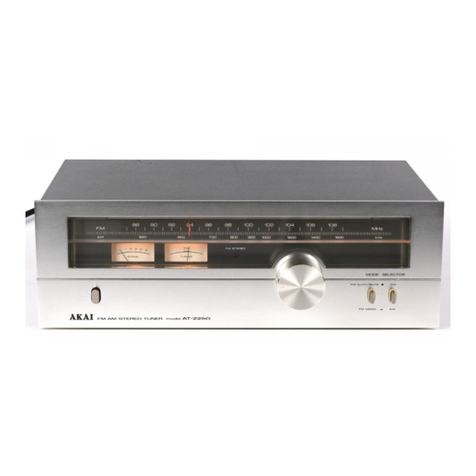
FM DIAL scALE '4r
AM DIAL SCALE
SIGNAL STRENGTH METER
When tuning in FM or AM broadcasts, tune for ìndica-
t¡on as far as possible toward the right end of the scale.
Movement of the needle to left or right indicates signal
st rengt h.
FM CENTER TUNING METER
Turn Tuning Knob to select FM station while observ¡ng
this meter. Tune until the ind¡cator needle comes to
the center of the meter. The Stereo lndicalor Lamp
will light when FM Stereo broadcasts are being received.
FM STEREO LAMP
Lights when FM stereo broadcasts are being received.
TUNING KNOB
Rotate this knob for selection of desired broadcasts.
POWER SWITCH
FM MODE SWITCH
FM AUTO/MUTE: Will automatically receive any FM
broadcasts in stereo or monaural.
* Cuts noise between FM stations
and disturbances from weak inputs.
FM MONO: For listening to FlVl stereo broad-
casts ¡n monaural. Left and right
channels are mixed and em¡tted
from both left and right speakers.
(When FIV broadcast signals are
too weak for stereo separation,
MONO position fac¡litates better
audibility. )
FM/AM SELECTOR SWITCH
Set to FM position to receive FM broadcasts, and to
AM posit¡on for receiving AM broadcasts.
AM FERRITE BAR AN iENNA
Pull out 'rom rear panel for AM reception. lf signals
are not received with sufficient clarity, use an outdoor
antenna and connect to the AM antenna terminal.
FM and AM ANTENNA TERMINALS (See Antenna
lnformation).
OUTPUT JACKS (Left and Right)
Connects to inputs of external amplifier for playback.
COI\INEGTIGINS
Connect to a deeply buried
underground bar.
* Do no1 connect to a gas
l¡ne, etc.
AM Outdoor Antenna 300O parallel FM outdoor antenna or FM
di-pole antenna.
* When using a 75S¿ coaxial cable from
the FM outdoor anlenna. connect to
the 75S¿ antenna terminal, and connect
the shielded ground wire to the ground
terminal.
lf the FM broadcast station is nearby and
d¡stortion exists, use the LOC antenna
term¡nals instead of the DIST terminals of
Model AT-2250 and connect ¡n the same
way as described above.
B Speakers System
AT-2250
1.
2.
3.
4.
sr0ct illm¡-¡¡
lls¡lt lt c¡13 -l¡
/ tÉtúÍtoiGstttill-