DJ-100
3
ANT SW RF
AMP
MCF
38.850MHz
IF SYSTEM
450KHz
CF
ANT
AF
AMP SP
FINAL
PRE
DRIVE
PLL
VCO MIC
MIC
AMP
MIX
TCXO 19.200MHz
Tripler
38.40MHz
X3
RX/TX:136 ~ 17 4MHz
DRIVE
ANT SW
IF,MIX,DET
LV
ANT
AF AMP
SP
1st Loca l OSC
AF PA AMP
U205
U502
IF AMP
Q509
MCF
XF500,XF501
MI XER
Q506
BPF
RF AMP
Q506
BPF
D517
2nd Loca l OSC
D503,D504
VFO
.
Q510
Tri pl e r X3 TCXO 19.200MHz
X500
U206
MPU
U203B
38.400MHz
VCO PLL
(PLL)
Tun ing vol tage
AQUA
U200
CF500
CIRCUIT DESCRIPTION
1. Overview
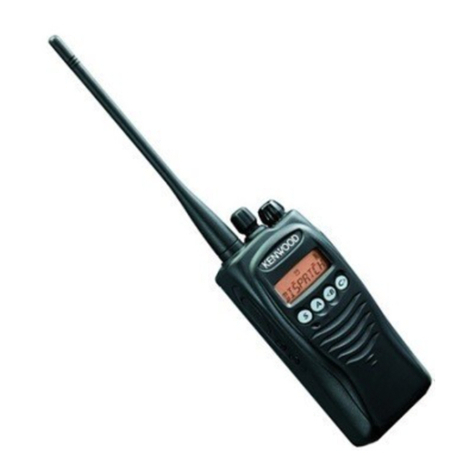
This transceiver is a VHF portable transceiver designed
to operate in the frequency range of 136 to 174MHz.
The unit consists of receiver, transmitter, phase-locked
loop (PLL) frequency synthesizer, base band parts, power
supply, and control circuits.
2. Frequency Configuration
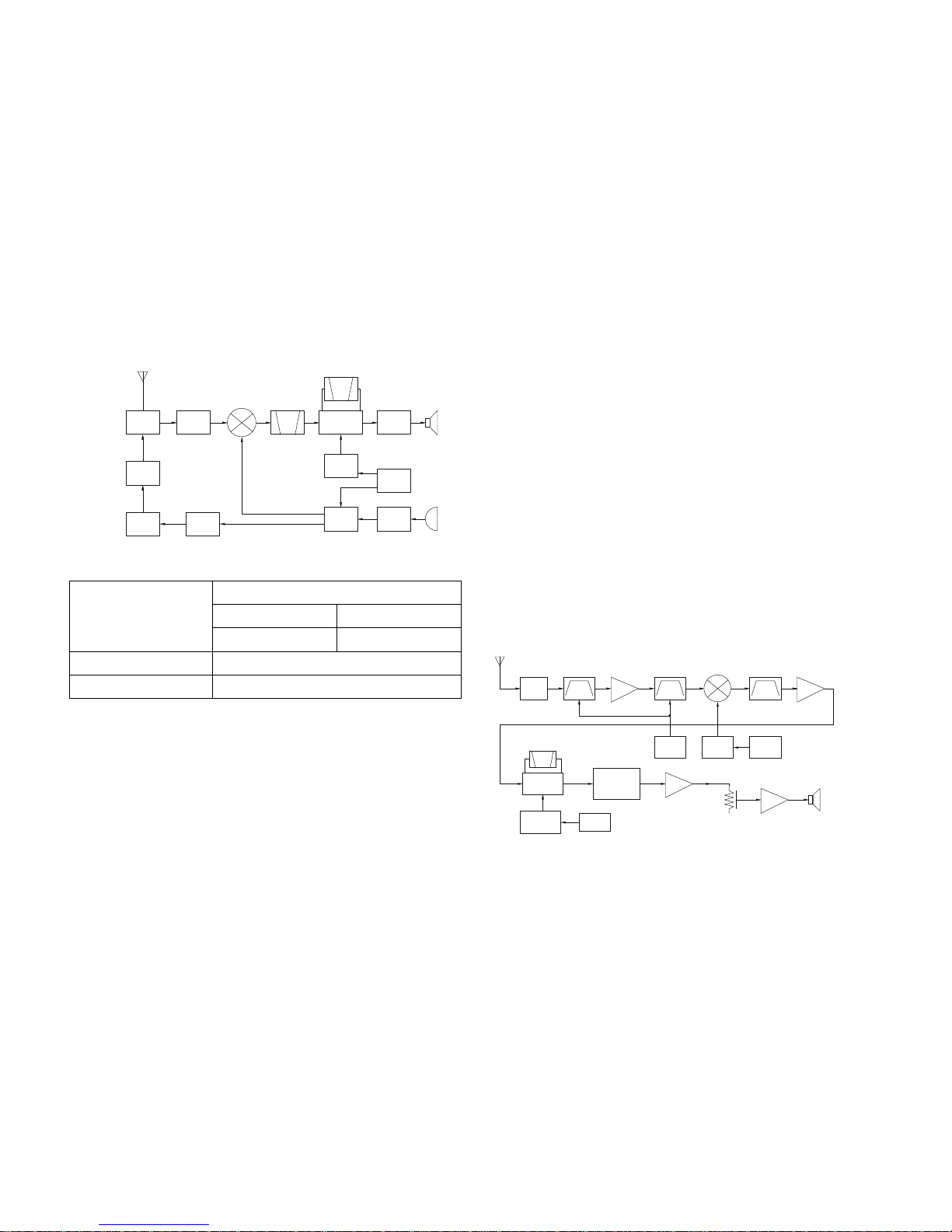
The frequency configuration is shown in Figure 1 and
Table 1.
Fig. 1 Frequency configuration
Table 1 Basic configuration
3. Receiver
3-1-1. Front-end RF Amplifier
The received signal from the antenna passes through a
low-pass filter and then through a transmission/reception
switching circuit (antenna switch) and enters the tuned
filter (L510).
The signal passing through the band-pass filter (L510) is
amplified by with an RF amplifier (Q505), passes through a
band-pass filter (L512, L542) and enters the first mixer
(Q506).
These band-pass filters are tuned to a desired frequency
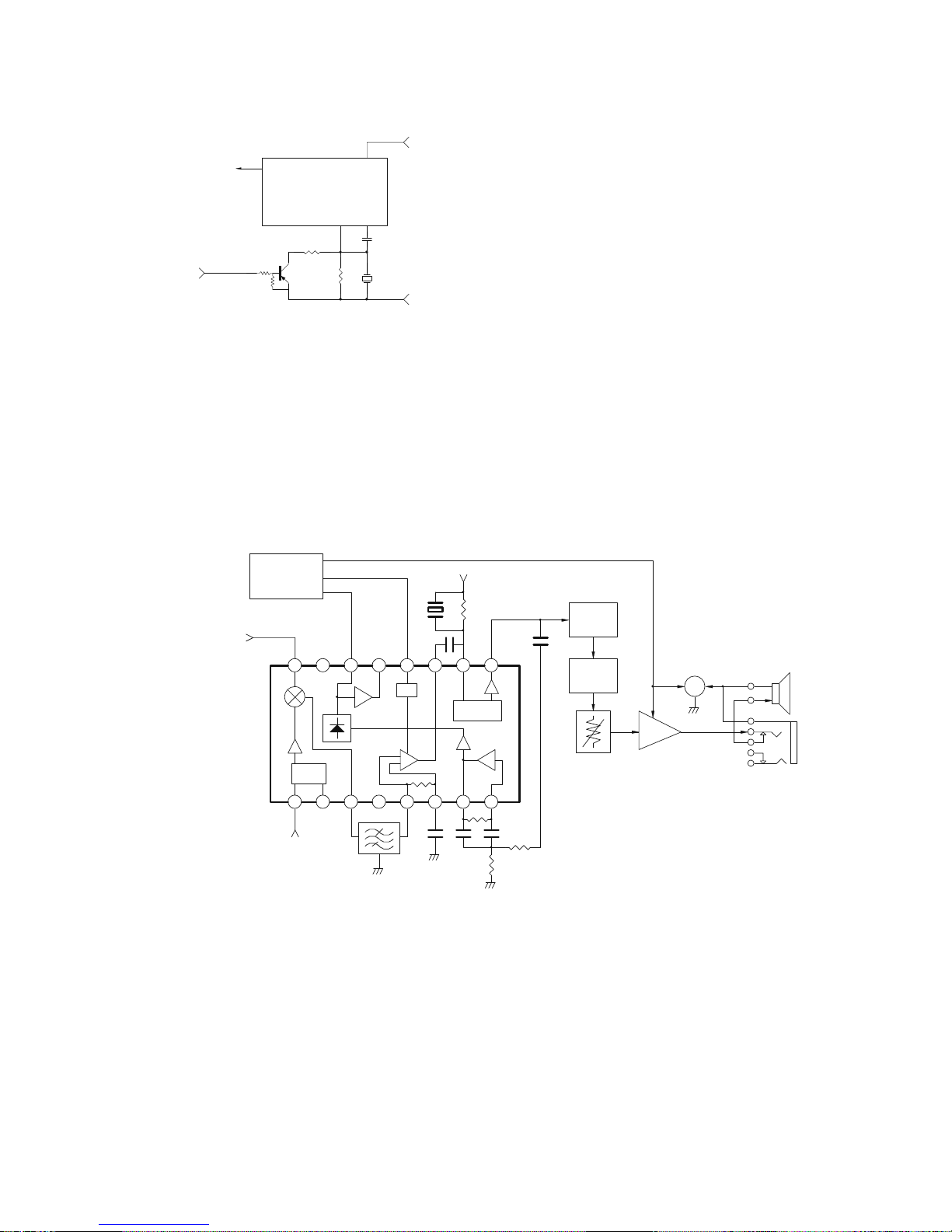
by varicaps (D509, D510, D511, D512).(See Fig.2)
A tuning voltage corresponding to the desired signal is
applied to each varicap through the VFO terminal (pin 60)
of the MPU (U206) to tune to the receive frequency.
3-1-2. First Mixer
The received signal passing through the band-pass filter
(L512, L542) is mixed with the first local signal generated
by the VCO by the first mixer (Q506) to produce a first IF
signal (38.85MHz) (Upper heterodyne).
The first IF signal passes through a MCF (Monolithic
crystal filter: XF500 and XF501) to remove unwanted
components.
The first IF signal passing through the MCF (XF500 and
XF501) is amplified by an IF amplifier (Q509) and the
resulting signal enters the FM IC (U502).(See Fig.2)
3-1-3. IF Amplifier Circuit
The first IF signal (38.85MHz) amplified by the IF
amplifier (Q509) and the second IF signal (45.9MHz)
generated by tripling the 19.200MHz reference oscillator
frequency of the TCXO (X500) by Q510, are mixed in the
FM IC to produce a second IF signal (450 kHz) (Lower
heterodyne).
The second IF signal passes through a ceramic filter
(CF500) to remove unwanted components.
The second IF signal passing through the ceramic filter
(CF500) passes through the IF amplifier in the FM IC again
and is detected to produced an audio signal.(See Fig.2)
Fig.2
3-1-4. Wide/Narrow Switching Circuit
Narrow and Wide settings can be made for each channel
by switching the demodulation level. The WIDE (low level)
and NARROW(high level) data is output from U206, pin 11.
When a WIDE (low level) data is received, Q507 turn on.
When a NARROW (high level) data is received, Q507
turn off.
Q507 turns on/off with the Wide/Narrow data and the U502
detector output level is switched to maintain a constant
output level during wide or narrow signals. (See Fig.3)
Reception method
Double super heterodyne
1st IF Frequency 38.85MHz (Upper)
2nd IF Frequency 450kHz (Lower)
Transmission method VCO direct oscillation amplification
Modulation Variable reactance phase modulation