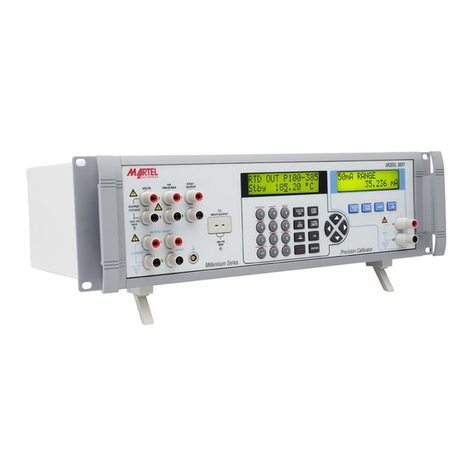
AUDIO IMPEDANCE TESTER
INSTUCTION MANUAL
1. INTRODUCTIN
WARNING!
read " SAFETY NOTES " before using the meter.
2. SAFETY NOTES
1. Read the following safety information carefully before
attempting to operate or service the meter.
2. Use the meter only as specified in this manual, otherwise
the protection provided by the meter may be impaired.
3. Rated environmental conditions:
a. Indoor use
b. Installation CAT III 100V.
c. Pollution Degree 2.
d. Altitude up to 2000 Meter.
e. Relative Humidity 80% Max.
f. Ambient Temperature 0*~40*.
4. Observe the international electrical symbols listed below:
Meter is protected throughout by double insulation or
reinforced insulation.
Warning! Risk of electric shock.
Caution! Refer to this manual before using the meter.
Note Do not use on live system.
3. FEATURES
1. True measurement of speaker systems actual impedance
at1kHz
2. Three test ranges (20*/200*/2000*) allow testing of
home theater and commercial sound systems.
3. Convenient portable battery operation.
4. Low battery indication
5. Data hold function.
6. Timer function for continuous hands free operation. The
timer can last about 3-5 minutes when users press TEST
ON/OFF button.
4. SPECIFICATIONS
1. Measurement range:
20*/200*/2000*
2. Test frequency:
1kHz
3. Accuracy:
20*: *2%rdg*2dgt or *0.1*, which is greater.
200*/2000*: *2%rdg*2dgt
4. Protection:
Meets IEC-1010 (EM61010). Installation CAT III 100V
5. Power requirement:
9V DC (6*1.5V "AA" UM-3 batteries)
6. Dimensions:
168(L)*110(W)*60(D) mm
7. Included Accessories:
Test leads, instruction manual, carry case
8. Low battery indication:
" " Symbol appears on the display
9. Data hold indication:
" HOLD " Symbol appears on the display
10. Display:
LCD 3 1/2 digit (2000 counts)
11. Weight:
Approx. 550g (battery included)
5. MEASURING METHODS
BEFORE PROCEEDING MEASUREMENT, READ SAFETY
NOTES.
1. Ensure the system under test is not live.
2. In proceeding with measurement, if " " symbol
appears on the display, replace with new batteries.
3. Rotary the function switch to suitable range then press
the pushbutton to test and take the reading.
4. A drawing of the system should be made before testing
so the measurement can be attributed to network.
5. Measure system power-an 10W up
P=ZI2
P=V2/ Z
For example on a 100V system:
If P=50W, Z=V2/ P=1002/ 50=200*
a. The tester can measure load down to 2k*. (10W at
100V line).
b. The tester can't measure 100V system with power
lower than 10W.
6. Checking a speaker:
Speakers are general from 2*to 16*, use 20*range or
for higher impedance speaker, use 200*or 2000*range.
7. Checking a PA system:
For example on a PA system. using a 100V configuration.
a. If Z measured is lower, check for short-circuited wires
or faulty speakers or transformers.
b. If Z measured is higher, check for wiring or
components (Speakers, teansformers or connections).
6. MAINTENANCE
1. Battery Replacement:
When the symbol " " appears on the display, replace
with new batteries. As follows:
a. Disconnect the test leads from the instrument and turn
off the power.
b. Use a screwdriver to unscrew the screws on back
cover then slide the cover, take out the cover, take out
the batteries and replace with new batteries type SUM-3.
c. Place back cover and install the screws.