8
DMHDO2
Set the file you want to play
from the USB stick
Enter the filename where you
want to record to. Finish with
the ‘enter’ character to start
recording
Select yes or no to stop the
current action
Leave the menu
DMHD02
PLAY DMHD02
X
DMHD02
USB
DMHD02
RECORD efgh[i]jkl
DMHD02.ts
DMHD02
STOP DMHD02
(YES)
DMHD02
EXIT DMHD02
(YES)
4.2 - Using a USB stick
To operate the USB menu, please rst insert a USB 3.0 memory stick and then power up
the DMHD02. With the USB memory stick connected, you can play les. Only les with the
extension ‘.ts’ can be played through this device. When you play a le, the source connected to
Input A will be interrupted and your ‘.ts’ le will be played.
5 - Programming using a PC
The settings of the DMHD02 can also be
changed using a PC.
First, please install the software DMHDiFace
on your PC. You can download this software
from our internet site http://antiference.
co.uk/product/conexer-twin-hdmi-modulator/
After installing the software, connect the
DMHD02 using a USB cable (not included)
to your computer. Then launch the program
DMHDiFace. On the display of the DMHD02
the message <USB> appears, indicating that
programming is now performed through your
PC. The following window appears on your
screen. All the functions can now be edited and
modied using DMHDiFace.
When you select a USB ‘.ts’ le, this will be played on a continuous loop.
If you want to play a selection of les, name your les sequentially eg: le001.ts, le002.ts,
le003.ts etc. If you select a le from this list to play, that le will start to play and at the end,
the DMHD02 will play the next le with a higher number. When no le with a higher number is
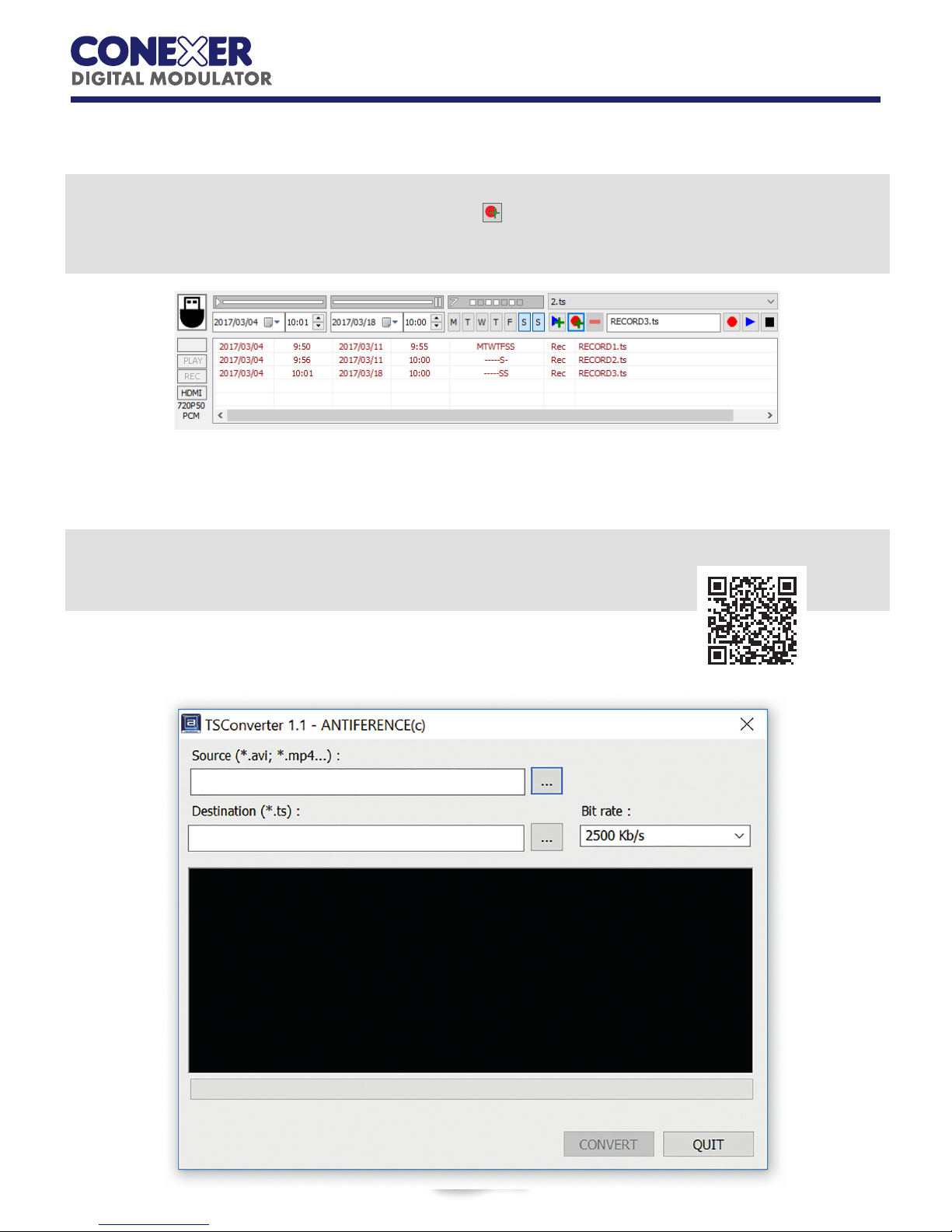
found, it will return to the start and play again from the rst le. Please refer to section 6.5 for
more information on how to create ‘.ts’ les or check out the www.antiference.co.uk website for
software to produce appropriate ‘.ts’ les for your DMHD02.To operate the USB menu, please
rst insert a USB 3.0 memory stick and then power up the DMNSD02. With the USB memory
stick connected, you can play les. Only les with the extension ‘.ts’ can be played through this
device. When you play a le, the source connected to Input A will be interrupted and your ‘.ts’
le will be played.