2 Applied Wireless, Inc.
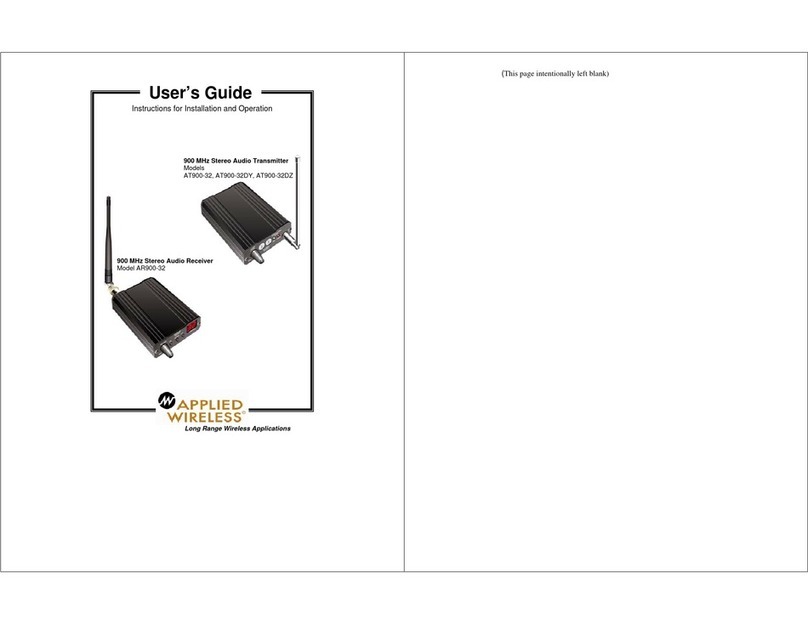
attaches with a BNC connector, enabling the use of an alternative antenna,
(such as a directional flat panel or Yagi) to increase operating range
(please contact Applied Wireless for a selection of available antennas).
The AT900-32 transmitter and the AR900-32 receiver are well-suited for
many diverse applications, including distribution of audio entertainment
content throughout a building, home theater installations, commercial and
industrial surveillance, monitoring, security, etc.
Installation Instructions
Before Beginning the Installation
Plan your installation carefully. The physical location and orientation of
the transmitter and receiver antennas (relative to each other and their
surroundings) will have a significant influence on reception quality at the
receiver. The following guidelines will generally yield the best results:
•Both the transmitter antenna and the receiver antenna should be
positioned vertically (pointing either up or down).
•Antennas should be positioned high enough to enable people to move
about below them without creating obstructions between the antennas.
•Although the RF signal from the transmitter will pass through most
non-metallic building materials (wood, stucco, brick, etc.), its strength
is reduced with every wall through which it must pass. Therefore,
maximum stated reception range is based on unobstructed line of sight
conditions.
•The transmitter and receiver are both rated for indoor use only. If
either unit must be located outdoors, it must be protected from the
elements (using, for example, a non-metallic NEMA4 enclosure).
Connecting Audio to the AT900-32 Transmitter
Connect a line level stereo audio source (outputs from a CD player, for
example) to the corresponding LEFT and RIGHT line-level input jacks on
the transmitter’s rear panel (refer to Figure 1). A shielded dual cable is
supplied with the transmitter for making these connections. Some audio
devices, such as MP3 players, portable CD players, and PC sound cards
have a single miniature (3.5mm) stereo phone jack (as opposed to separate