Innovative purication solutions
www.aquablu.com
7
How does it work?
SYSTEM DESCRIPTION
Purication takes place in three stages. Pre-ltration – purication – post-ltration. The pre-
ltration unit exist of three cartridge lters, a 20 micron string wound, a 10 micron activated
carbon block and a 5 micron string wound cartridge to provide ideal protection for the
membranes. Please note that according to your water source quality additional pre-ltration such
as sand-lters and/or a softener may be required. Please see max. raw water specications on
page 31 under technical data.
After having passed the pre-ltration unit, the water is pushed into the purication unit where
a pump pressurizes the water stream to 6-8 bar initializing the purication process through the
membrane. In the membrane two separate water streams are generated.
1. The permeate water stream, which is led through the controller block, and then leaves the
purication unit. Optionally this could go towards a permeate tank. The permeate may then
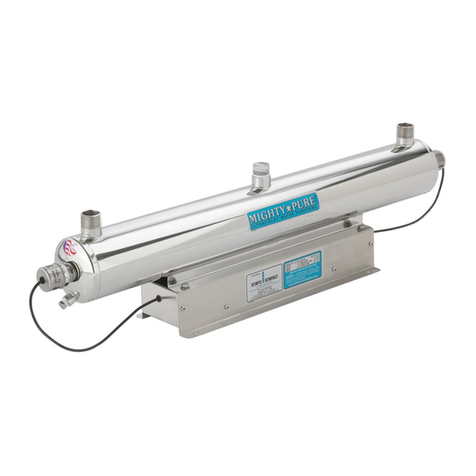
be further treated by an UV unit to eliminate possible bacterial contamination accumulated
while in storage.
2. The rejected water stream, which rinses and ushes the membrane from collected impurities.
The rejected water may be collected for further use as shown in gure 10 overview or needs
to be discarded.
MEMBRANE PURIFICATION AND REGENERATING PRINCIPLE
The pre-ltered water is pushed into the membrane at maximum pressure of 8 bar by the pump,
in the membrane the ow is pushed in 2 directions, one direction is the reject and the other
direction is through the membrane. The reject is pressurized by a spring that creates a resistance
of 2 bar, this is a factory set control valve in the reject circuit.
As the feed water is pushed through the membrane lter, the suspended dissolved pollutants
collide with the membrane tissue and stick to it. Most of the pollutants are ushed away with
the reject water. As a result of this the eciency of the membrane will slowly deteriorate. If the
eciency drops below a certain value, the CPU of the system will initiate a ush cycle, in which
water is pumped through the membrane without back pressure. The contamination is pushed out,
and washed away into the drain through the reject water port. This action is known as membrane
ush. After ushing the membrane performance is restored nearly to the initial value. During a
ush (30 - 60 sec) the system cannot produce puried water.
HOW IS THE PROCESS CONTROLLED?
When the system is powered up, and a correct feed water pressure (>1. 5 bar <3 bar) is detected,
the solenoid valve in the feed water inlet tube is opened, and water from the ltration unit tted
between the feed water source and the purication unit is admitted to the purication unit. At
this entry point also a temperature sensor and a non-return valve are tted.
From the entry point the feed water is pushed under feed water pressure to an electrical pump
that forces the feed water under high pressure through the membrane. Pump pressure is
monitored in the pressure line to the membrane, while pump motor current is also measured as a
process parameter.