manuals.online logo
Brands
  1. Home
  2. •
  3. Brands
  4. •
  5. Audio Technica
  6. •
  7. Microphone System
  8. •
  9. Audio Technica ATW-1821 Manual instruction

Audio Technica ATW-1821 Manual instruction

Other manuals for ATW-1821

1

This manual suits for next models

2

Other Audio Technica Microphone System manuals

Audio Technica JFZT5000D User manual

Audio Technica

Audio Technica JFZT5000D User manual

Audio Technica ATW-901a/G User manual

Audio Technica

Audio Technica ATW-901a/G User manual

Audio Technica ATW-0327 Owner's manual

Audio Technica

Audio Technica ATW-0327 Owner's manual

Audio Technica Artist Elite 4000 Series Operating instructions

Audio Technica

Audio Technica Artist Elite 4000 Series Operating instructions

Audio Technica M2 Manual instruction

Audio Technica

Audio Technica M2 Manual instruction

Audio Technica ATW-1811 Setup guide

Audio Technica

Audio Technica ATW-1811 Setup guide

Audio Technica ATW-49SP Owner's manual

Audio Technica

Audio Technica ATW-49SP Owner's manual

Audio Technica ATW-600 Operation manual

Audio Technica

Audio Technica ATW-600 Operation manual

Audio Technica System 10 Operating instructions

Audio Technica

Audio Technica System 10 Operating instructions

Audio Technica ATW-702 Owner's manual

Audio Technica

Audio Technica ATW-702 Owner's manual

Audio Technica Pro Series 3 Owner's manual

Audio Technica

Audio Technica Pro Series 3 Owner's manual

Audio Technica GENUINE AT8688 User manual

Audio Technica

Audio Technica GENUINE AT8688 User manual

Audio Technica AT-ONE ATW-R1 User manual

Audio Technica

Audio Technica AT-ONE ATW-R1 User manual

Audio Technica ATW-R3210N User manual

Audio Technica

Audio Technica ATW-R3210N User manual

Audio Technica ATW-901a/L User manual

Audio Technica

Audio Technica ATW-901a/L User manual

Audio Technica 3000 Series Operating instructions

Audio Technica

Audio Technica 3000 Series Operating instructions

Audio Technica AT-ONE ATW-R1 User manual

Audio Technica

Audio Technica AT-ONE ATW-R1 User manual

Audio Technica ATW-3110C Manual

Audio Technica

Audio Technica ATW-3110C Manual

Audio Technica Artist Elite AEW-DA550C Owner's manual

Audio Technica

Audio Technica Artist Elite AEW-DA550C Owner's manual

Audio Technica 200 Series Owner's manual

Audio Technica

Audio Technica 200 Series Owner's manual

Audio Technica 2000 Series Installation guide

Audio Technica

Audio Technica 2000 Series Installation guide

Audio Technica ATW-1101 Owner's manual

Audio Technica

Audio Technica ATW-1101 Owner's manual

Audio Technica ESW-R210 Owner's manual

Audio Technica

Audio Technica ESW-R210 Owner's manual

Audio Technica ATW-BH1 Owner's manual

Audio Technica

Audio Technica ATW-BH1 Owner's manual

Popular Microphone System manuals by other brands

INIM SAGITTARIUS VW2W instructions

INIM

INIM SAGITTARIUS VW2W instructions

AKG IVM 4500 User instructions

AKG

AKG IVM 4500 User instructions

Earthworks Audio PM40 manual

Earthworks Audio

Earthworks Audio PM40 manual

Nady Systems ENCORE 2 owner's manual

Nady Systems

Nady Systems ENCORE 2 owner's manual

Oklahoma Sound WM-200H instruction manual

Oklahoma Sound

Oklahoma Sound WM-200H instruction manual

Chiayo SDR-8200 Operation manual

Chiayo

Chiayo SDR-8200 Operation manual

Paso R824 quick start guide

Paso

Paso R824 quick start guide

Naxa NAM-982 instruction manual

Naxa

Naxa NAM-982 instruction manual

Xvive U3 user manual

Xvive

Xvive U3 user manual

Tekon DUOS installation guide

Tekon

Tekon DUOS installation guide

Heyuan Intelligence IOT-G2S-01 user manual

Heyuan Intelligence

Heyuan Intelligence IOT-G2S-01 user manual

Devine WMD-IE user manual

Devine

Devine WMD-IE user manual

LG LF-D7150 owner's manual

LG

LG LF-D7150 owner's manual

LD U305 HBH 2 user manual

LD

LD U305 HBH 2 user manual

Chainway URA8 user manual

Chainway

Chainway URA8 user manual

ORATOR D860TD instruction manual

ORATOR

ORATOR D860TD instruction manual

Sennheiser Evolution Wireless Digital EW-DX EM 2 quick guide

Sennheiser

Sennheiser Evolution Wireless Digital EW-DX EM 2 quick guide

Shure UA844 user guide

Shure

Shure UA844 user guide

manuals.online logo
manuals.online logoBrands
  • About & Mission
  • Contact us
  • Privacy Policy
  • Terms and Conditions

Copyright 2025 Manuals.Online. All Rights Reserved.

w i r e l e s s
w i r e l e s s
w i r e l e s s
w i r e l e s s
w i r e l e s s
1800 Series
Camera-mount UHF Wireless
Microphone Systems (dual-channel)
ATW-
1821
UniPak®Body-pack Transmitter System
ATW-
1822
Plug-on Transmitter System
ATW-
1823
Plug-on and Body-pack Transmitter System
Set-up and Operation
This device complies with part 15 of the FCC Rules. Operation is subject to the condition that this device does not cause harmful interference.
This device complies with IN USTRY CANA A R.S.S. 210, en conformité avec IC: RSS-210/CNR210.
Operation is subject to the following conditions: 1) This device may not cause harmful interference and 2) this device must accept any interference
received, including interference which may cause undesired operation. Changes or modifications not expressly approved by Audio-Technica could
void your authority to operate this equipment.
Notice to individuals with implanted cardiac pacemakers or AICD devices:
Any source of RF (radio frequency) energy may interfere with normal functioning of the implanted device. All wireless microphones have
low-power transmitters (less than 0.05 watts output) which are unlikely to cause difficulty, especially if they are at least a few inches away.
However, since a “body-pack” mic transmitter typically is placed against the body, we suggest attaching it at the belt, rather than in a shirt pocket
where it may be immediately adjacent to the medical device. Note also that any medical-device disruption will cease when the RF transmitting
source is turned off. Please contact your physician or medical-device provider if you have any questions, or experience any problems with the
use of this or any other RF equipment.
CAUTI N! The circuits inside the receiver and transmitter have been precisely adjusted for optimum performance and compliance with federal
regulations. o not attempt to open the receiver or transmitter. To do so will void the warranty, and may cause improper operation.
Warning: To prevent fire or shock hazard, do not expose this appliance to rain or moisture.
Attention: Pour prévenir feu ou choc électrique, ne pas exposé l'appareil à la pluie ou à l'humidité.
About RF Interference
Please note that wireless frequencies are shared with other radio services. According to Federal Communications Commission regulations,
“Wireless microphone operations are unprotected from interference from other licensed operations in the band. If any interference is received
by any Government or non-Government operation, the wireless microphone must cease operation...”
If you need help with operation or frequency selection, please contact your local dealer or Audio-Technica. Extensive wireless information
also is available at www.audio-technica.com.
Contents
Components and System Configurations 3
System Features 4
Quick verview of System peration 5
Receiver Controls 6
perating the Receiver 8
Transmitter Controls 11
perating the Transmitter 12
Tips for Best Results 14
Specifications 15
2
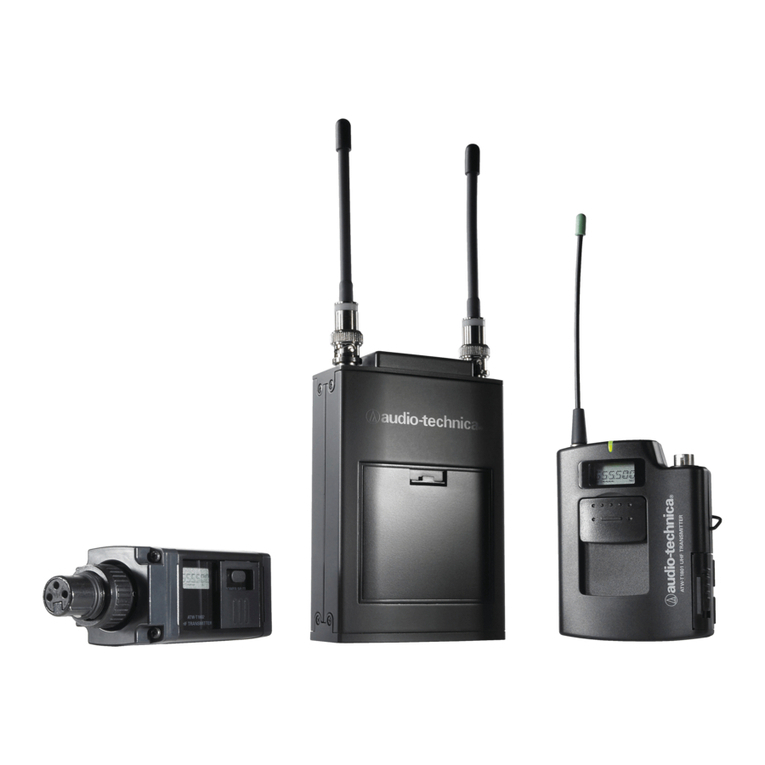
1800 Series Components (dual-channel)
Receiver and Included Components/Accessories
AT W - 18 23
Camera-mount UHF Wireless
Microphone System (dual-channel)
with Body-pack and Plug-on Transmitters
ATW-R1820
ual-channel receiver
Two detachable
antennas
Two 18" output cables,
TA3F to XLRM
Pouch with belt clip
(holds receiver)
Transmitters
AT W - T 1 8 01
UniPak®transmitter with included omnidirectional lavalier microphone
ATW-T1802
Plug-on transmitter
AT W - 18 21
Camera-mount UHF Wireless
Microphone System (dual-channel)
with Body-pack Transmitters
AT W - 18 22
Camera-mount UHF Wireless
Microphone System (dual-channel)
with Plug-on Transmitters
System Configurations
3
Note: All model numbers have an additional letter at the end to indicate frequency band.
System Features (dual-channel)
• Two completely independent receiver channels in a single unit, for simultaneous
operation of two microphones
• True Diversity operation for resistance to multi-path interference and dropouts
• UHF reception with 996 frequencies selectable in 25 kHz steps
• Automatic frequency scanning for easy selection of open channels
• Tone Lock™ squelch system eliminates interference when transmitter is off
• Two independent balanced outputs
• Headphone monitor output with independent level control
• Battery fuel-level indicators on transmitters and receiver
• Soft-touch controls for easy frequency selection
• LCD frequency and battery status display with backlight on receiver and transmitters
• Antenna and AF Peak LED indicators
• Dual-channel receiver can operate in single-receiver mode to extend battery life
when only one audio channel is required
• Compact dual receiver is easy to mount on a camera
• Transmitters operate in low or high transmission modes to conserve
battery life/maximize power
• Easy, user-friendly operation
• Clear, natural sound quality
• Powered by AA batteries or by external 12V DC power (not included)
• System components of the 1800 Series and 3000 Series UHF wireless systems
can be used interchangeably
4
Quick verview of System peration
Thank you for purchasing this Audio-Technica 1800 Series Dual-channel Camera-mount
UHF Wireless Microphone System. All 1800 Series systems are designed primarily to be used
with video cameras, with the AT W-R1820 dual-channel receiver mounted on a camera and
connected to the camera's audio input; the systems may also be used with other components
equipped with microphone-level input(s).
This system is equipped with a dual receiver, which consists of two completely independent
receiver channels in a single unit, for simultaneous operation of two microphones.
First, insert batteries (see Battery Installation, page 8 ). Note: The AT W-R1820 dual-channel
receiver also functions without batteries if connected to an external power supply
(12V DC source, 500 mA nominal current, not included).
Next, attach the antennas to the antenna input jacks, and mount the AT W-R1820 dual-channel
receiver to your camera (mounting hardware not included); or use the included pouch with belt
clip to attach the AT W-R1820 to your belt. Connect the output cable(s) to the AT W-R1820 and
your video camera (and/or audio mixer). (See Output A, Output B, and Output Sele t Swit h,
page 7.)
Turn the AT W-R1820 Power Switch on. Choose “1” to activate only Receiver Channel 1 and
Output A (Power/Peak LE 1 should light red); this option will increase useable battery life.
Choose “Both” to activate both receiver channels and both outputs (Power/Peak LE s 1 and 2
should light red). (See Power Swit h with four positions: External, Off, 1, Both, page 6.)
Select a frequency for Receiver Channel 1 and Receiver Channel 2. (See Sele ting Frequen ies
on your Re eiver, page 8.)
N TE: Receiver Channel 1 and Receiver Channel 2 must be set to different frequencies to
avoid interference. Transmitter-Receiver pairs must be set to identical frequencies: set
Transmitter 1 to the same frequency as Receiver Channel 1; setTransmitter 2 to the same
frequency as Receiver Channel 2.
If your system is equipped with a UniPak®Body-pack Transmitter and lavalier microphone:
Plug the included lavalier microphone(s) into the UniPak®body-pack transmitter(s) and position
microphone(s) on your subject about six inches below the chin. Anticipate movements that may
cause the microphone to rub against or be covered by clothing, and position the microphone to
avoid it. Turn the power on, select a frequency and choose other settings. (See Operating the
Transmitter, page 12.)
If your system is equipped with a Plug-on Transmitter:
Attach a microphone (dynamic or condenser) to the plug-on transmitter’s input connector
(see Mi rophone Input, page 11). The transmitter provides power to condenser microphones
rated to operate on 12V phantom power or less. Turn the power on, select a frequency and
choose other settings. (See Operating the Transmitter, page 12.)
5
AT W-R1820 Dual-channel Receiver Controls (front panel)
Liquid Crystal isplay shows battery status and frequency settings. (Use the ual-channel
Control Switch (6) to select frequencies for Receiver Channel 1 and Receiver Channel 2;
in Hold position, only Receiver Channel 1 frequency appears in LC .) Battery meter is only
active when ual-channel Control Switch is in the Hold position.
BNC-type antenna connectors. Antennas A & B (split internally) both provide signals for
Receiver Channel 1 and Receiver Channel 2. Attach the antennas to the antenna input jacks.
Make certain that during operation there is a clear open-air path between the receiver antennas
and the transmitters.
True iversity operation: two antennas feed two completely independent RF sections on the
same frequency for each receiver; automatic logic circuitry selects the superior signal.
iversity Indicator 1 indicates which tuner has the better reception and is in operation for
Receiver Channel 1; iversity Indicator 2 indicates which tuner has the better reception and is
in operation for Receiver Channel 2.
Turns the unit on and off.
Choose “Ext”, if the unit is connected to an external power supply (12V C source, 500 mA
nominal current, not included). In “Ext” position, both receiver channels and both outputs are
activated (indicated by illumination of Power/Peak LE s 1 and 2).
Choose “Off” to turn the unit off.
Choose “1” to activate only a single receiver channel (Receiver Channel 1/Output A, indicated by the
illumination of Power/Peak LE 1). This conserves energy if you are only using one audio channel.
Choose “Both” to activate both receiver channels and both outputs (indicated by illumination of
Power/Peak LE s 1 and 2).
Note: Selected receiver will be muted unless Dual-channel Control Switch (6) is in Hold position.
Indicates which receiver channel(s) is (are) in operation. Also indicates receiver overload by
turning off; too much signal will cause blinking LE (off during peaks). To correct overload,
adjust audio gain on transmitter. (See Audio Input Level (Gain) Adjustments, page 13.)
This switch allows you to use the single LC window to control each of the two receiver
channels separately.
To set frequency for Receiver Channel 1, switch to 1 (left position).
To set frequency for Receiver Channel 2, switch to 2 (right position).
To lock settings and operate unit, switch to Hold (center position).
Note: Receiver Channel 1 is muted when switch is at 1; Receiver Channel 2 is muted
when switch is at 2; both channels un-mute when switch is at Hold.
This LE is red when switch is in position 1, indicating muted operation for Receiver Channel 1.
It is also red when switch is in position 2, indicating muted operation for Receiver Channel 2.
LE turns green in Hold position, indicating unit is ready for operation.
Use with the ual-channel Control Switch and Up/ own arrows to choose operating frequencies
manually or automatically (using your choice of three automatic scan groups).
Press Up or own arrows, in conjunction with the Set button, to choose operating frequencies
manually or automatically (using your choice of three automatic scan groups).
LCD
Antenna Input Jacks
Diversity Indicators
for each antenna
for each receiver
ower Switch
with four positions:
External, Off, 1, Both
ower/ eak LED
Dual-channel Control Switch
with three positions: 1, Hold, 2
Dual-channel Control LED
Set
Up/Down Arrows
1
2
3
4
5
6
7
8
9
2
3
6
1 7 2
3 4
5
698
Output A
Output B
Output Select Switch
Receiver Level Controls (1 and 2)
Monitor Select Switch
Monitor Level Control
DC Input
Monitor Output
(rear panel)
Balanced Audio Output Jack: TA3M-type connector. Pin 1: ground (shield); Pin 2: “audio +”;
Pin 3: “audio -”. Use the included TA3F to XLRM interface cable to connect the receiver output
to a balanced microphone-level input on a camera, mixer or integrated amplifier.
Balanced Audio Output Jack: TA3M-type connector. Pin 1: ground (shield); Pin 2: “audio +”;
Pin 3: “audio -”. Use the included TA3F to XLRM interface cable to connect the receiver output
to a balanced microphone-level input on a camera, mixer or integrated amplifier.
The rear panel provides two balanced audio outputs (Outputs A & B). The unit is equipped with
an output select switch that assigns a signal to each of the audio outputs, as follows:
Output A (left) can be assigned either Receiver Channel 1 or Mix. (Mix = Ch. 1 and Ch. 2
signals mixed together. The relative levels of each signal can be adjusted using the individual
receiver level controls.)
Output B (right) can be assigned either Receiver Channel 1, Receiver Channel 2, or Mix.
Note: utput B is not active when Power Switch is in “1” position.
Typical configuration: Output A is assigned Channel 1; Output B is assigned Channel 2, feeding
individual channels in a mixer or camera. Many other options are available, providing much
flexibility. For instance:
• If your camera doesn’t accept two inputs, you can sum the signal from both transmitters
in Output A and connect this mixed signal to your camera.
• You can connect Output A (mixed signal) to a camera, and Output B (mixed signal)
to an audio mixer.
• When using the unit with a single transmitter with both outputs active (Power Switch set
at Both), Output A can be used to feed a camera, while Output B can feed an audio mixer
(both with identical signals from Receiver Channel 1).
The signal levels of each receiver signal (Receiver Channel 1 and Receiver Channel 2) may
be adjusted using these controls. When the outputs are assigned to a single receiver signal,
these controls will adjust the output level. (Turn clockwise to increase output level.) When the
outputs are assigned to Mix, these controls adjust the relative levels between the
receiver signals.
This switch assigns a signal to the monitor headphone output.
• Choose 1(left position) to hear Channel 1 in both ears (mono signal, stereo output);
• Choose 2(right position) to hear Channel 2 in both ears (mono signal, stereo output);
• Choose UT (middle position), to hear Output A in the left ear, and Output B in the right ear.
The level control (volume control) for headphones is independent of other level controls.
Turn to the right to increase the volume.
You may connect the unit to an external power supply (12V C source, 500 mA nominal
current, not included). In this case, move the Power Switch to the “Ext” position; both receiver
channels are activated (indicated by illumination of Power/Peak LE s 1 and 2).
1/4" TRS jack.
7
10
17
14 11
16 13 15
10
11
12
5
6
13
14
15
16
17
13
12 12
PIN 1 PIN 3
PIN 2
AT W-R1820 Dual-channel Receiver Batteries
Each AT W-R18 20 dual-channel receiver uses six 1.5V AA batteries, not included. Alkaline type is
recommended. Always replace all batteries. Make certain the receiver power is Off before
replacing batteries. Note:The AT W-R18 20 receiver also functions without batteries if connected
to an external power supply (12V DC source, 500 mA nominal current, not included).
1. Open the battery compartment door by pushing the catch back.
2. Observe correct polarity as marked and carefully insert six fresh 1.5V AA alkaline batteries
(see above).
3. Replace the door, making certain the latch clicks securely in place.
After the batteries are installed, turn the power on by moving the Power Switch to either the 1
or Both position. The small red power- on LE (s) (see aat left ) should light (red light at 1 if Power
Switch is in position 1; red light at 1 and 2 if Power Switch is in Both position) and the LC window
should come on. If this does not happen, the batteries are installed incorrectly or they are depleted.
The receiver’s “fuel gauge” battery indicator (see bat left ) displays a maximum of four bar
segments. When LC flashes “LOW.BAT”, the batteries should be replaced immediately to
ensure continued operation. Note: Battery indicator is only visible in the “Hold” position.
perating the Receiver
N TE: Receiver Channel 1 and Receiver Channel 2 must be set to different frequencies to
avoid interference. Transmitter-Receiver pairs must be set to identical frequencies: set
Transmitter 1 to the same frequency as Receiver Channel 1; set Transmitter 2 to the same
frequency as Receiver Channel 2.
Overview…
1. Turn the power on by moving the Power Switch to either the 1 position (for single-channel
operation) or Both position (for dual-channel operation).
2. Switch the ual-channel Control Switch to 1 (to set frequency for Receiver Channel 1) or 2
(to set frequency for Receiver Channel 2). Audio output is muted for the channel that is selected.
3. Press the Set button to enter the Frequency Selection Menu mode; the word “MENU” will appear.
4. Use the Up/ own arrows to cycle through functions:
- first arrow up is Manual Frequency Selection mode;
- second arrow up is Automatic Scan Group 1;
- third arrow up is Automatic Scan Group 2;
- fourth arrow up is Automatic Scan Group 3;
- fifth arrow up is Quit, allowing exit from Menu mode.
First…
Turn the power on by moving the Power Switch to Both (for dual-channel operation). To set
frequency for Receiver Channel 1, switch ual-channel Control Switch to 1 (left position).
1. Press Set button. The word “MENU” will appear. Press Up arrow to show current frequency.
Press Set button and frequency will begin to flash; then use up and down arrows to adjust
the frequency. Frequency changes in 25 kHz steps. To increase scroll speed, hold the Up or
own arrow for more than 4 seconds.
2. When you arrive at desired frequency, press and hold the Set button until the word “STORE ”
appears. Frequency is now set.
Battery Selection
Battery Installation
Battery Condition Indicator
Selecting Frequencies
on your Receiver
Dual-channel Operation
(using two transmitters)
Setting Receiver Frequency Manually
8
ab
3. To “back out” of the Manual Frequency Set mode without making a frequency choice, simply
press the Set button once to exit the menu and return the receiver to normal operation.
The word “ESCAPE” will appear in the window, and no changes in frequency setting will be
made; the receiver's audio output will again be enabled (when ual-channel Control Switch
is returned to Hold position).
To set frequency for Receiver Channel 2, switch ual-channel Control Switch to 2 (right position).
Repeat steps 1-2 above.
To lock settings and operate unit, switch ual-channel Control Switch to Hold (center position).
Note: While Channel Selection mode is still active, if the Dual-channel Control Switch is
moved back to Hold position before channel selection is complete, LED will remain red
and audio will remain muted until the control sequence is completed.
First…
Turn the power on by moving the Power Switch to Both (for dual-channel operation).
Then switch ual-channel Control Switch to 1 (left position).
1. Press the Set button to enter the Frequency Selection Menu mode; the word “MENU” will appear.
2. Use the Up or own arrow to reach Scan 1, Scan 2, or Scan 3. Press the Set button once to
select one of these three Scan groups. The word “SCAN1”, “SCAN2” or “SCAN3” will flash
in the LC window.
3. Press the Up or own arrow to begin the scan. Press the Up arrow to scan up from the lowest
frequency in the group; press the own arrow to scan down from the highest frequency
in the group.
4. The first available frequency will flash in the LC window. To activate this frequency selection,
press and hold the Set button until the word “STORE ” appears in the LC window.
5. If you do not wish to use the frequency found, you may press the Up or own arrow. The Up
arrow will scan upwards, the own arrow will scan downwards, from the frequency you are on.
6. To set frequency for Receiver Channel 2 (for dual-channel operation), switch ual-channel
Control Switch to 2 (right position). Repeat steps 1- 4 above. Note: Be certain to select the
same Scan Group that you used for Receiver Channel 1.
7. To lock settings and operate unit in dual-channel operation (using two transmitters), switch
ual-channel Control Switch to Hold (center position). The receiver will return to normal operation,
audio function will be restored and the ual-channel Control LE indictor will turn green.
8. If you are using multiple systems, use the same scan group for all receivers. After completing the
first receiver’s scan and frequency selections, set its transmitters to the appropriate frequencies
(see How to Set Frequen ies on your Transmitter, page 12 ); leave the transmitters On, and
run the next receiver’s automatic scan function. Always set a receiver-transmitter pair to the
same frequency before using the automatic scan function to select frequencies for the next receiver.
In the event that no more free frequencies are available within the scan group, the receiver will
indicate “EN ” on the receiver display. In this case, select a different scan group for both
Receiver Channels 1 and 2 and re-scan.
Note: While Channel Selection mode is still active, if the Dual-channel Control Switch is
moved back to Hold position before channel selection is complete, LED will remain red
and audio will remain muted until the control sequence is completed.
First…
Turn the power on by moving the Power Switch to the 1 position (for single-channel operation).
Switch ual-channel Control Switch to 1 (left position). Output from Receiver Channel 1 is now
muted. Note: utput B is not active when the Power Switch is in the “1” position.
1. Press Set button. The word “MENU” will appear. Press Up arrow to show current frequency.
Press Set button and frequency will begin to flash; use up and down arrows to adjust the
frequency. Frequency changes in 25 kHz steps. To increase scroll speed, hold the up or down
arrow for more than 4 seconds.
2. When you arrive at desired frequency, press and hold the Set button until the word “STORE ”
appears. Frequency (which appears on the screen) is now set.
3. To “back out” of the Manual Frequency Set mode without making a frequency choice, simply
press the Set button once to exit the menu and return the receiver to normal operation. The
word “ESCAPE” will appear in the window, and no changes in frequency setting will be
made; the receiver's audio output will again be enabled.
To lock settings, un-mute and operate the unit, switch ual-channel Control Switch to Hold
(center position).
Using the Automatic Scan Function
to Set Receiver Frequency
(dual-channel operation)
Single-channel Operation
(using one transmitter)
Setting Receiver Frequency Manually
9

First…
Turn the power on by moving the Power Switch to 1 (for single-channel operation). Then switch
ual-channel Control Switch to 1 (left position). Note: utput B is not active when Power
Switch is in the “1” position.
1. Press the Set button to enter the Frequency Selection Menu mode; the word “MENU” will appear.
2. Use the Up or own arrow to reach Scan 1, Scan 2, or Scan 3. Press the Set button once
to select one of these three Scan groups. The word “SCAN1”, “SCAN2” or “SCAN3” will
flash in the LC window.
3. Press the Up or own arrow button to begin the scan. Press the Up arrow to scan up from
the lowest frequency in the group; press the own arrow to scan down from the highest
frequency in the group.
4. The first available frequency will flash in the LC window. To activate this frequency selection,
press and hold the Set button until the word “STORE ” appears in the LC window.
5. If you do not wish to use the frequency found, you may press the Up or own arrow.
The Up arrow will scan upwards, the own arrow will scan downwards, from the
frequency you are on.
6. To lock settings and operate unit in single-channel operation (using one transmitter),
switch ual-channel Control Switch to Hold (center position). The receiver will return to
normal operation, audio function will be restored and the ual-channel Control LE
indicator will turn green.
Using the Automatic Scan Function
to Set Receiver Frequency
(single-channel operation)
10