SPECIFICATIONS
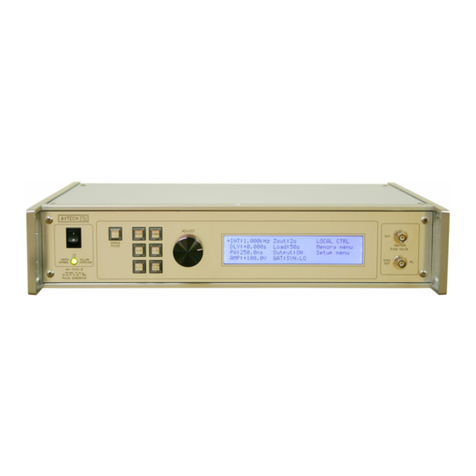
Model: AVR-G1-B-P-EMRA-R5-RP-IM1
Amplitude: 0 to +240 Volts
Pulse width (FWHM)2: us to 0 us
Load impedance: ≥ 1.6 kΩ, ≤ 900 pF.
150 mA maximum output current.
Output impedance: 50 Ω (i.e., internal resistance in series with the output).
Rise time (20%-80%): ≤ 10 ns, into a resistive load
Fall time (80%-20%): ≤ 20 ns, into a resistive load
PRF: 1 Hz to 10 kHz
Duty cycle: 0% maximum
Polarity: Positive
GPIB and RS-2 2 control1: Standard on -B units
LabView Drivers: Check http://www.avtechpulse.com/labview for availability and downloads
Propagation delay: ≤ 100 ns (Ext trig in to pulse out)
Jitter (Ext trig in to pulse out): ± 100 ps ± 0.0 % of sync delay
Trigger required:
(External trigger modes)
Mode A: + 5 Volt, > 50 ns (TTL)
Mode B: + 5 Volt, PWIN = PWOUT (TTL)
Sync delay: Variable, 0 to ± 1 second
Sync output: + Volts, 100 ns, will drive 50 Ohm loads
Gate input: Synchronous or asynchronous, active high or low, switchable.
Suppresses triggering when active.
Monitor output: Provides an internal current monitor circuit whose measurements are
displayed on the front panel and can be queried digitally through the GPIB /
RS-2 2 ports. The current monitor will sense the output current at the end
of the pulse. Currents in the range of 0 to 250 mA can be measured
properly. (Higher currents will not damage the monitor, but they will not be
reported properly.) Measurement accuracy: +/- 10%.
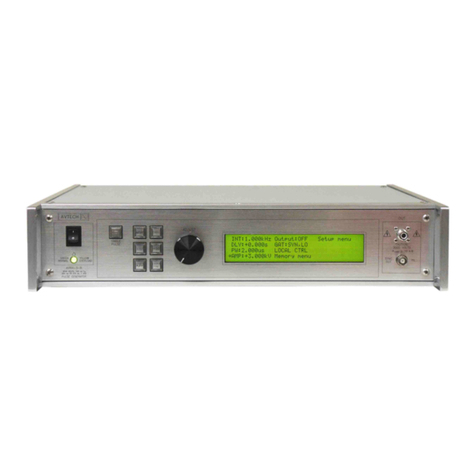
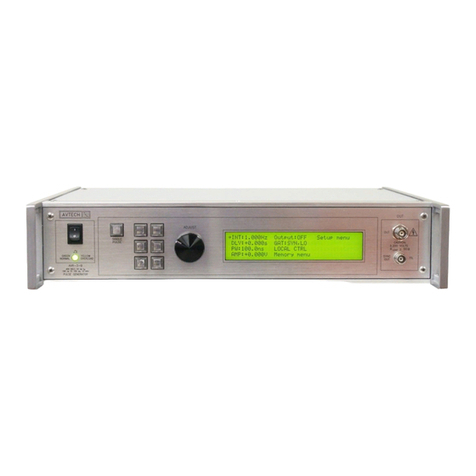
Connectors: SYNC: BNC, front panel
All others: BNC, rear panel
Power requirements: 100 - 240 Volts, 50 - 60 Hz
Dimensions (H x W x D): 100 mm x 4 0 mm x 75 mm ( .9” x 17” x 14.8”)
Chassis material: cast aluminum frame and handles, blue vinyl on aluminum cover plates
Mounting: Any. Add the suffix -R5 to the model number to include a rack-mount kit.
Temperature range: +5°C to +40°C
1) -B suffix indicates IEEE-488.2 GPIB and RS-2 2 control of amplitude, pulse width or duty cycle (as appropriate), pulse repetition frequency, and
delay (See http://www.avtechpulse.com/gpib).
2) When triggered externally, the pulse width can be set by the pulse instrument controls, or it may be set to track the input trigger pulse width.