OPERATION
STARTING
Before
engagingpowertake-off,proceedas
follows
in
theordershown.
1.
Alternator
circuit
breakers
mustbeintheOFF
position.
2.
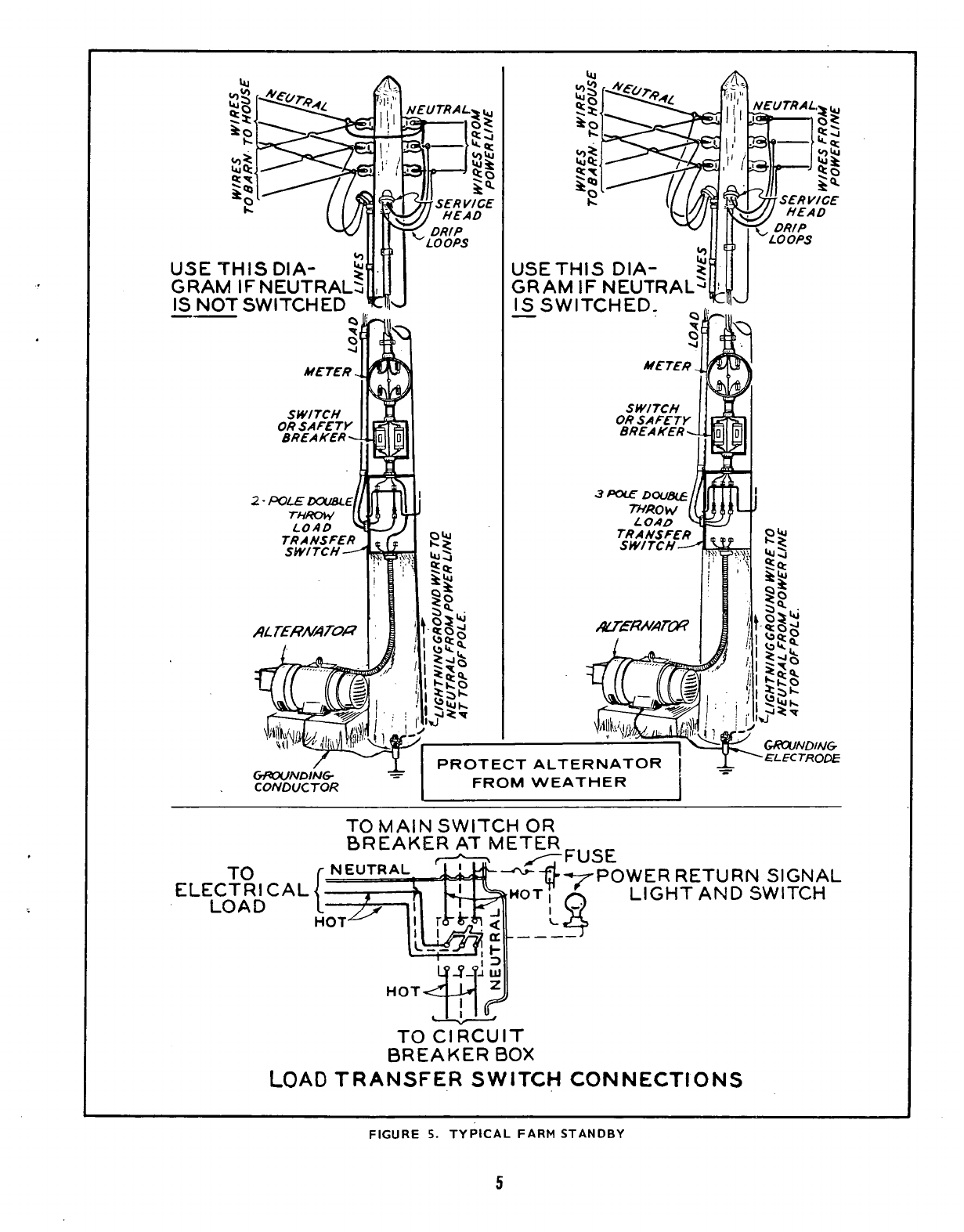
Connectpower
leads
betweenthealternatorand
load
transferswitch.
3.Throwtransferswitchtoconnectloadtoalternator.
4.Turn
powerreturnsignalONifonehas
been
in-
stalled.
5.Enginepower
take-off
and
bring
PTOshaft
speed
to
520rpm(530rpmforApex
gear
box).Thealter-
nator
speed
atthistime
will
be3600rpm(60cycle).
Thevoltmeteronthealternatorcontrolbox
will
readapproximately250volts.A green
segment
on
thevoltmeter
scale
indicatesthecorrectoperating
range.
6.
Snap
bothalternator
circuit
breakers
totheON
position.
SeeNotesA andB.
OPERATING
Voltage
will
decrease
ordrop,asthealternatorwarms
upevenwhenconstant
speed
ismaintained.Thisis
normal.
However,ifthepowerdropsbelowtherecom-
mendedoperatingvoltage(230to240volts)it
will
be
necessary
to
increase
thetractorPTO
speed
tocom-
pensate.
Also,
avoidover-voltagetoprevent
damage
to
electrical
equipmentand/orthealternator.
Reduce
voltagebydecreasingPTO
speed.
NOTE
A:
Keep
the
alternator load within
its
nameplate
rating.
If the
alternator
is
seriously overloaded
the
cir-
cuit breakers will automatically trip, disconnecting
the
entire electrical load. Reduce
the
load before throwing
the circuit breakers back
to the ON
position.
NOTE
B:
Motors require
low to
five times more current
for starting than running.
If
several motors start simul-
taneously,
the
total electrical load
may
overload
the
alternator causing
the
circuit breakers
to
open
and
dis-
connect
the
circuit.
To
avoid this, always start larger
horsepower motors
one at a
time. Your alternator
is
equipped with
an
auxiliary field timer switch, which,
when actuated, will connect
an
auxiliary winding
for
supplying added field strength
for
starting motors rated
at
3 H.P. or
larger.
Set the
timer
at one
minute
or
longer
for proper timer operation.
At the end of the
preset time,
the switch cuts
out and the
motor runs
on
normal current.
T^Cf^jJIQfit^\
H
tractor engine horsepower
is
t~-*^»^-*~^^*^^J> less than
2 H.P. per
kilowatt load, care
should
be
exercised
in
disconnecting large loads. Gover-
nor speed changes
can
cause high voltage surges which
could damage electrical equipment
of
lesser current
draw than that which
is
removed from
the
line.
TIPS
ON
OPERATION
Total
thewattagerequirementsofalltheequipmentthat
could
beoperatingsimultaneouslyduringa power
fail-
ure.Thiscanbedonebytakingthe
information
either
from
the
typical
wattagerequirementguide,orbytaking
the
informationfrom
thenameplateontheequipment
itself.
Startmotorsoneata time,beginning
with
thelargest
one,ifpossible.Then,afterallmotorsarerunning,
there
will
beextrapowerforother
less
critical
equip-
mentsuchasa television,airconditioner,etc.See
Note
B.
Checkthemotor
nameplates
forthehorsepowerrating
of
essentialequipment:furnaceblowermotor,
circu-
lating
heater,
electric
milking
machine,
milk
pump,barn
cleaner,feedconveyor,silageunloader,chickbrooder,
sumppump,
well
pump,ventilatingfans,freezer,
refrig-
erator,washingmachine,etc.
TYPICAL
WATTAGE
REQUIREMENTS
SINGLEPHASE
MOTORS*(CAPACITORTYPE)
WATTS
REQUIRED
SINGLEPHASE
MOTORS*(CAPACITORTYPE)
START
RUN
1/2
horsepower 2800 550
3/4horsepower 4300 775
1horsepower 5500 1000
2horsepower 7130 I960
3horsepower 10350 2970
5horsepower 16660 3500
T/ihorsepower 23000 5250
*
-
Repulsion
-
inductionmotorsrequirelessstarting
wattage.Splitphasemotorsrequireslightlymore
startingwattage.