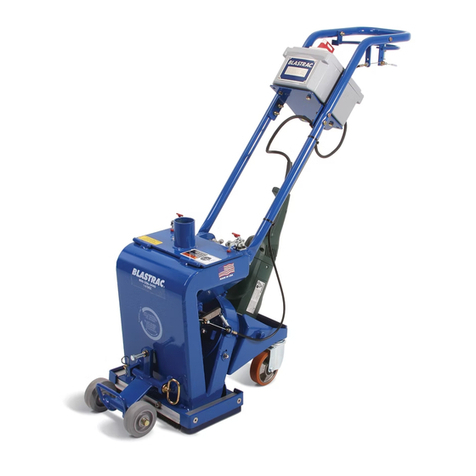
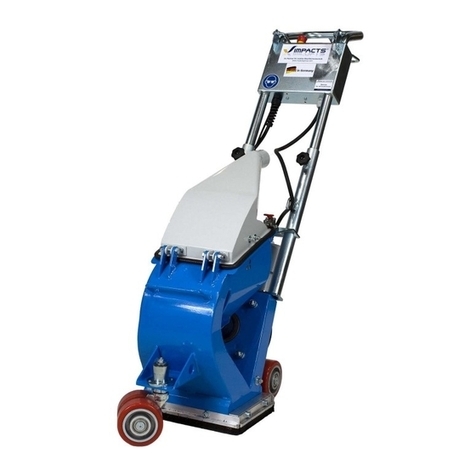
Blastrac 1-7D User manual

Operating Instructions
1-7D
MAN-1-7D-EN

Technical data
Safety instructions
General
Transport
Initial operation
Operation
Maintenance
Electrical systems
Fault diagnosis
Spare parts
Design and specifications are subject to
change without notice - September 1999
ISPC Blastrac/EBE
Utrechthaven 12
3433 PN Nieuwegein
THE NETHERLANDS
T +31(0)30 - 601 88 66
F +31(0)30 - 601 83 33
I www.surfacepreparation.com
Nieuwegein

1-7D Operating Instructions
Technical data
Contents Chapter 1
1.1 Rating
1.2 Unit specifications
1.3 Operative range and correct usage
1.4 Machine type designation
1
Operating Instruction 1-7D
Technical data
1.1 Rating
Unit / designation : ISPC Blastrac/EBE blast cleaning
machine
Machine type : 1-7D
Manufacturer : ISPC Blastrac/EBE
Utrechthaven 12
NL-3433PN Nieuwegein
THE NETHERLANDS
1.2 Unit specifications
Dimensions:
1-7D
Length 1040 mm
Width 310 mm
Height 980 mm
Weight 48 kg
Connected loads (electrical system):
The indicated input current values correspond to the nominal current
values of the motors working under full load. These values are not
achieved under normal operating conditions.
1-7D Power
consumption
Input
current
Blast wheel drive 2,5 kW max. 16 A
Filter unit 3,0 kW max. 16 A
Electrical connection required : 230 V, 50 Hz, 16 A, plug 230V
2

1-7D Operating Instructions
Technical data
Blast wheel size : 165 mm Ø
Working width : 200 mm
Drive speed : manual driven
Blast cleaning output on concrete : up to 15 m²/h
Dust hose connection : 50 mm Ø
Recommended abrasive : Media No. 2 - No. 4
Abrasive consumption : 100 g/m²
Recommended filter unit : 317 DC
1.3 Operative range and correct usage
The 1-7D is exclusively designed to clean dry, frost-
free horizontal surfaces. The machine may not be
used for other purposes. The manufacturer will not
be liable for damage resulting from such incorrect
usage. In these cases the user assumes all risks.
1.4 Machine type designation
number of blast wheel
s
blast cleaning widt
h
product cod
e
1 - 7 D
3

1-7D Operating Instructions
Safety instructions
Contents Chapter 2
2.1 Warnings and symbols
2.2 Organisational measures
2.3 Personnel selection and qualification
2.4 Safety precautions applicable to different operating conditions
2.5 Special work within the scope of use of the equipment and
maintenance activities as well as repairs during operation
2.6 Definition of the Safety off position
2.7 Particular dangerous aspects of the equipment
2.8 Electrical engineering regulations
1

Operating Instructions 1-7D
Safety instructions
2.1 Warnings and symbols
The following denominations and symbols are used in the Operating
Instructions to highlight areas of particular importance:
Symbol of operational safety.
In these Operating Instructions this symbol will be
shown next to all safety precautions that are to be
taken in order to ensure prevention to life and injury.
Follow these instructions and take special care in
these circumstances. In addition to these
instructions, the general safety precautions and
accident prevention guidelines are also to be
followed.
Particular details regarding the economical use of
the equipment.
Information, instructions and restrictions with regard
to possible risks to persons or to extensive material
damages.
2

1-7D Operating Instructions
Safety instructions
Warning against dangerous voltages.
Indications relating to protective devices in electrical
appliances.
Indications where consultation with the
manufacturer is required.
Instructions relating to periodical checks.
Reference to important instructions contained in the
Operating Instructions.
3

Operating Instructions 1-7D
Safety instructions
2.2 Organisational measures
The Operating Instructions are to be kept near the location
where the machine is located and must be within reach at all
times!
In addition to the Operating Instructions general and legal regulations
regarding accident prevention and environmental protection must be
complied with and indicated!
Such duties may for example relate to the handling of hazardous
substances or to the provision and wearing of personal protection
equipment as well as compliance with traffic regulations.
The Operating Instructions must be supplemented by instructions
including the duty to supervise and report relating to particular
working practices, for example work organisation, work procedures
and personnel allocation.
Personnel entrusted with working with the machine must have read
the Operating Instructions before starting work, in particular the
Safety Instructions chapter. To read these instructions during work
is too late. This particularly applies to incidental activities such as
setting up the equipment, carrying out maintenance work or training
staff to work with the machine.
From time to time the working practices of the staff are to be checked
regarding awareness of safety and hazards.
Personnel must tie back long hair and not wear loose clothing or
jewellery including rings. There is a risk of injury through getting stuck
or being drawn into moving machinery.
Use personnel protection equipment if necessary or required by
regulations! Take notice of all safety and hazard notices on the
machine!
All safety and hazard notices at or on the machine must be kept
complete and legible!
4

1-7D Operating Instructions
Safety instructions
If safety-critical changes occur to the machine or its working
method, the machine must be shut down immediately! The cause of
the fault must be established immediately!
Changes, add-ons or conversions to the machine which might impair
safety must not be undertaken without the manufacturer’s
permission!
This applies in particular to the fitting and adjustment of safety
devices as well as to welding on load-bearing parts.
Spare parts must comply with the technical requirements specified
by the manufacturer. This is always guaranteed if original spare
parts are used.
Intervals for recurring checks and inspections specified in these
Operating Instructions must be complied with!
To perform maintenance work correctly it is imperative to be equipped
with the proper tools for the task in question.
The location and the operation of fire extinguishers must be made
known on each building site!
Take note of the facilities for reporting and fighting fires!
2.3 Personnel selection and qualification
Fundamental duties :
Work on the machine may only be undertaken by reliable personnel.
Only trained personnel may be deployed. Note the statutory
minimum age! Specify clearly the responsibilities of personnel for
operation, setting up, servicing and maintenance work!
Make sure that only authorised personnel operate or work on the
machine!
Define responsibilities of the machine operator also regarding to
traffic safety regulations and empower him to decline instructions
from third parties which are not complying with the safety
requirements!
5
Other manuals for 1-7D
1
Table of contents
Other Blastrac Shot Blasting Machine manuals