8
such as pipes, radiators, ranges and refrigerators. There is
an increased risk of electric shock if your body is earthed or
grounded.
c) Do not expose power tools to rain or wet conditions.Water
entering a power tool will increase the risk of electric shock.
d) Do not abuse the cord. Never use the cord for carrying,
pulling or unplugging the power tool. Keep cord away from
heat, oil, sharp edges and moving parts. Damaged or entan-
gled cords increase the risk of electric shock.
e) When operating a power tool outdoors, use an extension
cord suitable for outdoor use. Use of a cord suitable for out-
door use reduces the risk of electric shock.
f) If operating a power tool in a damp location is unavoid-
able, use a residual current device (RCD) protected supply.
Use of an RCD reduces the risk of electric shock.
3) Personal safety
a) Stay alert, watch what you are doing and use common
sense when operating a power tool. Do not use a power tool
while you are tired or under the inuence of drugs, alcohol
or medication. A moment of inattention while operating
power tools may result in serious personal injury.
b) Use personal protective equipment. Always wear eye pro-
tection. Protective equipment such as dust mask, non-skid
safety shoes, hard hat, or hearing protection used for appro-
priate conditions will reduce personal injuries.
c) Prevent unintentional starting. Ensure the switch is in the
o-position before connecting to power source and/or bat-
tery pack, picking up or carrying the tool. Carrying power
tools with your nger on the switch or energising power
tools that have the switch on invites accidents.
d) Remove any adjusting key or wrench before turning the
power tool on. A wrench or a key left attached to a rotating
part of the power tool may result in personal injury.
e) Do not overreach. Keep proper footing and balance at all
times. This enables better control of the power tool in unex-
pected situations.
f) Dress properly. Do not wear loose clothing or jewellery.
Keep your hair, clothing and gloves away from moving parts.
Loose clothes, jewellery or long hair can be caught in mov-
ing parts.
g) If devices are provided for the connection of dust extrac-
tion and collection facilities, ensure these are connected and
properly used. Use of dust collection can reduce dust-related
hazards.
4) Power tool use and care
a) Do not force the power tool. Use the correct power tool for
your application. The correct power tool will do the job bet-
ter and safer at the rate for which it was designed.
b) Do not use the power tool if the switch does not turn it on
and o. Any power tool that cannot be controlled with the
switch is dangerous and must be repaired.
c) Disconnect the plug from the power source and/or the
battery pack from the power tool before making any adjust-
ments, changing accessories, or storing power tools. Such
preventive safety measures reduce the risk of starting the
power tool accidentally.
d) Store idle power tools out of the reach of children and do
not allow persons unfamiliar with the power tool or these
instructions to operate the power tool. Power tools are dan-
gerous in the hands of untrained users.
e) Maintain power tools. Check for misalignment or binding
of moving parts, breakage of parts and any other condi-
tion that may aect the power tool’s operation. If damaged,
have the power tool repaired before use. Many accidents are
caused by poorly maintained power tools.
f) Keep cutting tools sharp and clean. Properly maintained
cutting tools with sharp cutting edges are less likely to bind
and are easier to control.
g) Use the power tool, accessories and tool bits etc. in ac-
cordance with these instructions, taking into account the
working conditions and the work to be performed. Use of
the power tool for operations dierent from those intended
could result in a hazardous situation.
5) Service
a) Have your power tool serviced by a qualied repair person
using only identical replacement parts. This will ensure that
the safety of the power tool is maintained.
4. Special safety instructions
• Hold power tool by insulated gripping surfaces, when
performing an operation where the cutting accessory may
contact hidden wiring or its own cord. Cutting accessory
contacting a “live” wire may make exposed metal parts of
the power tool“live”and could give the operator an electric
shock.
• Keep hands away from the sawing range. Do not reach
under the workpiece. Contact with the saw blade can lead
to injuries.
• Apply the machine to the workpiece only when switched
on. Otherwise there is danger of kickback when the cutting
tool jams in the workpiece.
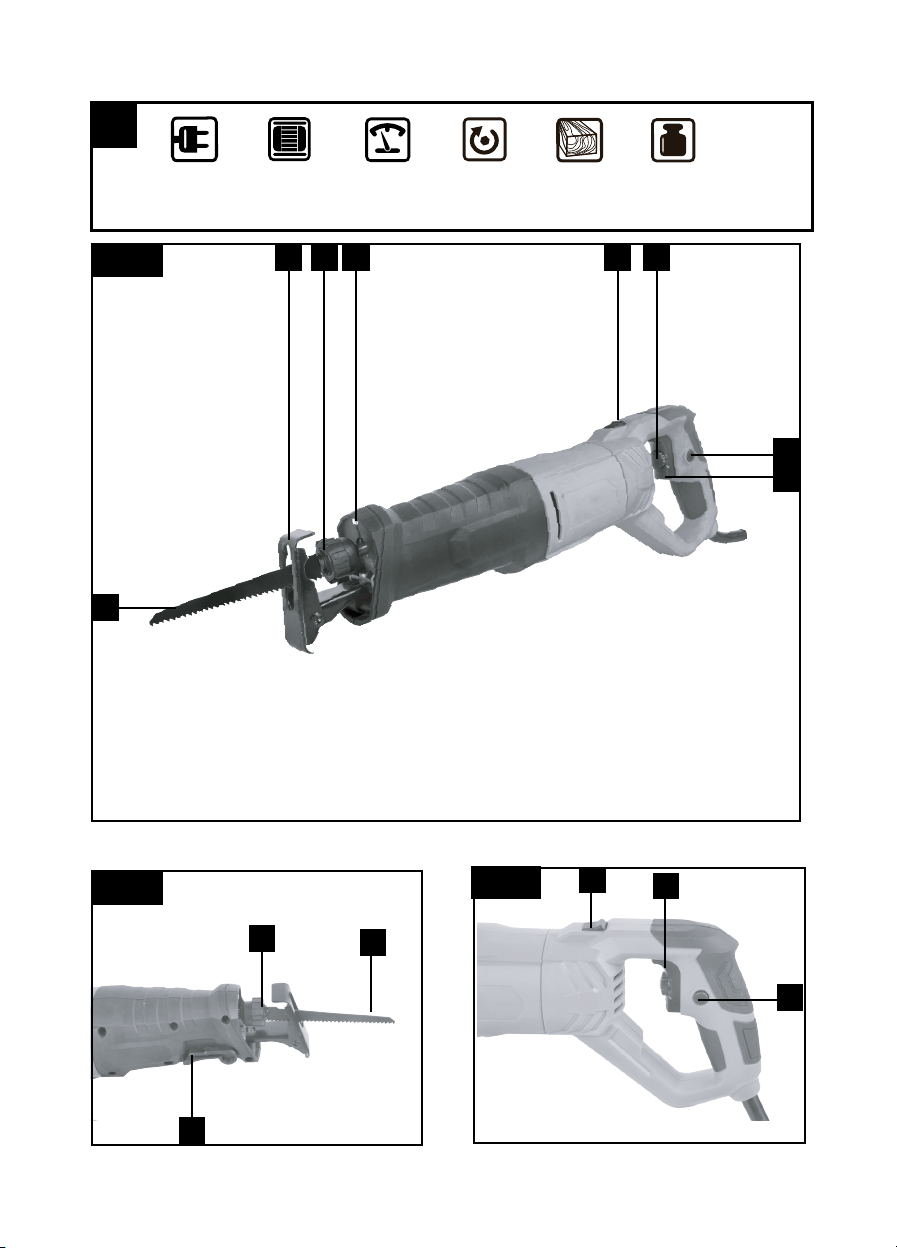
• Pay attention that the Soleplate (5) rests securely on the
material while sawing. A jammed saw blade can break or
lead to kickback.
• When the cut is completed, switch o the machine and
then pull the saw blade out of the cut only after it has come
to a standstill. In this manner you can avoid kickback and
can place down the machine securely.
• Use only sharp, awless saw blades. Bent or unsharp saw
blades can break or cause kickback.
• Do not brake the saw blade to a stop by applying side
pressure after switching o. The saw blade can be dam-
aged, break or cause kickback.
• Use suitable detectors to determine if utility lines are hid-
den in the work area or call the local utility company for
assistance. Contact with electric lines can lead to re and
electric shock. Damaging a gas line can lead to explosion.
Penetrating a water line causes property damage or may
cause an electric shock.
• Secure the workpiece. A workpiece clamped with clamp-
ing devices or in a vice is held more secure than by hand.
• Keep your workplace clean. Blends of materials are par-
ticularly dangerous. Dust from light alloys can burn or ex-
plode.
• Always wait until the machine has come to a complete
stop before placing it down. The tool insert can jam and
lead to loss of control over the power tool.
• Never use the machine with a damaged cable. Do not
touch the damaged cable and pull the mains plug when