- 6 -
posts. After soldering, a jumper shunt should be placed on JP8 if using a non-Kenwood hand held radio. No
jumpers should be left on JP1-JP5.
Install 2 jumper posts JP7A & JP7B (1x4). After soldering, jumper shunts should be placed on the left 2 pins of
JP7A, and another on the 2 right pins of JP7A. Two more should be placed on the left and right pin pars of JP7B.
Install jumper posts JP6 (1x3). This jumper is normally pre-cut.
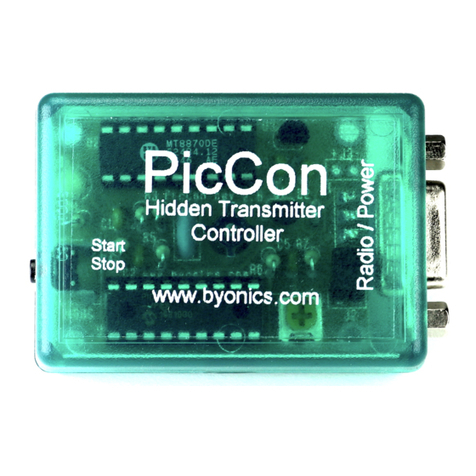
Install LED D4 (blue, but case is clear when not lit). Physical orientation is important. Be sure to align the flat or
notched side of all LEDs with the shape on the silk-screen, nearest the top edge of the PCB. The short lead on an
LED is nearest the flat or notched side (square hole). The LED should be touching the PCB. Note that the LED
order on the PCB from left to right is D4, D3, D2, D1. The color order of the LEDs, left to right, will be blue, yellow,
green, red.
Install LED D3 (yellow). Physical orientation is important. Align the flat or notched side as was done for D1.
Install LED D2 (green). Physical orientation is important. Align the flat or notched side as was done for D1.
Install LED D1 (red). Physical orientation is important. Align the flat or notched side as was done for D1.
Install inductor L1 (10uH, brn-blk-blk-gold). Polarity and physical orientation are not important. This component
looks like the resistors, but is larger. Bend one lead 180 degrees at the end of the bulb so that both leads are
parallel and 0.1 inch apart. Install vertically on the board.
Install the voltage regulator U3 (LM2940CT-5.0). Physical orientation is important. This will be mounted with the
heat sink, and the screw, washer, and nut. The heat sink should be between the regulator and the PCB, with the
fingers pointing up. Bend the regulator leads so that the printed text is facing up and the large mounting hole at
the top is aligned with the hole in heat sink and the hole in the PCB and flat against the PCB. Prior to soldering,
add the #4-40 screw through the holes. If the screw is inserted from the underside of the PCB, it will fit in the
case. On the other side, use the washer and nut. Do not over tighten. Mount with screw before soldering leads
Install capacitor C17 (100uf). Physical orientation is important. There is a stripe on the capacitor to mark the
negative side, which should be nearest the center of the PCB through the round pad. Push C17 down as close as
possible to the board to be sure it will fit in the case.
Install female DB-9 J1. This is the connector with the holes. Do not confuse with J2, as these are difficult to
remove. Solder all 9 pins, plus the mounting tabs on either side. The 9 pins do not need to be trimmed after
soldering, but the mounting tabs should be.
Install male DB-9 J2 as you did for J1. This is the connector with the pins.
Assembly Completion
After all components have been installed, inspect the solder side of the board for poor or cold solder joints. All pads
should be shiny and smooth. Inspect for any undesired solder bridges. Use an ohmmeter to be sure power in, ground,
and 5V (the 3 pins of U3) are not shorted together. There should be about 12K ohms resistance between power in and
ground, and about 8K ohms between 5V and ground. You can then provide power to the board and confirm +5 volts at U3
between the center pin (ground) and lower pin, closest to C17 (+5V). If the board looks ready, remove power, and
complete the assembly as follows.
Insert programmed microprocessor U1. The chip is static sensitive, so ground yourself by touching a large metal
object before touching the chip. The 2 rows of pins may need to be bent slightly to be parallel to each other. Be
sure to align the notch on the chip with the notch on the socket, as well as the notch on the silk-screen (nearest
JP1-JP5). An improperly inserted chip may become permanently damaged. The chip comes pre-programmed
with the diagnostic program.
Insert MAX232A chip U2. The rows of pins may need to be bent slightly. Be sure to align the notch on the chip
with the notch on the socket, as well as the notch on the silk-screen.
From The N3UJJ.COM Document LibraryFrom The N3UJJ.COM Document Library