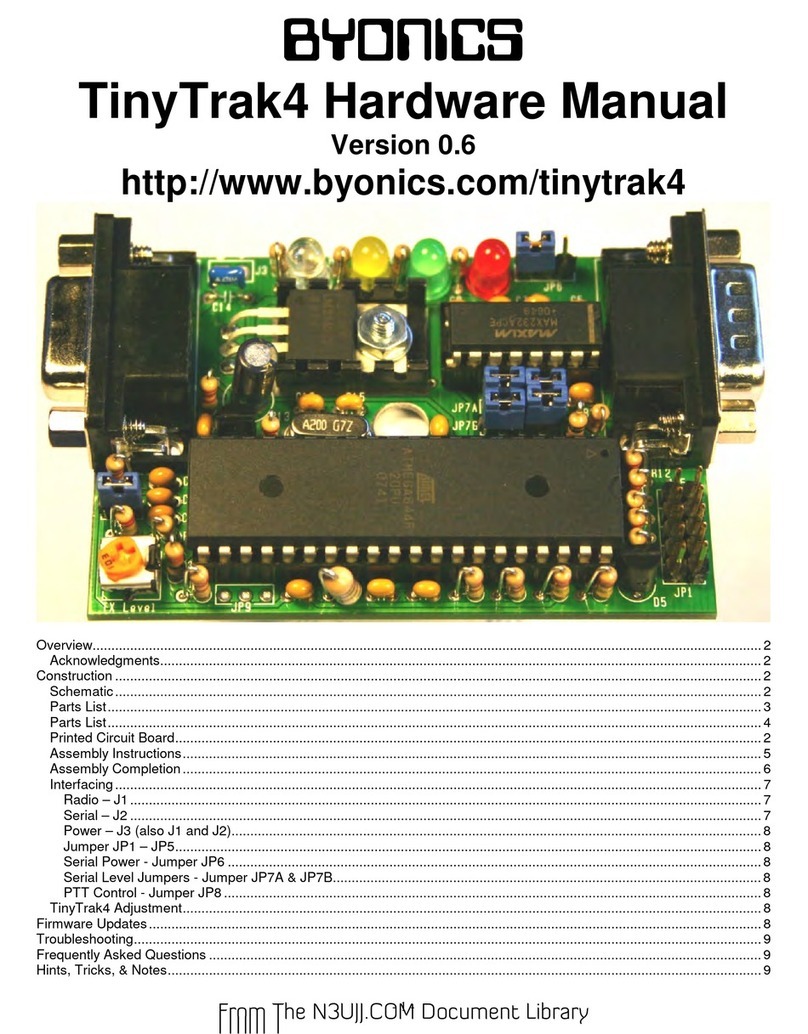
BYONICS TinyTrak4 User manual

TinyTrak4 Quick-Start Guide
Version 0.7 – July 23, 2017
Introduction
This Quick-Start Guide is intended to help new users get up and running with a Byonics TinyTrak4.
What is needed?
Most users will need the following items to setup and operate the TinyTrak4. The first 4 are available
from www.byonics.com.
●TinyTrak4 – Either the TinyTrak4 Built and Tested unit, or a TinyTrak4 Kit. See the TinyTrak4
Hardware Manual for information on building the kit version.
●Radio/Power Interface Cable – This cable is needed to connect the TT4 to a power supply,
and to the radio’s mic and speaker connections. These can be purchased at www.byonics.com
or built from the wiring diagrams at that site.
●TT USB cable – This is a custom USB to serial adapter that can connect directly to the
TinyTrak4 serial port (J2) and also power the TT4. Another option is a normal USB to serial
adapter, and a female to female null modem adapter, though it will not power the TinyTrak4.
●Serial GPS – If TinyTrak4 will be used as an APRSTM position tracker, a serial GPS sending
NMEA sentences is needed. A USB only GPS cannot be used. The TinyTrak4 can be
configured to power a 5V GPS, such as the Byonics GPS5.
●Radio – 2-meter amateur radio, along with radio power and antenna. Either a mobile radio or a
handheld (HT) will work, as long as it has a microphone jack and an earphone/speaker jack.
●Computer with Terminal Emulation software – TeraTerm Pro for Windows and CoolTerm
for Mac are recommended, but any terminal software should work. If the TT4 will only be used
as a tracker, the computer is only needed during initial configuration.
●TinyTrak4 Power Supply – A 6V-15V power supply is needed to configure and operate the
TinyTrak4. Most users will use a 12V battery, or vehicle cigarette lighter plug. When using the
TT USB cable, do not use an additional power source.
Set the TinyTrak4 Jumpers
The TinyTrak4 has two user jumpers on the circuit board. JP8 is used to set the Radio PTT type, and
JP6 is used to set the GPS power. To access, remove the screw on the back center of the TT4 case.
JP8 is located on the left side, near the DB-9 connector J1. When using a radio without a separate
PTT line (Yaesu or Icom HTs, with cables HT1, HT2, or HT4), this jumper should be installed across
both pins, shorting them together. For radios with a separate PTT line (Kenwood, Baofeng, Wouxun,
and most all mobiles), this jumper should be removed, or stored on only 1 pin. A built TinyTrak4
normally has the jumper installed. If this jumper is installed when it shouldn’t be, mobile radios may
constantly transmit. If the jumper is not installed when it should be, radios will not transmit.
JP6 is located on the top of the PCB, near the right DB-9 connector J2. It has 3 posts. If a jumper is
installed on the left two posts, 5V will be sent to the GPS/Computer port J2 pin 4 to power the GPS,
such as the Byonics GPS5. If a jumper is installed on the right two posts, the supply voltage (usually
12V) will be sent to the J2 port. If the jumper is left off, or just stored on a single post, no power will be
sent to the J2 port. A built TinyTrak4 normally has the jumper installed on the left 2 posts, providing
5V to J2. Warning: Sending 12V to a 5V GPS, such as the Byonics GPS5, will destroy the GPS.
Make the connections
Connecting all the above elements together is fairly simple. Connect the TT USB to the computer
USB port, and install the drivers if needed. Connect the other end to the TinyTrak4 J2 Male DB-9
connector, marked “GPS/Computer”. Then connect the Radio/Power Interface cable to the TinyTrak4

J1 Female DB-9 connector, marked “Radio/Power”. Connect the other end of that cable to the radio
mic and speaker/ear jack, but not to a power supply yet. This should allow you to configure the
TinyTrak4 settings. After that, disconnect the TT USB from the TinyTrak4, connect the GPS, and
connect the Radio/power cable to 12V to start operation.
Configure the Alpha firmware
The final step is to configure the TinyTrak4 with your desired options. Start the terminal emulation
software, set for the proper COM port, set the baud rate to 19200 and turn off flow control. Then cycle
power to the TT4 by disconnecting and reconnecting the TT USB from the TinyTrak4 J2 port, and the
terminal should display:
?
Press ESC 3 times to enter TT4 Options Menu
When you see this, press the ESC key 3 times quickly within about one second, and you should see:
Byonics TinyTrak4 Alpha v0.72 (1284)
Options Menu
:
at which point you are in the Alpha config menu, and you can configure the TinyTrak4. You can type
text commands such as
●HELP – to display a list of all commands and descriptions
●DISPLAY – to display all currently set options
●RESTORE – to restore all settings to factory defaults
●QUIT – to quit the config menu, and allow the TT4 to start operating
Typing any command without a parameter will display its current setting. Refer to the Alpha Firmware
Manual for details on all the commands, and the section below for recommended settings. Once
configured, disconnect the TT USB and connect the GPS, and connect power to the radio interface
cable to begin TT4 Alpha operation.
Setting Alpha audio levels
The TT4 needs to have the outgoing and incoming audio levels set to work with the particular radio
you will be connecting to it.
To set the outgoing audio level, you will need a second radio to listen to your transmitted audio. Use
the menu CALIBRATE command to make the radio to transmit test audio. Press B to send both the
high and low tones, and while listening on the receiver, press the 1 and 2 keys to adjust the transmit
audio level. You should start the level high, and then bring it down until you hear a noticeable level
drop on the receiver. You can also use the R1 pot on the TT4 PCB to adjust the transmit audio level.
To set the incoming audio level you will use the MONITOR and RXAMP command. The radio volume
should usually be set low, around 10%, if connected to the speaker jack. The MONITOR command will
cause the TT4 to display the received audio level to the terminal. The value displayed when a packet
is received should be between 50 and 80. The value displayed when a packet is not received should
be between 2 or less if using squelch, and greater than 80 with open squelch. If it is not, press any
key to quit the MONITOR command, and use the RXAMP command to adjust the incoming audio gain
and then re-check the level with the MONITOR command. If needed, adjust the radio volume, but be
sure the volume is left in the position found suitable for the selected RXAMP setting. To confirm
decoding, set AMODE TEXT and ABAUD 19200 and then QUIT the config menu, don’t press ESC
when prompted, and see if decoded packets appear on the terminal screen.

Recommended Alpha configuration
Below are some recommendations for basic settings. These assume you begin with all parameters at
their default settings (as set with the RESTORE command.)
Tracker configuration with GPS connected directly to the TT4
●MYCALL <your callsign> – set your callsign, i.e.: MYCALL N6BG-1
●PPERIOD 120 – set the position report rate to 2 minutes (120 seconds)
KISS TNC configuration
●AMODE KISS – set to KISS protocol
●ABAUD 19200 – or whatever is desired
Digipeater configuration
●ALIAS1 WIDE1 – set the Digipeater call to repeat
Transmit Digipeater details for fixed location configuration
●TSYMC # – set the digipeater symbol
●PPERIOD 3600 – set the digipeater position report rate to 1 hour (3600 seconds)
●LOCATION <your location> – format be DDMM.mmmmH DDDMM.mmmmH
●TOSV FALSE – to send location without GPS
●PATH1 WIDE2-1 – set outgoing path
●PATH2 % – set outgoing path by clearing PATH2
Telemetry configuration
●TPERIOD 300 – set the telemetry report rate to 5 minutes (300 seconds)
Additional Resources
Hopefully, this guide has helped to get you started using the Byonics TinyTrak4. If you need
additional assistance, here are some resources:
●www.byonics.com/tinytrak4 – The TinyTrak4 website contains all Byonics TinyTrak4
documentation, firmware, and software available.
●groups.yahoo.com/group/tinytrak4 – This TinyTrak4 user mailing list is a great place
to ask questions, and read how others are using the TinyTrak4. There are many experienced
TinyTrak4 users here.
●[email protected] – You can email any TinyTrak4 questions to Byonics.
Other manuals for TinyTrak4
3
Table of contents
Other BYONICS Controllers manuals
Popular Controllers manuals by other brands
Digiplex
Digiplex DGP-848 Programming guide
YASKAWA
YASKAWA SGM series user manual
Sinope
Sinope Calypso RM3500ZB installation guide
Isimet
Isimet DLA Series Style 2 Installation, Operations, Start-up and Maintenance Instructions
LSIS
LSIS sv-ip5a user manual
Rockwell Automation
Rockwell Automation 1769-L31 installation instructions