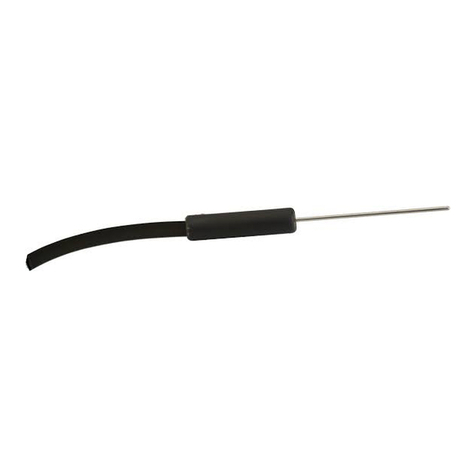
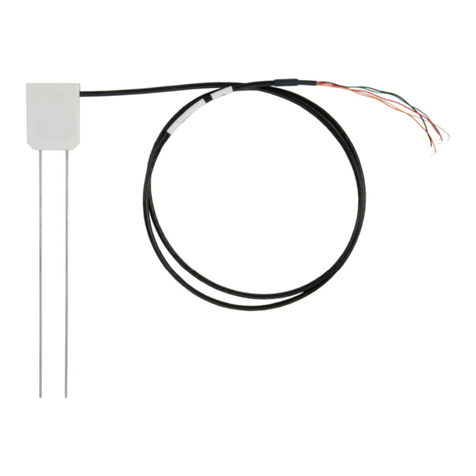
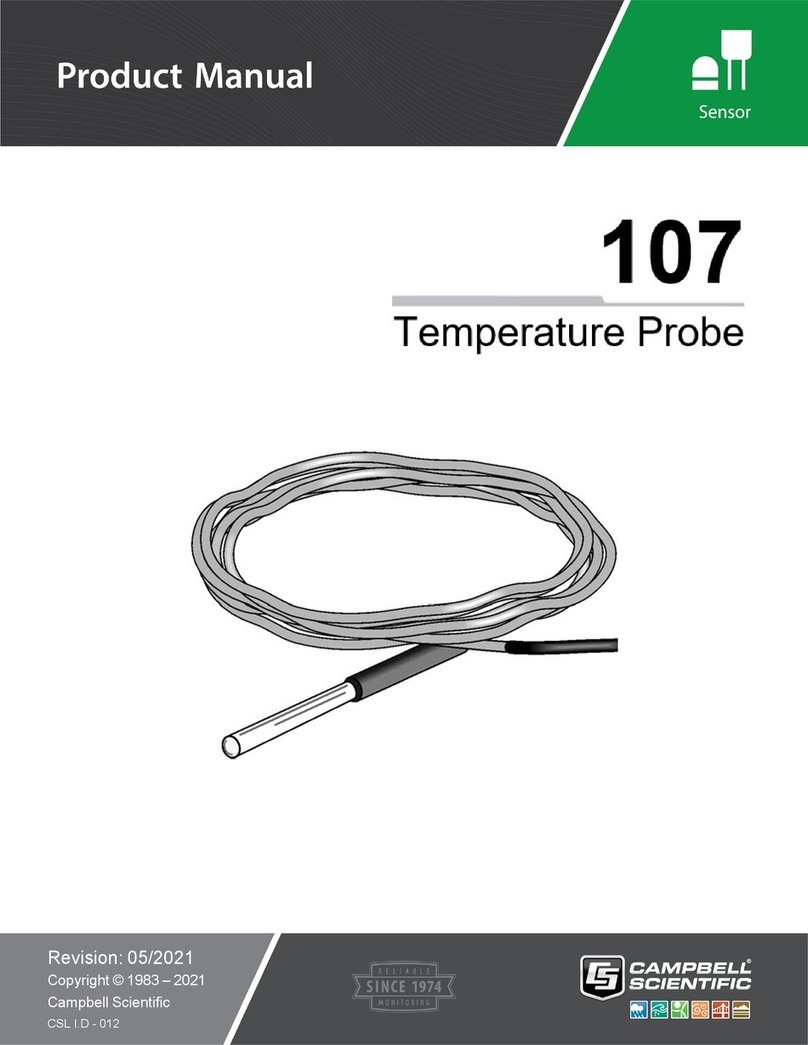
Model 107 Temperature Probe
5
Example 1. Sample Program
1: Temp (107) (P11)
1: 1 Reps
2: 9 SE Channel
3: 3 Excite all reps w/E3
4: 1 Loc [ Air_Temp ]
5: 1.0 Mult
6: 0.0 Offset
Excitation/Integration Codes
Code Result
0x excite all rep with channel x
1x increment chan x with each rep
2x excite all reps with channel x, 60 Hz rejection, 10 ms delay
3x excite all reps with channel x, 50 Hz rejection, 10 ms delay
4x increment chan x with each rep, 60 Hz rejection, 10 ms delay
5x increment chan x with each rep, 50 Hz rejection, 10 ms delay
5. Maintenance and Calibration
The 107 Probe requires minimal maintenance. Check monthly to make sure the
radiation shield is free from debris.
For most applications it is unnecessary to calibrate the 107 to eliminate the
thermistor offset. However, for those users that are interested, the following
briefly describes calibrating the 107 probes.
A single point calibration can be performed to determine the 107 temperature
offset (thermistor interchangeability). This calibration will not remove the
polynomial error. The value of the offset must be chosen so that the probe
outputs the temperature calculated by the polynomial, not the actual calibration
temperature. For example, a 107 is placed in a calibration chamber that is at 0°C
and the probe outputs 0.1°C. The offset is -0.16, because at 0°C the polynomial
calculates a temperature of -0.06°C (Table 6-1).
6. Instruction 11 Details
Understanding the details in this section are not necessary for general operation
of the 107 Probe with CSI's dataloggers.
Instruction 11 outputs a precise 2 VAC excitation (4 V with the 21X) and
measures the voltage drop due to the sensor resistance (Figure 6-1). The
thermistor resistance changes with temperature. Instruction 11 calculates the
ratio of voltage measured to excitation voltage (Vs/Vx) which is related to
resistance, as shown below:
Vs/Vx = 1000/(Rs+249000+1000)
where Rs is the resistance of the thermistor.
See the measurement section of the datalogger manual for more information on
bridge measurements.
Instruction 11 then calculates temperature using a fifth order polynomial equation
correlating Vs/Vx with temperature. The polynomial coefficients are given in
Table 6-2. The polynomial input is (Vs/Vx)*800. Resistance and datalogger
output at several temperatures are shown in Table 6-1.