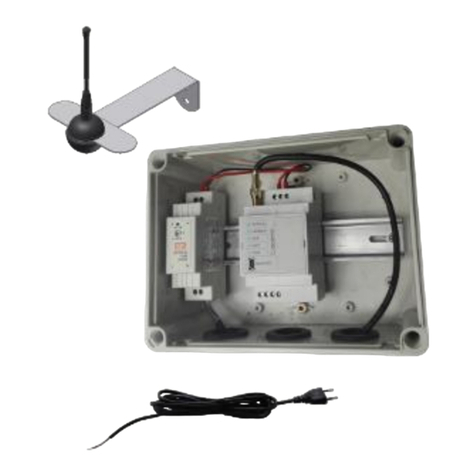
7. EXP4IO-00 and EXP4IO-07 install.
The EXP4IO-00 and EXP4IO-07 expansions allows a SELF-LEARNING procedure, to recognise the connection input type (voltage and
current of the reading circuit).
After physically connected the module’s outputs to related inputs and powered up all the device perform the following procedure (in
case of EXP4IO-07 the channel #4 must be connected to NTC1K “External Probe” input):
Input self-learning procedure
1. Connect the COSTER basestation’s inputs to EXP4IO expansion outputs.
2. Power up the system.
3. Keep pressed SW1 and SW2 keys for two seconds long, LD1 and LD2 leds will turn off:
4. Press SW1 for one second long. LD1 led flash in GREEN and the self-learning procedure for channel 1 starts. LD2 led is off.
At the end of procedure, LD1 will have a fixed light showing the result of self-learning procedure: GREEN=PASS, RED=FAIL.
5. Premere nuovamente SW1, la procedura si ripete lampeggiando LD1 ma apprende il canale 2. Press again SW1, the
procedure starts again with LD1 flashing but channel 2 starts learning.
6. Press SW2 for one second long. LD2 led flash in GREEN and the self-learning procedure for channel 3 starts. LD1 led is off.
At the end of procedure, LD2 will have a fixed light showing the result of self-learning procedure: GREEN=PASS, RED=FAIL.
7. Press again SW2, the procedure starts again with LD2 flashing but channel 4 starts learning.
8. Keep pressed SW1 and SW2 keys for two seconds long to exit from the self-learning procedure. LD1 and LD2 leds will have
fixed green light.
Invalid measure or offline probe condition.
In case the probe/datalogger presents an INVALID measure condition (damaged transducer) or probe/datalogger is in radio OFFLINE
condition (radio range not sufficient or battery exhausted), the EXP4IO module put outputs in high impedance status, to emulate an NTC
physical disconnection from related COSTER device’s input.
This condition can be detected as malfunction and can be managed properly programming the controller and, in case, highlighting
the fail status.
This condition is also detected when the device is powered on, and is maintained until measures are received by probes/dataloggers,
which update output status with desired values.