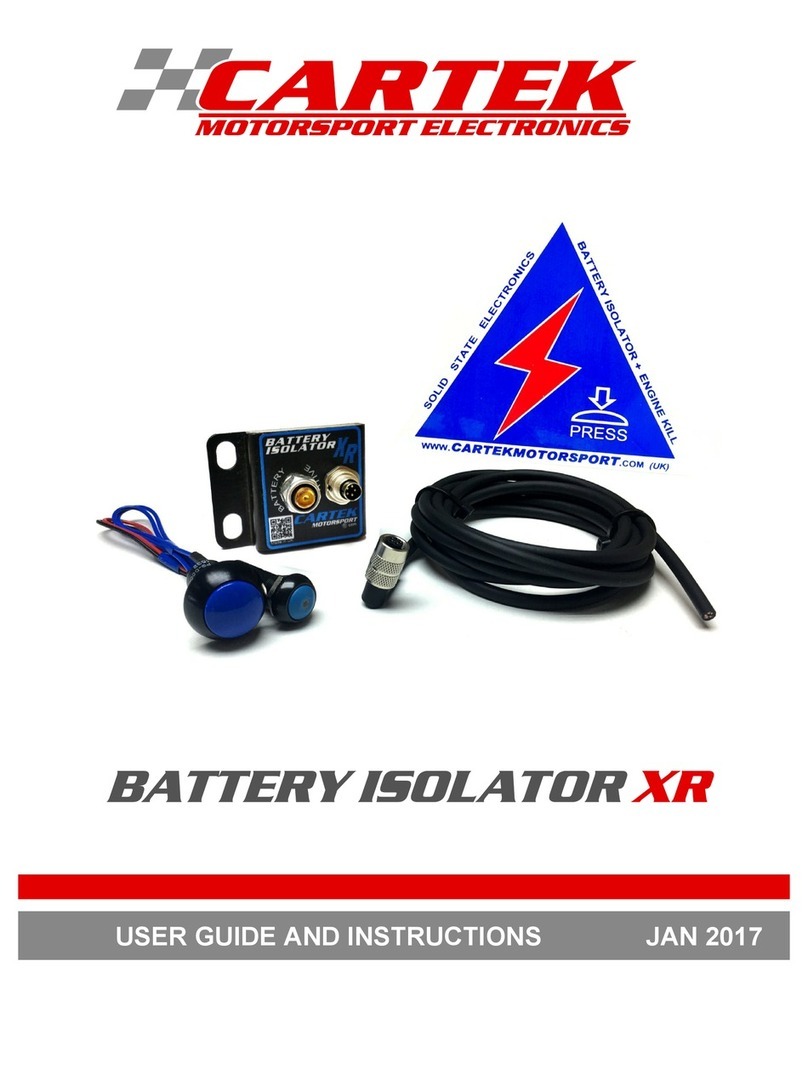
Cartek XClub CK-BXC-01 User manual

Size: L = 60mm, W = 50mm.
Weight: 70g.
Battery negative terminal: M6 stud.
Operational Voltage: 8v - 18v.
Current consumption: 50mA ON, 10mA OFF
Battery negative switching current: 450A cranking, 1500A surge
Positive power switching current: 10A.
Operating temperature: -10°C - +100°C.
Storage temperature: -40°C - +125°C
For off-road use only
INSTALLATION GUIDE
BATTERY ISOLATOR
SPECIFICATION
Manufactured in U.K.

INTRODUCTION
The CARTEK Solid State Battery Isolator is a fully electronic ‘master/kill switch’ system designed specifically
for race car applications. This system contains no moving parts and the solid construction provides very high
resistance to shock, vibration, water and dirt. Using the latest MOSFET technology this isolator provides safe,
spark-free isolation of the vehicle’s battery and engine electrics in accordance with FIA safety regulations.
SAFETY NOTES
●Please read through the Instructions thoroughly before installing on your race car. If not installed correctly
then damage may occur to the Battery Isolator.
●The Battery Isolator MUST be fully connected before starting the engine. If the ‘ENGINE STOP’ signal wire
is not properly connected when the engine is running then damage to the Battery Isolator may occur.
(This does not apply to cars without alternators)
●Do not use the CARTEK Internal ON/OFF pushbutton switch for any other application, it is designed
specifically for use with CARTEK Battery Isolators only.
●The Battery Isolator must be removed if any electric welding is being carried out on the car.
When using a Battery Charger or an external starter/booster battery then it is important to connect both
terminals directly to the car battery. DO NOT CONNECT THE NEGATIVE LEAD OF THE CHARGER OR EXTERNAL
BATTERY TO THE CHASSIS. THIS MAY CAUSE DAMAGE TO THE BATTERY ISOLATOR.
EXTERNAL
STARTER BATTERY
OR CHARGER
+
-
EXTERNAL
STARTER BATTERY
OR CHARGER
+
-
CHASSIS
EARTH
+
-
For the latest information and extra
installation advice go to:
www.cartekmotorsport.com/downloads
ONBOARD
CAR BATTERY
ONBOARD
CAR BATTERY
Part Numbers:
CK-BXC-01 Battery Isolator XC unit only.
CK-BXC-04-B Battery Isolator XC kit includes:
Battery Isolator XC unit,
Internal ON/OFF switch,
External 'kill' pushbutton (Blue),
Safety stickers.
CK-EP-02 External 'kill' pushbutton, Red.
CK-LP-03 External 'kill' pushbutton, Blue.
CK-YP-04 External 'kill' pushbutton, Yellow.
CK-LT-01 Internal ON/OFF pushbutton.
CK-SS-03 Safety Stickers.
+
-

FITTING
MOTORSPORT IS DANGEROUS.
THIS PRODUCT IS DESIGNED FOR MOTORSPORT USE ONLY AND SHOULD NOT
BE USED ON ROAD/STREET VEHICLES OR ON PUBLIC HIGHWAYS.
NO WARRANTY IS MADE OR IMPLIED REGARDING ANY CARTEK PRODUCTS TO
PROTECT USERS FROM INJURY OR DEATH.
USER ASSUMES ALL RISKS.
1. The Battery Isolator should be mounted directly to the
vehicle’s metal chassis and close to the vehicle’s battery but
away from any high temperature sources. The Battery Isola-
tor should be mounted securely with two, unpainted
screws/bolts to provide good electrical contact with the
chassis.
If mounting directly to a metal chassis is not possible then an 'earth' cable can be used to connect
the the Battery Isolator to a suitable point
on the chassis or engine block.
2. Make the connections to the External Kill
switch and the Internal ON/OFF switch.
Thin, low current wire can be used here.
3. Make the the Engine Stop connection.
This signal wire outputs +12V (10A) when the Battery
Isolator is ON and 0V (Grounded) when OFF.
This output can be connected directly to motorsport
ECUs and PDMs that have a dedicated Ignition-
Switch or Engine-Kill input.
Alternatively, it can be used to control a Main
Engine Relay or power to Ignition Coils.
4. Make the Battery Positive connection.
5. Finally, make the Battery Negative connection.
This connection should be made with cable of
100-200Amp capacity and by keeping as short
as possible will offer maximum weight saving of
the complete installation. No other cable
should be attached to the negative side of the
battery.
Always make the Battery Negative connection
last during installation but disconnect first dur-
ing removal.
6. Switch the Battery Isolator ON by operating the ON/OFF switch. The Battery Isolator status LED
should show Green. If the LED displays anything other than Green when ON then consult the Fault
Diagnosis page.
www.CARTEKMOTORSPORT.com Made in UK
BAT TE RY
IS OLA TO R
N
E
G
A
T
I
V
E
B
A
T
T
E
R
Y
STATUS
i
BATTERY
POSITIVE
ENGINE
STOP
INSIDE
ON/OFF
SWITCH
OUTSIDE
‘KILL’
SWITCH
INTERNAL ON/OFF SWITCH
EXTERNAL KILL SWITCH
www.CARTEKMOTORSPORT.com Made in UK
BAT TE RY
IS OLA TO R
N
E
G
A
T
I
V
E
B
A
T
T
E
R
Y
STATUS
i
BATTERY
POSITIVE
ENGINE
STOP
INSIDE
ON/OFF
SWITCH
OUTSIDE
‘KILL’
SWITCH
www.CARTEKMOTORSPORT.com Made in UK
BAT TE RY
IS OLA TO R
N
E
G
A
T
I
V
E
B
A
T
T
E
R
Y
STATUS
i
BATTERY
POSITIVE
ENGINE
STOP
INSIDE
ON/OFF
SWITCH
OUTSIDE
‘KILL’
SWITCH
OUTPUT SIGNAL
FOR ENGINE STOP
(10A max)
BATTERY
NEGATIVE
CONNECTION
CAR BATTERY
+
-
STARTER
ALTERNATOR
FUSE BOX
or PDM
www.CARTEKMOTORSPORT.com Made in UK
BA TT ER Y
IS OL ATO R
N
E
G
A
T
I
V
E
B
A
T
T
E
R
Y
STATUS
i
BATTERY
POSITIVE
ENGINE
STOP
INSIDE
ON/OFF
SWITCH
OUTSIDE
‘KILL’
SWITCH
BATTERY
POSITIVE
CONNECTION

FAULT DIAGNOSIS
Once fully installed, the Isolator is switched ON by activating the internal ON/OFF switch/button. On activation,
the Isolator performs a system check before the battery connection function occurs. If any fault is detected then
the Isolator will remain in the OFF state and display an error code via the status LED in a sequence of RED flashes:
2 or 6 flashes - Maximum temperature exceeded.
The Battery Isolator will automatically switch OFF if maximum temperature is exceeded.
This may occur after very prolonged engine cranking or if the Battery Isolator is mounted close to a source of
heat e.g. engine, coolant pipes, exhaust, radiator fan, etc.
3 flashes - External Kill Button pressed or External Kill Button circuit broken.
If the External Kill Button has not been activated then check for loose or poor connection between the Battery
Isolator and the External Kill switch.
4 flashes - Maximum current in ENGINE STOP circuit exceeded.
The maximum current this Engine Stop signal can deliver is 10Amp continuous and 15Amp surge.
5 flashes - Low Battery Voltage.
The car battery voltage dropped below 8 Volts.
7 or 8 flashes -Maximum current in NEGATIVE circuit exceeded or short circuit detected.
Check for a short circuit from battery positive to chassis such as broken cables, faulty Alternator or Starter Motor.
9 flashes - Fault with installation or internal fault detected.
Check wiring for installation errors.
Once the fault is remedied the Battery Isolator can be reset by switching the internal switch/button OFF then
switching ON again. The unit will also be fully reset by disconnecting from the vehicle battery and reconnecting.
Note: When connecting to the car battery, the LED will flash BLUE 2 times to indicate a power-up reset has occurred. When
in the OFF/Standby state, this LED can also be seen to pulse BLUE, slowly. This is not an error code.
POSSIBLE ERRORS
1. Make sure there is only one cable attached to the negative terminal of the battery and that this cable
connects to the Battery Isolator and nowhere else. There must be no cable between the negative
terminal of the battery and chassis.
2. If the Battery Isolator does not switch ON when the internal button is pressed to the ON position then
observe any flashing LED error code and identify the fault from the list above. If the Battery Isolator
does not switch ON and does not display any error code then check the connections between battery
and Battery Isolator, make sure the battery is fully charged. Also check connections to the Internal
ON-OFF switch.
3. If the Battery Isolator is left in the ON state for a long period of time and the battery voltage drops
below 11 Volts and remains low for 90 minutes then the Battery Isolator will turn itself OFF to reduce
current draw and help protect the battery. Note, this will not occur when the engine is running or
when the car is being driven as long as the alternator maintains a battery voltage higher than 11 Volts.
4. Note that, when the Battery Isolator is in the OFF state the integrated LED will flash Blue very
slowly to indicate that it is connected to the battery and receiving power.
CARTEK AUTOMOTIVE ELECTRONICS LTD
Unit 25, Mitchell Point
Ensign Way, Hamble
Southampton, SO31 4RF
UNITED KINGDOM
Tel: +44 (0) 2380 457747
Email: [email protected]
Web: www.CARTEKMOTORSPORT.com
This manual suits for next models
1
Table of contents
Other Cartek Automobile Accessories manuals