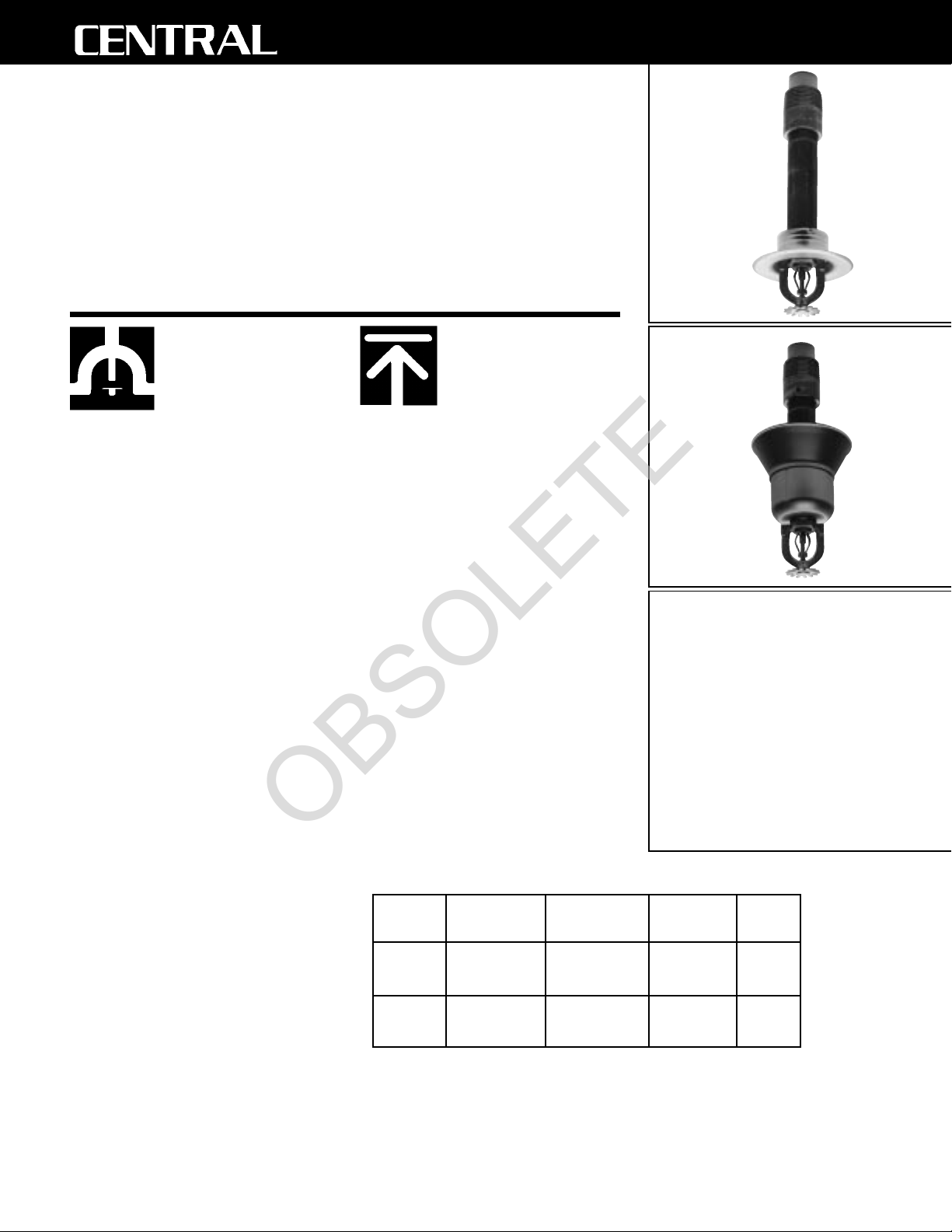
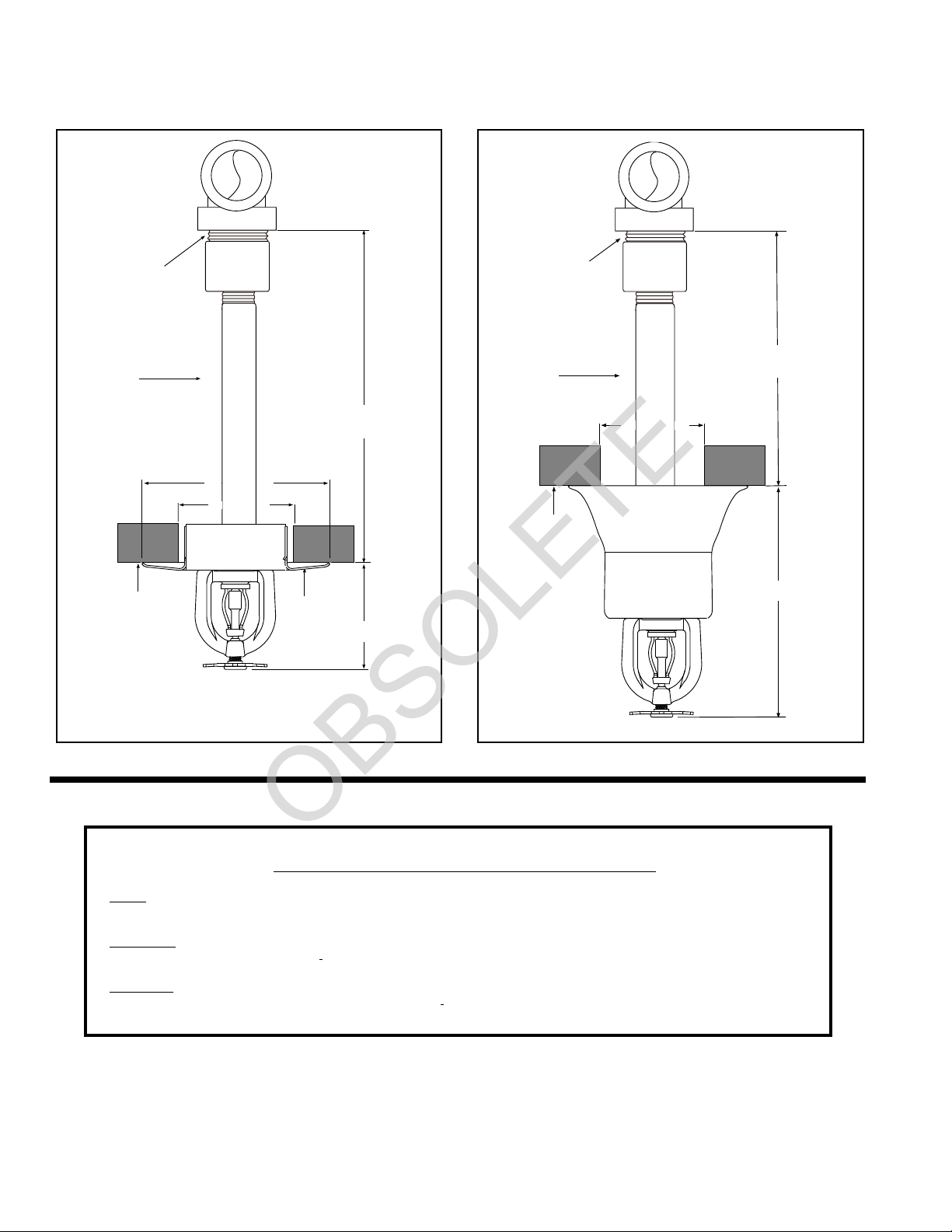
Design Requirements—Standard Applications
The Model A-1 Flush, Recessed, and Extended Dry Pendent Sprinklers are
intended for standard area coverages and standard flow and pressure require-
ments as specified in current NFPA Standards.
Design
Data
Sprinklers must be handled care-
fully. They must not be transported
or stored where ambient temperature
may exceed 100°F/38°C. For best
results, store them in a dry, cool
location in the original shipping
package.
Do not install sprinklers that have
been dropped or visibly damaged.
Sprinklers should never be painted,
coated, plated or altered in any other
way from manufactured condition or
they may not function properly. Any
sprinklers altered in such a manner
must be replaced.
The owner is responsible for the
proper operating condition of all fire
protection devices and accessories.
The NFPA standard 25 entitled,
“Inspection, Testing and Maintenance
of Water-Based Fire Protection
Systems”
, contains guidelines and
minimum maintenance requirements.
Furthermore, the local
Authority
Having Jurisdiction
may have addi-
tional regulations and requirements
for maintenance, testing, and inspec-
tion that must be obeyed.
It is advisable to have sprinkler
systems inspected regularly by a
qualified inspection service. Length
Care &
Maintenance
Installation Installation Sequence
Step 1. The unit should be
installed into a 1 inch NPT
threaded tee fitting conforming to
ANSI B16.3 for malleable iron and
ANSI B16.4 for cast iron threaded
fittings. Do not install into any
other type fitting without
consulting the Technical Services
department. Use of an improper
fitting can result in the failure of
the dry sprinkler to operate due to
binding of the plug or leakage
caused by insufficient engagement
of the threads into the fitting. In
scenarios with dry systems
subject to freezing conditions, the
use of an improper fitting can
result in the formation of an ice
plug on top of the dry pendent
plug if the plug does not extend
sufficiently into the fitting.
Step 2. Use only a non-hardening
pipe joint compound or Teflon* tape.
Apply only to the male threads.
Step 3. Hand tighten the sprinkler
into the fitting. The Model A-1 Dry
Pendent is installed by using a pipe
wrench at the upper brass thread
connector of the dry pendent. Use
the appropriate Wrench to tighten the
unit in the fitting. A leak tight joint
requires only 7 to 14 ft. lbs. (9.5 to
19.0 Nm) of torque; a tangential force
of 14 to 28 lbs. (62.3 to 124.5 N)
delivered through a 6" handle will
deliver adequate torque. Torque
levels over 40 ft. lbs. (54.4 Nm) may
twist the head in the main tube,
damaging the seal.
Step 4. To install the escutcheon
plate, align it with and push it over the
sprinkler body and into the upper
All Model A-1 Dry Pendent Auto-
matic Sprinklers must be installed
according to current NFPA 13 Stan-
dards.
Dry Pendent sprinklers are de-
signed to prevent water from accumu-
lating in the drops to sprinklers. To
accomplish this, they have a fitting
that protrudes into the branch line
with a cap (plunger) assembly. This
prevents the possibility of water
freezing in the drop to the pendent
sprinkler, creating an ice plug. Dry
Sprinklers should be installed in a
tee. (See Step 1)
Deviations from these require-
ments and standards or any alteration
to the sprinkler itself will void any
warranty made by Central Sprinkler
Company. In addition, installation
must also meet local government
provisions, codes and standards as
applicable.
Check for the proper model, style,
orifice size, and temperature rating
prior to installation. Install sprinklers
after the piping is in place to avoid
mechanical damage; replace any
damaged units. Wet pipe systems
must be protected from freezing.
Upon completion of the installation,
the system must be tested per
recognized standards.
In the event of a thread leak,
remove the unit, apply new pipe joint
compound or tape, and reinstall.
*Teflon is a trademark of the DuPont Corp.
support piece until the outer edge of
the escutcheon meets the mounting
surface.
Do not over- or under-tighten the
sprinkler to compensate for
inaccurate escutcheon plate
adjustment.
Caution: Special care must be
taken when installing with a CPVC
system. Sprinklers must be installed
after the manufacturer's recom-
mended setting time for the primer
and cement to ensure that neither
accumulate within the sprinkler.
Special care must be taken when
installing with a copper system.
Sprinklers must be installed only after
the inside of the sprinkler drop and
associated fittings have been wire
brushed to remove any flux. Residual
flux can cause corrosion and in
extreme cases can impair proper
sprinkler operation.