5
1. UNPACKING
Before installing and starting up the equipment, it is
important that you check the box and the state of the
equipment in order to verify that it has not suffered any
damages during its transportation.
Attention: Any claim for damages suffered during
transportation must be presented to the equip-
ment’s distributor together with the packaging
slip or invoice, adding the name of the carrier, within
24 hours from receiving the merchandise.
Take out the equipment and accessories from their
cardboard packaging, removing the corresponding pro-
tections.
Attention: Make sure to properly dispose of any
plastic bags, keeping them out of the reach of
children as they can be dangerous for them.
On the inside you will find (depending on the model):
The water treatment equipment, installation acces-
sories and its documentation.
The materials used in the packaging
are recyclable and
must be discarded in the appropria-
te collection bins or
in the local centre designated for
the recuperation of
waste materials.
This product cannot be discarded
together with other urban waste.
When the equipment’s lifespan comes
to an end, it should be handed
over to the company or centre where
you acquired the device, or in a Recycling
Centre or local centre specialised
in the recycling of materials,
indicating that it has electronic components
and refrigerating gases. The proper collection
and treatment of the unusable devices contributes to
the preservations of natural resources and helps avoid
any potential risks to public health.
2. INTRODUCTION
This general manual for Columbia dispensers describes
the characteristics of versions F and UF of the equip-
ment.
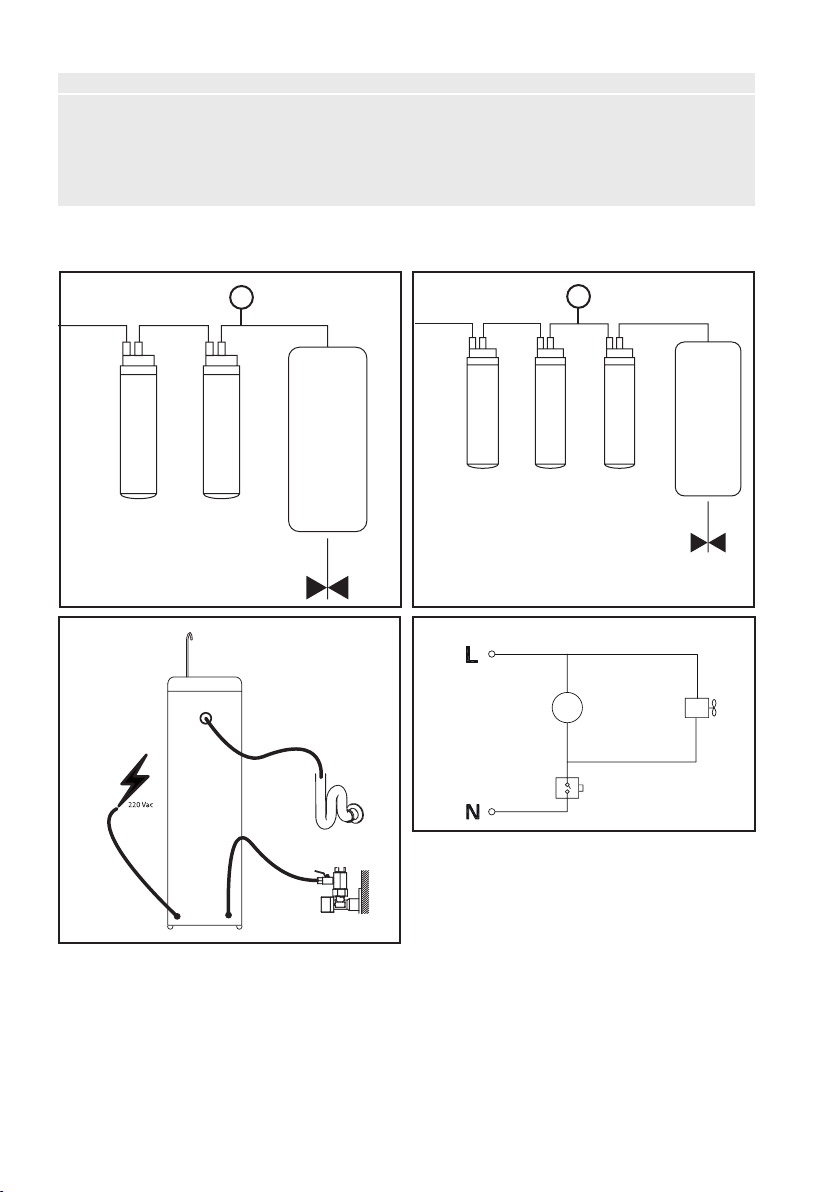
F systems include sediment filters and activated carbon
filters. UF systems include sediment filters, activated
carbon filters and an ultrafiltration membrane.
Congratulations. You have acquired one of the best
existing equipment in the market for the treatment of
water for domestic and office use.
This equipment will help you improve the characteris-
tics of your water, putting high quality water at your
disposal.
Your equipment will offer you various benefits and ad-
vantages:
• This is a physical system that does not use nor add
chemical products into the water.
• It offers water of high quality.
• It has a low maintenance cost.
• It ensures high production.
3. THE TYPES OF TREATMENT USED BY
COLUMBIA
Depending on the model, Columbia dispensers equip-
ment
are available with different types of water treatment:
filters and ultrafiltration.
3.1 WHAT IS FILTRATION?
Sediment filters
Filtration is the process of separating suspended solids
in the water by using a porous medium, also called filter.
The water goes through the pores of the filter, but par-
ticles that are larger than the pores of that filter are re-
tained by the filter itself which provides a clearer water.
Columbia dispensers equipment utilises 5 μm filters.
Activated carbon filters
Activated carbon is used to eliminate chloride in water,
and to improve its flavour and smell, as well as to elimi-
nate some organic components thanks to its great
absorbing capacities. Columbia dispensers equipment
utilise granulated carbon.
3.2 WHAT IS ULTRAFILTRATION?
Ultrafiltration is a system used to completely eliminate
all virus and bacteria from the water. Ultrafiltration
membranes have a porosity between 0,1 and 0,001 μm,
and for this reason they are able to retain suspended
solids much better.
4. PRIOR WARNINGS
Attention: Carefully read and safeguard this ma-
nual before installing and starting up the equip-
ment. If you have any doubts regarding the ins-
tallation, use or maintenance of this equipment, get in
touch with the technical assistance service (T.A.S) of
your distributor.
Attention: This equipment does not PRODUCE
POTABLE water. If the water to be treated comes
from a public source (and therefore conforms to
all applicable laws), this equipment will substantially
improve the quality of the water. Otherwise, it will be
necessary to carry out a physical, chemical and bac-
teriological analysis of the water to ensure its proper
purification by using the appropriate techniques and
equipment as needed. This needs to be done BEFORE
THE INSTALLATION of the equipment. Get in touch with
your distributor so that it can advise you with regards
to the appropriate treatment for your situation.
The water treatment equipment requires regular main-
tenance that needs to be carried out by qualified te-
chnical personnel in order to guarantee the quality of
water produced and provided.