www.controlair.com
Installation, Operation, and
Maintenance Instructions
TYPE 400
General Service Pressure Re
ulator
INTRODUCTION
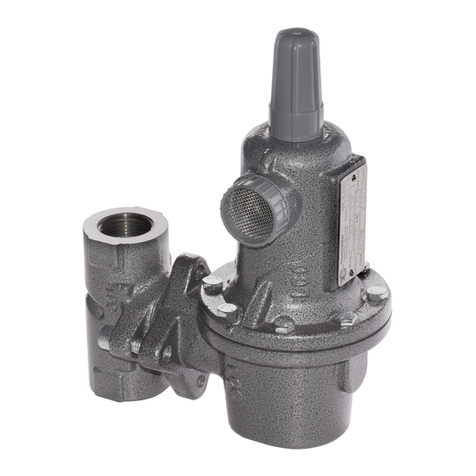
The Type-400 General Service Pressure Regulator is an air or gas service unit designed for instrumentation and general purpose use.
This unit is reliable and has excellent stability and repeatability. In addition, all units are irridite coated and finished with baked epoxy
paint for corrosion resistant construction necessary for harsh industrial environments. Maximum allowable inlet pressure is 250 psi.
Operating temperatures are 0 to 1600F. The Type-330 has low capacity internal relief which provides very limited down-stream over
pressure protection. Note: Non-relieving version does not provide internal relief. To avoid exceeding outlet pressure limits in service, a
pressure-relieving or pressure-limiting device should be provided.
SPECIFICATIONS
Port Size 1/4" NPT
Output Ranges 0-10 psig (0-0.7 BAR), 0-30 psig (0-2 BAR), 0-60 psig (0-4 BAR), 0-120 psig (0-8 BAR)
Maximum Supply Pressure 250 psig (17 BAR)
Mounting Pipe, bracket or panel
Flow Capacity 20 scfm (660 Nl/min) at 100 psig (7 BAR) supply with 20 psig(1.4 BAR) output
Exhaust Capacity 0.1 scfm (3 Nl/min) with downstream pressure 5 psig (0.3 BAR) above set point
Sensitivity 1" (2.5 cm) of water
Air Consumption Less than 5 scfh (2.5 Nl/min)
Effect of Supply Pressure Variation Less than 0.2 psig (0.01 BAR) for 25 psig (1.7 BAR) change
Temperature Limits -200F to 1600F (-290C to 710C)
Weight 0.84 lb (0.38 kg)
INSTALLATION
Clean all pipelines to remove dirt and scale before installation. Apply a minimum amount of pipe compound to the male threads of the
fitting only. Install the regulator as close as possible to the instrument or tool it is to service. Start with the third thread back and
work away from the end of the fitting to avoid contaminating the regulator. Install the regulator in the air line. The words "IN" and "OUT"
are cast into the body to indicate the direction of flow. Tighten all connections securely. If a lubricator is to be used in the system, install
it downstream.
OPERATION
Prior to turning on supply air, back out adjusting screw until there is no compression on the range spring. After turning supply pressure
on, turn the adjusting screw clockwise until the desired output pressure is reached.
WARNING: Only qualified personnel should install or service a regulator. Regulators should be installed, operated, and maintained in
accordance with international and applicable codes and regulations, and ControlAir instructions. If the regulator vents fluid or a leak
develops in the system, it indicates that service is required. Failure to take the regulator out of service immediately may create a
hazardous condition. Personal injury, equipment damage, or leakage due to escaping fluid or bursting of pressure-containing parts may
result if this regulator is over pressured or is installed where service conditions could exceed the limits given in the Specifications section,
or where conditions exceed any rating of the adjacent piping or piping connections. To avoid such injury or damage, provide pressure-
relieving or pressure-limiting devices (as required by the appropriate code, regulation, or standard) to prevent service conditions from
exceeding limits. Additionally, physical damage to the regulator could result in personal injury and property damage due to escaping fluid.
To avoid such injury and damage, install the regulator in a safe location. The internal relief valve in the Type-400 regulators does not
provide full overpressure protection. The internal relief valve is desi
ned for minor seat leaka
e onl
.
WARNING: To avoid personal injury resulting from sudden release of pressure, isolate the regulator from all pressure before attempting
disassembl
.