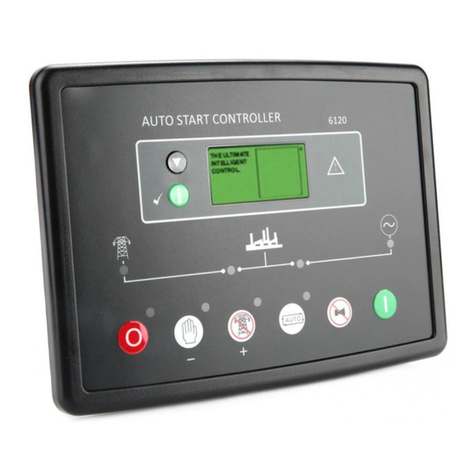
DSE DSEG8680 User manual

DEEP SEA ELECTRONICS
DSEG8680 Installation Instructions
053-254
ISSUE 1
This document details the installation and operation requirements of
the DSEG8680 module and is part of the DSEGenset® range of
products.
The DSE8680 module is a bus tie controller designed to control a
Bus Tie. A bus tie controller separates two halves of a generator
common bus. The DSE8680 manages the synchronising and check
synch and automatically controls the DSE AMSC (Advanced Multi
Set Communications) Link when opening/closing the bus tie.
CONTROL BUTTONS
Icon
Description
Auto Button
In the G8680 the auto button is used to select Auto Mode.
Alarm Mute / Lamp Test
This button silences the audible alarm in the controller,
de-activates the Audible Alarm output (if configured) and
test function.
Open Close Bus Breaker
There are two controller buttons (left and right) which
provide various control options for the breaker:
This button opens and closes the breaker.
Manual
This mode allows manual control of the functions. Once in
Manual mode the module will respond to the breaker
button , toggling the bus breaker.
Reset
Resets any alarms that have been detected by the
controller.
Menu Navigation
Used for navigating the instrumentation, event log and
configuration screens.
ACCESSING THE ‘RUNNING’ CONFIGURATION EDITOR
NOTE: Depending upon module configuration, some parameters in the
‘Running’ Editor may not be available. For more information refer to DSE
publication 057-326 DSEG8680 Configuration Suite PC Software Manual
available from www.deepseaelectronics.com
RUNNING’ CONFIGURATION EDITOR PARAMETERS
Section
Parameter As Shown On
Display
Values
Display
Settings
Contrast
0-100 %
Language
English, Other
Commissioning Screens
Active, Inactive
EDITING A PARAMETER
•Press and hold the Tick button for 5 seconds to access the editor.
•Press the Scroll buttons to select parameter.
•Press the Tick button to adjust the value (flashing) using the .Scroll
buttons
•Press the Tick button save the changes.
Editor
Display
Contrast
53%

ACTIVATING THE COMMISSIONING SCREENS
•Press the Scroll buttons to select commisioning screens parameter.
•Press the Tick button to adjust the value (flashing) using the .Scroll
buttons
•Press the Tick button save the changes.
EXITING THE RUNNING CONFIGURATION EDITOR
NOTE: The editor automatically exits after 5 minutes of inactivity to
ensure security.
•Press and hold the Tick button for 5 seconds to exit the editor and save
the changes.
DIMENSIONS AND MOUNTING
Parameter
Specification
Dimensions
250 mm x 189 mm x 50.5 mm (9.85 ” x 7.43 ” x 1.99 ”)
Panel Cutout
220 mm X 160 mm (8.7” X 6.3”)
Weight
0.76 kg (1.67 lb)
Operating Temperature with Standard
Display
-30 ºC to +70 ºC (-22 ºF to +158 ºF)
Operating Temperature with Heated
Display
-40 ºC to +70 ºC (-40 ºF to +158 ºF)
Storage Temperature
-40 ºC to +80 ºC (-40 ºF to +176 ºF)
FIXING CLIPS
NOTE: In conditions of excessive vibration, mount the control panel on suitable anti-vibration mountings
The module is held into the control panel fascia using the supplied fixing clips.
•Withdraw the fixing clip screw (turn anticlockwise) until only the pointed end is protruding from the clip.
•Insert the three ‘prongs’ of the fixing clip into the slots in the side of the DSE module’s case.
•Pull the fixing clip backwards (towards the back of the module) ensuring all three prongs of the clip are inside their allotted
slots.
•Turn the fixing clip screws clockwise until they make contact with the panel fascia.
•Turn the screws a quarter of a turn to secure the module into the control panel’s fascia. Care must be taken not to over tighten
the fixing clip screws.
Editor Display
Commissioning Screens
Active

REQUIREMENTS FOR UL CERTIFICATION
WARNING!: More than one live circuit exists, see diagram overleaf for further information.
Specification
Description
Screw Terminal Tightening Torque
•4.5 lb-in (0.5 Nm)
Conductors
•Terminals suitable for connection of conductor size 13 AWG to 20 AWG (0.5 mm² to 2.5 mm²).
•Conductor protection must be provided in accordance with NFPA 70, Article 240 (USA)
•Low voltage circuits (35 V or less) must be supplied from the engine starting battery or an isolated
secondary circuit.
•The communication, sensor, and/or battery derived circuit conductors shall be separated and
conductors unless all conductors are rated 600 V or greater.
Current Inputs
•Must be connected through UL Listed (if working to UL requirements) or recognized isolating
current transformers with the secondary rating of 5 A max.
Communication Circuits
•Must be connected to communication circuits of UL Listed equipment (if working to UL
requirements).
DC Output Pilot Duty
•0.5 A
Mounting
•Suitable for flat surface mounting in Type 1 Enclosure Type rating with surrounding air
temperature -22 ºF to +122 ºF (-30 ºC to +50 ºC)
•Suitable for pollution degree 3 environments when voltage sensing inputs do not exceed 300
V. When used to monitor voltages over 300 V device to be installed in an unventilated or filtered
ventilation enclosure to maintain a pollution degree 2 environment.
Maximum Operating Temperature
•122 ºF (50 ºC)
TYPICAL WIRING DIAGRAM
NOTE: Typical Wiring Diagrams are available in the product’s operator manual, refer to
DSE Publication: 057-327 DSE8660 Operator Manual available from www.deepseaelectronics.com for more information.
Deep Sea Electronics Ltd.
Tel:+44 (0)1723 890099
Web: www.deepseaelectronics.com
Deep Sea Electronics Inc.
Tel: +1 (815) 316 8706
Email: usasupport@deepseaelectronics.com
Web: www.deepseaelectronics.com
Other DSE Control System manuals