manuals.online logo
Brands
  1. Home
  2. •
  3. Brands
  4. •
  5. Duolabs
  6. •
  7. Measuring Instrument
  8. •
  9. Duolabs Season Wireless User manual

Duolabs Season Wireless User manual

Popular Measuring Instrument manuals by other brands

Powerfix Profi 278296 Operation and safety notes

Powerfix Profi

Powerfix Profi 278296 Operation and safety notes

Test Equipment Depot GVT-427B user manual

Test Equipment Depot

Test Equipment Depot GVT-427B user manual

Fieldpiece ACH Operator's manual

Fieldpiece

Fieldpiece ACH Operator's manual

FLYSURFER VIRON3 user manual

FLYSURFER

FLYSURFER VIRON3 user manual

GMW TG uni 1 operating manual

GMW

GMW TG uni 1 operating manual

Downeaster Wind & Weather Medallion Series instruction manual

Downeaster

Downeaster Wind & Weather Medallion Series instruction manual

Hanna Instruments HI96725C instruction manual

Hanna Instruments

Hanna Instruments HI96725C instruction manual

Nokeval KMR260 quick guide

Nokeval

Nokeval KMR260 quick guide

HOKUYO AUTOMATIC UBG-05LN instruction manual

HOKUYO AUTOMATIC

HOKUYO AUTOMATIC UBG-05LN instruction manual

Fluke 96000 Series Operator's manual

Fluke

Fluke 96000 Series Operator's manual

Test Products International SP565 user manual

Test Products International

Test Products International SP565 user manual

General Sleep Zmachine Insight+ DT-200 Service manual

General Sleep

General Sleep Zmachine Insight+ DT-200 Service manual

Sensa Core Lacto Spark user manual

Sensa Core

Sensa Core Lacto Spark user manual

VOLTCRAFT UTS-1980 operating instructions

VOLTCRAFT

VOLTCRAFT UTS-1980 operating instructions

EBCHQ 94915 Operation manual

EBCHQ

EBCHQ 94915 Operation manual

Balluff BIP LD2-T017-01-EP-S4 Series user guide

Balluff

Balluff BIP LD2-T017-01-EP-S4 Series user guide

Pulsar IMP Lite Series instruction manual

Pulsar

Pulsar IMP Lite Series instruction manual

ETCR 6800 user manual

ETCR

ETCR 6800 user manual

manuals.online logo
manuals.online logoBrands
  • About & Mission
  • Contact us
  • Privacy Policy
  • Terms and Conditions

Copyright 2025 Manuals.Online. All Rights Reserved.

Season Wireless – User Manual
www.duolabs.com – All rights reserved
1
Season Wireless
User Manual
English
- April 2005 -
Season Wireless – User Manual
www.duolabs.com – All rights reserved
2
Premise
Season Wireless is a smartcard traffic analyzer and a useful support tool for
developers of smartcard emulators. This device is the natural evolution of
Season Logger 2, which can be connected to PCs by means of an RS-232 serial
cable.
This new product is wireless and enables therefore the analysis/testing device
to be installed in a different location as compared to the PC where the
testing/emulation software runs, thus eliminating the need of connection
cables.
The device consists of two distinct components: the Slave and Master. The
Slave is the card that is inserted in the remote device and that physically
replaces the smartcard, while the Master is the card connected to the PC
through the USB port and the RS-232 connection, which acts as radio link
between the PC and Slave. Both components have a removable wireless
antenna with a frequency of 2.4 GHz.
Season Wireless – User Manual
www.duolabs.com – All rights reserved
3
Connections
The Slave needs to be connected to an external 9 V power supply. Therefore,
the card has a standard power connector and a small connector for the
connection of the 9 V battery. The Slave also has a connector for the insertion
of the smartcard, which is used to log the traffic between the smartcard and
the remote device.
The Master is powered by the USB port that connects it to the PC. This port is
also used to transmit configuration commands, while the smartcard emulation
data is transmitted through the RS-232 serial port. This ensures maximum
compatibility with the software applications used with Season Logger 2.
The Slave and Master can be connected to one another through their 20-pin
male-female connectors if it is necessary to upgrade the internal firmware.
Both units have a connector for the wireless antenna. It is important to make
sure that the antennas are correctly positioned on each of these units and that
their orientation complies with the instructions given on next 2 images.
Both units also have red and yellow LEDs that light when the units are being
powered and when the firmware is upgraded. The Master also has an
additional green LED that lights when data is being transmitted to/from the PC
through the RS-232 serial port.
Season Wireless – User Manual
www.duolabs.com – All rights reserved
4
Software
Season Wireless is supplied with a software for PCs that can be used to setup
and upgrade the Slave and Master. This software requires the use of Windows
operating systems.
The device can operate correctly only if the Slave is powered at 9 V, the Master
is connected to the PC through the USB and RS-232 serial ports, the updated
drivers for the Master have been installed on the PC and if the software is
running on the PC.
The two units are configured with the following default settings that can be
changed through the software:
•Operating mode: Season (smartcard emulation) or Logger (traffic analysis)
•Wireless transmission channel (to allow the simultaneous use of several
Slave/Master units)
•ATR to be sent to the remote device
•Settings for serial communications; baud rate and parity before and after
the transmission of the ATR to the remote device.
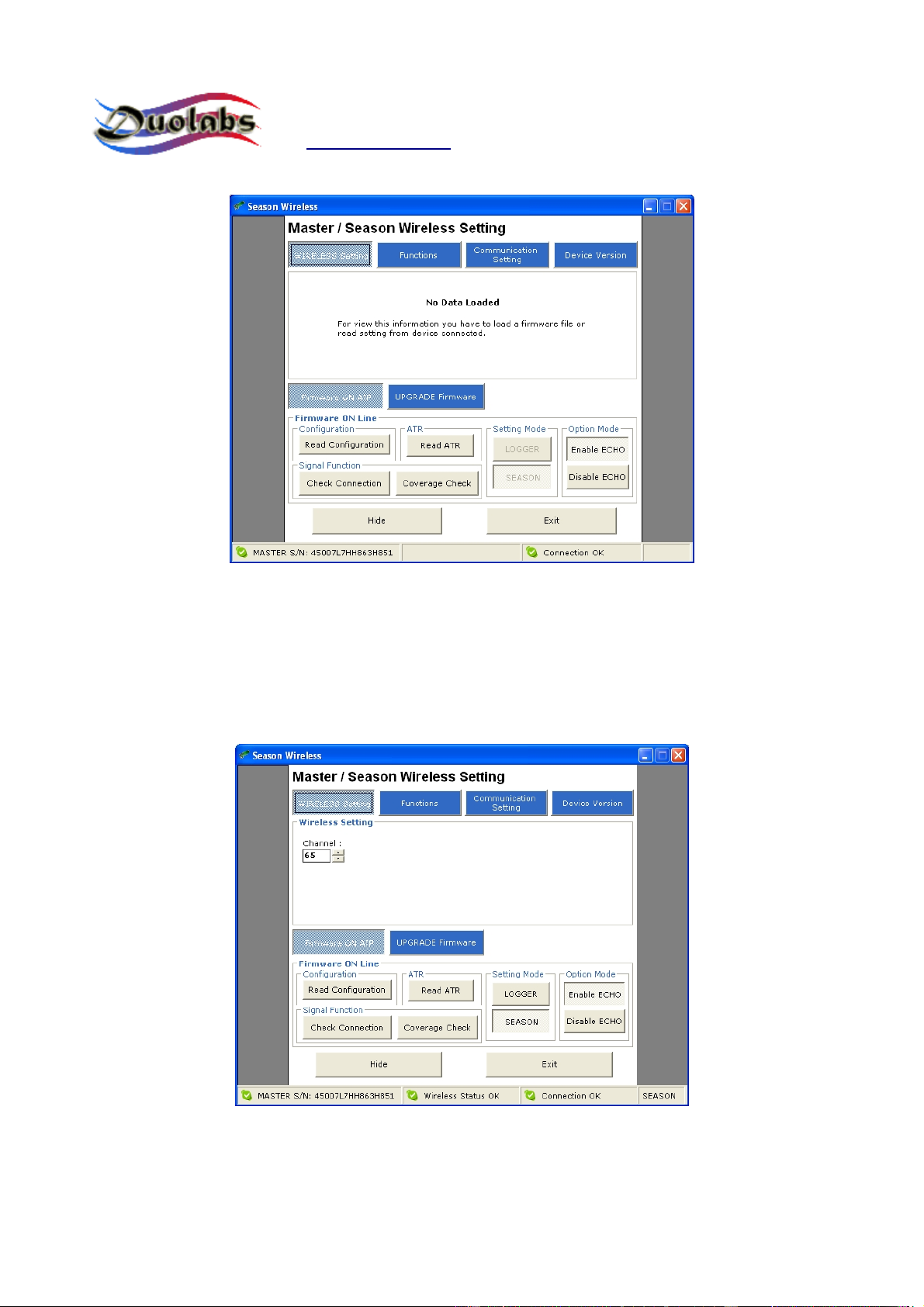
To change the initial settings of the device, press Firmware on AIR in the
software panel.
Season Wireless – User Manual
www.duolabs.com – All rights reserved
5
Click Read Configuration to display the initial settings of the device. The
settings are displayed only if both components are powered and if the two
antennas are correctly inserted in their respective slots.
At this point, you can display the settings by clicking the following buttons:
•WIRELESS Setting: to select the transmission channel
•Functions: to select the Season or Logger mode
Season Wireless – User Manual
www.duolabs.com – All rights reserved
6
•Communication Setting: to select the settings for serial and ATR
communications sent to the remote device.
Click Device Version to display the firmware version of the Slave and Master.
Season Wireless – User Manual
www.duolabs.com – All rights reserved
7
Click Read ATR to quickly display only the ATR that has to be sent to the
remote device.
Click Logger or Season in the Setting Mode pane to temporarily select an
operating mode. If you disconnect the Slave from the power supply, the
default operating mode is resumed. Before selecting the desired mode, it is
necessary to make sure that the Slave is powered and able to establish a radio
link, as during the reading of the initial settings.
To be able to use the Logger mode, you need to insert a smartcard in the slot
of the Slave. The Master is designed to receive the flow of data exchanged by
the smartcard and reader, and captured by the Slave.
In the Option Mode pane you can decide whether to enable or disable the
echo (Enable ECHO / Disable ECHO) of the bytes sent from the PC to the
Master. By default, the echo is always enabled when you switch the Master on
and it is not possible to save it as default configuration (unlike the settings
described above).
The byte echo is important because it guarantees full compatibility with the
software applications that are already used with Season Logger 2.
The Signal Function pane displays the options that you can use to check if
the Slave and Master are communicating correctly.
You can click Check Connection at any time to verify if the Slave and Master
are communicating correctly through the radio link. You can also click
Coverage Check to start the loop testing cycle that enables you to check the

Season Wireless – User Manual
www.duolabs.com – All rights reserved
8
radio link between the two units and quickly verify the existence of a radio
coverage if one of the components is moved. This function is very useful when
the Slave and Master are located at a great distance or separated by obstacles
that could affect the radio communications.
To change the initial settings of the device and/or update the internal
firmware, press UPGRADE Firmware in the software pane.
Settings can be changed and firmware can be upgraded with one operation
only. Therefore, to be able to carry out one of these two operations, it is
sufficient to use a file with the last version of the firmware of Season Wireless,
usually with an “.SWR” extension. To load the file, click the button that
represents the open yellow folder.
After loading the file, you can view the initial settings of Season Wireless by
Season Wireless – User Manual
www.duolabs.com – All rights reserved
9
clicking WIRELESS Setting,Functions and Communication Setting. The
settings can be read, edited and saved in the same file, so that they are
available in future, by simply clicking the icon that represents a floppy disk.
Click Device Version to display the firmware version (for the Slave and
Master) contained in the loaded file.
To apply the changes and/or upgrade the device firmware using the
parameters in the loaded file, disconnect the Slave from the power supply,
disconnect the USB and RS-232 cables from the Master, remove the antennas
from the two components, connect the Slave and Master to one another using
the 20-pin connectors and reconnect the USB cable to the Master.
To start the upgrade, click Program Devices, then select Proceed in the
confirmation dialog.
Season Wireless – User Manual
www.duolabs.com – All rights reserved
10
A progress bar displays while the upgrade process in progress
And the yellow LED flashes on both components (first on the Slave, then on
the Master).
The lower section of the software pane displays two buttons, Hide and Exit,
which can be used to hide the software dialog and close the application. To
resume the display of the dialog, it is sufficient to click the icon on the bar next
to Windows clock.
The software also displays a status bar that provides a summary of the status
of the device, indicates whether the Master is connected to the PC, if the
wireless communication between the Master and Slave was successful, if buffer
overflow problems have occurred and the operating mode of the Slave (Season
or Logger).