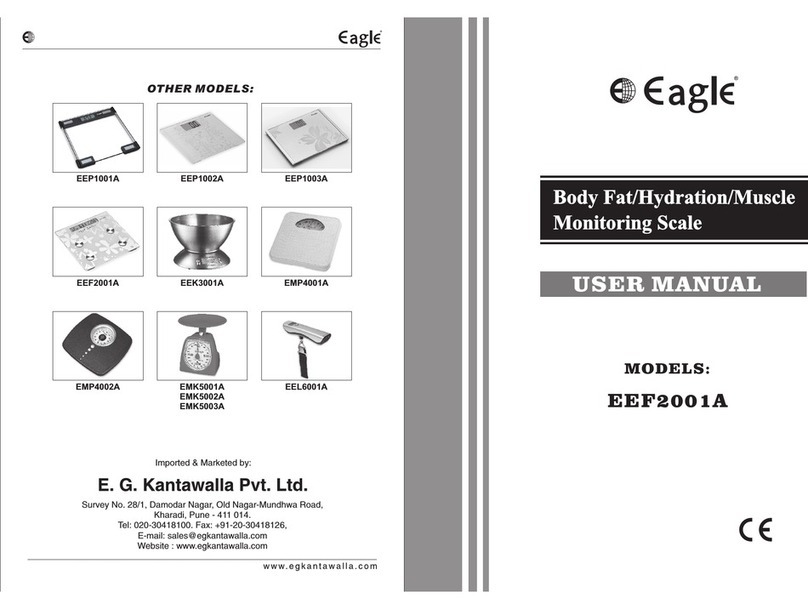
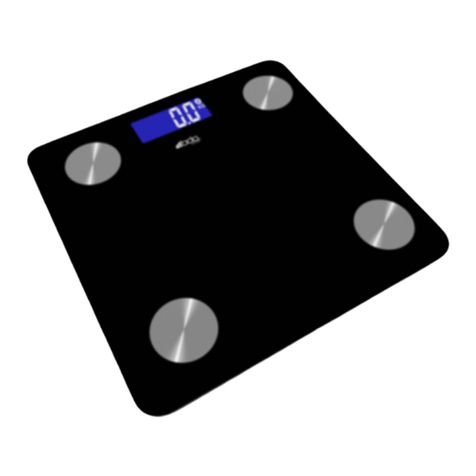
Eagle EEF2001A User manual

BMI MACHINE

•BMI or BODY MASS INDEX is calculated using just
your weight and height, so it is just an estimate of
whether you're likely to fit within the healthy
weight range.
•Any BMI between 18.5 and 24.9 puts you within
the normal range, while anything higher than this
indicates you may be overweight.
•For example, if you're 5 feet, 7 inches tall, you're
considered a healthy weight if you're between 121
and 153 pounds. This measurement doesn't take
into account how much muscle a person has,
however, and it can overestimate fat in very
muscular people or underestimate in elderly
individuals.
WHAT IS BMI?

•Body mass index, or BMI, is an easy-to-calculate measure of obesity based
on the ratio of your weight and your height.
•It's convenient to use -- just knowledge of your height and weight -- and it's
useful for most people to get a general idea of your disease risk.
•BMI isn't perfect, however, and while it's beneficial in some circumstances, it
has some major limitations if you're trying to use it to gauge your individual
disease risk.
Body Mass Index

Human body is made up of, amongst other things,
a percentage of fat.
Body fat is vital for a healthy, functioning body,
protects vital organs, helps regulate body
temperature, stores vitamins and helps the body
sustain itself when food is scarce.
However, too much body fat or indeed too little
body fat causes damage to your health.
It is difficult to gauge how much body fat we have
in our bodies simply by looking at ourselves in the
mirror. This is why it is important to measure and
monitor your body fat percentage.
Body fat percentage gives you a better measure of
fitness than weight alone, the composition of your
weight loss could mean you are losing muscle
mass rather than fat-you could still have a high
percentage of fat even when a scale indicates
‘normal weight’.
HEALTH TIPS - ABOUT BODY FAT

The table as follows may be used as a guide:
The body fat ratio (Unit - %) :
Rating Age
20-29 30-39 40-49 50-59 60+
Low <13 <14 <16 <17 <18
Normal 13-20 14-21 16-23 17-24 18-25
Moderately
High
20.1-23 21.1-24 23.1-26 24.1-27 25.1-28
High >23 >24 >26 >27 >28
Standard for Men

Rating Age
20-29 30-39 40-49 50-59 60+
Low <19 <20 <21 <22 <23
Normal 19-28 20-29 21-30 22-31 23-32
Moderately
High
28.1-23 29.1-32 30.1-33 31.1-34 32.1-35
High >31 >32 >33 >34 >35
Standard for Women
The color of display becomes Red if the body fat is above normal range.
The color of display becomes Green if the body fat is within normal range.
The color of display becomes Yellow if the body fat is below normal range.

•Body water is the single most important component of body weight. It
represents over half of your total weight and almost two thirds of your lean
body mass (predominantly muscle).
•Water performs a number of important roles in the body. All the cells in the
body, whether in the skin, glands, muscles, brain or anywhere else, can only
function properly if they have enough water.
•Water also plays a vital part in regulating the body's temperature balance,
particularly through perspiration.
•The combination of your weight and fat measurement could appear to
be 'normal' but your body hydration level could be insufficient for
healthy living.
HEALTH TIPS - ABOUT BODY WATER

The table as follows may be used as a guide:
The body water ratio (Unit - %) :
BF % RANGE OPTIMAL TBW % RANGE
Men
4 to 14% 70 to 63%
15 to 21% 63 to 57%
22 to 24% 57 to 55%
25 and over 55 to 37%
Women
4 to 20% 70 to 58%
21 to 29% 58 to 52%
30 to 32% 52 to 49%
33 and over 49 to 37%
The color of display becomes Red if the body water is above normal range.
The color of display becomes Green if the body water is within normal range.
The color of display becomes Yellow if the body water is below normal range.

HEALTH TIPS - ABOUT MUSCLE MASS
The table as follows may be used as a guide:
The body muscle ratio (Unit - %) :
Men Approximately 40% of total body weight
Women Approximately 30% of total body weight
The color of display becomes Red if the muscle mass is above normal range.
The color of display becomes Green if the muscle mass is within normal range.
The color of display becomes Yellow if the muscle mass is below normal range.
According to the American College of Sports Medicine (ACSM), lean muscle mass may
decrease by nearly 50 percent between the age of 20 and 90. If you do nothing with it you're
losing muscle and increasing fat. It is also important to know your muscle mass % during weight
reduction. At rest, the body burns approximately 110 additional calories for each kilo of muscle
gained.
Benefits of gaining muscle mass include:
•Reversing the decline in strength, bone density and muscle mass with aging.
•Maintenance of flexible joints.
•Guide weight reduction when combined with a healthy diet.

•Regular exercise and a balanced diet can help maintain healthy bones. Like muscle, bone is a living tissue that can respond
to exercise by becoming stronger.
•For most people, bone mass peaks in their thirties. Then people begin to lose bone. Regular exercise can help prevent
that loss.
•Calcium and vitamin D, good sources of which are dairy products, green leafy vegetables and fish, contribute to
healthy bones.
•The bone mass readings given by this product are an estimation of the amount of bone in your body. Those with
osteoporosis or low bone densities may not get accurate estimations. If you have any concern regarding your bones
please consult your doctor.
You may refer to the following guide :
The bone range (kg) < 10kg
The average bone mass percentage for both men and women is between 4 to 5%.
The color of display becomes Red if the bone mass is above normal range.
The color of display becomes Green if the bone mass is within normal range.
The color of display becomes Yellow if the bone mass is below normal range.
HEALTH TIPS - ABOUT BONE MASS
Other manuals for EEF2001A
1
Table of contents
Other Eagle Scale manuals